Dive Brief:
- The Center for Climate and Energy Solutions selected Texas’ Austin-San Antonio region for its third Climate Resilient Communities Accelerator. This two-year initiative brings together local governments, community leaders, businesses, nonprofits and academics to “build and advance a regional roadmap of high-impact resilience actions to locally identified climate hazards,” according to a C2ES press release.
- C2ES launched its first accelerator in Colorado’s North Front Range in 2023 and its second in Washington’s South-Central Puget Sound region in August. It chose Austin-San Antonio for the third because Texas has absorbed billions of dollars in climate and weather damages and is on track for even more extreme conditions as its population keeps rising, C2ES spokesperson Allison Dennis said in an email.
- Austin-San Antonio is one of the fastest-growing regions in the U.S. in a state with one of the highest rates of federally declared disasters, Laura Patiño, San Antonio’s chief resilience officer, said in a statement. “Yet, there is a strong culture for collaboration that can be leveraged to ensure we are improving quality of life for residents in the region for years to come,” she said.
Dive Insight:
C2ES, founded in 1998 as the Pew Center on Global Climate Change, works with policymakers and businesses to strengthen communities’ resilience to climate impacts.
Libby Zemaitis, C2ES senior manager of resilience programs and policy, said the accelerator is “a regional capacity and coordination model” that also works with the private sector.
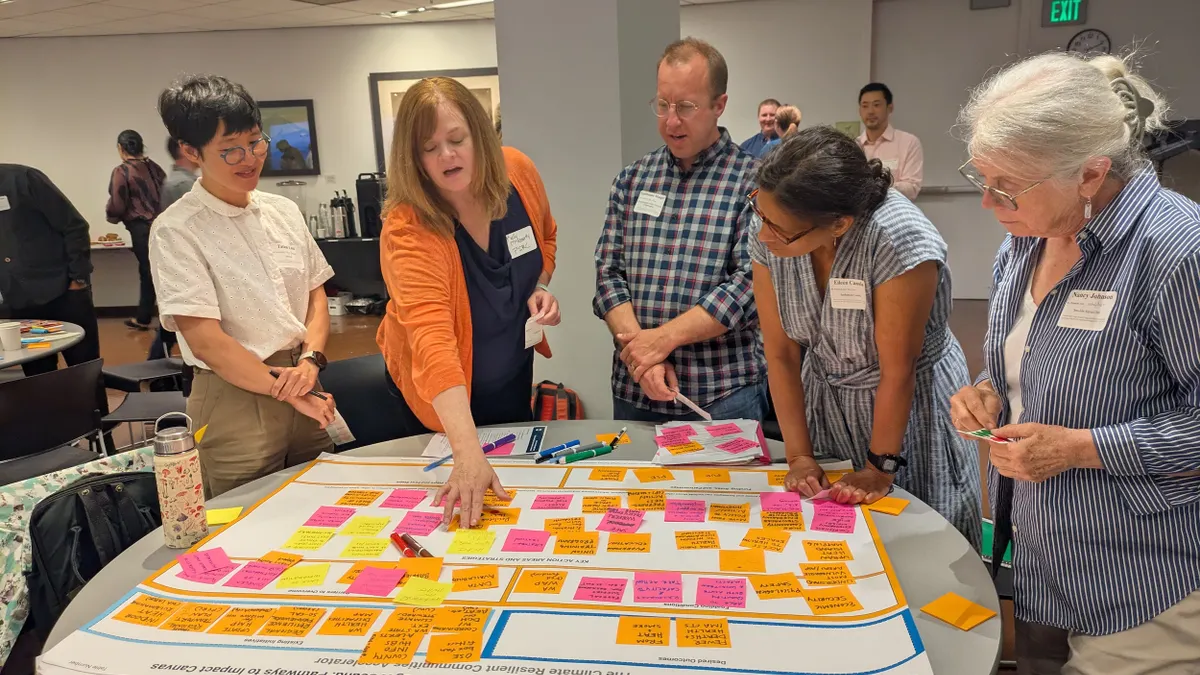
The accelerator will convene a series of workshops and support local leaders and cross-sector partners in building a road map of actions and public policy priorities to fortify the region’s resilience to climate hazards, according to a city of Austin press release.
“The regional level is a great level to work on resilience because you have whole groups of communities and businesses dealing with similar extreme weather hazards,” Zemaitis said.
Extreme heat, wildfire, drought, flooding and severe winter storms “impact our cities while placing the greatest strain on vulnerable residents and communities,” Zach Baumer, director of Austin Climate Action and Resilience, said in a statement. “As our region continues to grow rapidly, these climate hazards affect our surrounding counties as well. A collective, holistic approach is needed to protect both our quality of life and vibrant ecosystems that make this region unique.”
Zemaitis said the accelerator’s goal is not to tackle all the region’s climate hazards but to “couple hazards that play well together in terms of solutions.”
Within each regional accelerator, “anchor cities” — Austin and San Antonio in Texas, Denver in Colorado and Seattle and Tacoma in Washington — share resources and experience with smaller communities, Zemaitis said.
“We start with focusing on what’s working and key strategies, and then we start aligning those with available funding — and we look broadly, at the state, federal and local level but also at philanthropic and private resources,” she said.
Shrinking federal resources for climate resilience is a challenge for the accelerators, Zemaitis said, but she’s optimistic that “pre-disaster funding is coming back at some point.”
Editor's note: This article was updated to delete duplicated text.