Dive Brief:
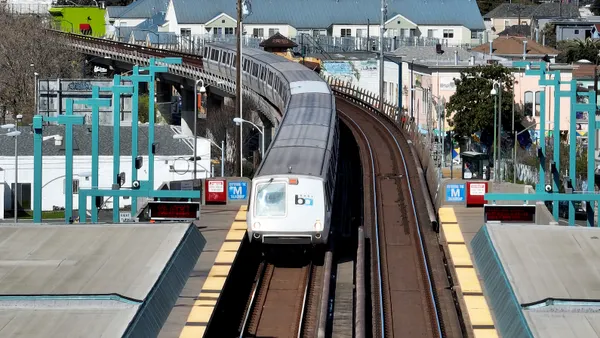
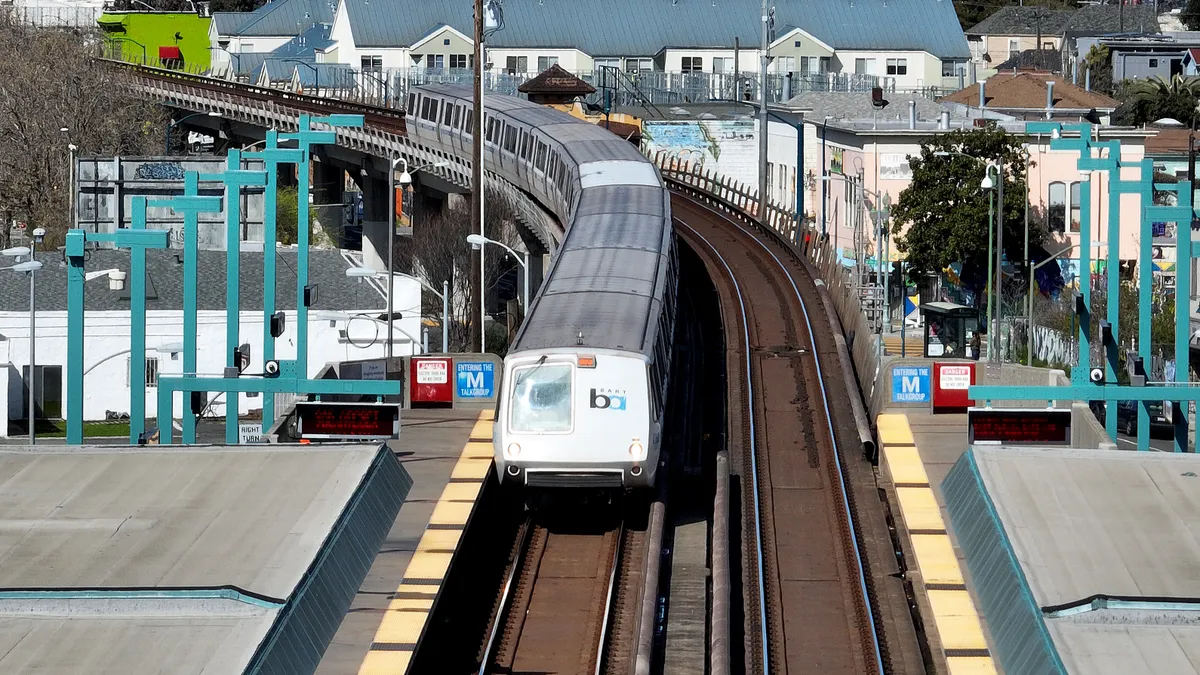
- California Gov. Gavin Newsom signed legislation last week to provide a $590 million loan to the Metropolitan Transportation Commission to help prevent service cuts on four San Francisco Bay Area transit systems.
- Bay Area Rapid Transit, the San Francisco Municipal Transportation Agency, Caltrain and AC Transit face a combined deficit of over $800 million in the coming fiscal year, according to the MTC.
- The region’s long-term solution relies on a November 2026 ballot measure that would create a half-cent sales tax in five Bay Area counties and a one-cent sales tax in the city of San Francisco to fund public transit.
Dive Insight:
Absent the loan, BART said it would have to cut service up to 85% and close 10 to 15 train stations. Caltrain, a commuter railroad operating between San Francisco and Tamien, California, has seen increased ridership but still expects ongoing deficits of approximately $75 million from fiscal year 2027 to FY 2035. The portion of fare box revenue covering its operating expenses stands at 23%, down from 72% in 2019.
The loan “will help protect transit service for more than three million monthly riders,” Newsom said in a statement.
The Bay Area has the nation’s highest rates of remote workers, according to BART. More than 23% of San Franciscans work from home, according to Employee Benefit News, and 31% of the workers in Berkeley, California, are remote, according to SmartAsset, a financial information service.
The loan “keeps the transit system running smoothly next year—supporting more than 900,000 daily trips—so people can keep getting to work, school, family, friends, and events without disruption,” MTC Chair Sue Noack said in a statement.
The MTC is required to repay the loan to the California State Transportation Agency in quarterly installments over 12 years, with interest-only payments for the first two years.
“With the signing of this bridge loan, we are securing necessary resources to sustain our recovery and ensure transit systems can continue serving the families, seniors, students, and workers who rely on them every day,” San Francisco Mayor Daniel Lurie said in a statement.
An October 2025 poll of voters in the five Bay Area counties where the tax measure would be implemented showed 56% in support, short of the two-thirds majority required for passage if the Regional Transit Revenue District places it on the ballot. However, a citizen-led measure requires only a 50% vote to pass.
The Connect Bay Area Campaign has raised $3 million so far to gather signatures in support of the measure, Streetsblog San Francisco reported. Donors include Meta, biotech firm Genentech, Service Employees International Union Local 1021, Herzog Contracting, design and engineering firm HNTB and Silicon Valley investor Chris Larsen.