

When Northrop Grumman announced it would expand operations in Utah and bring thousands of new jobs, many considered it a boon for the state. But when the company hired workers from outside the area, it soon became apparent that “we don’t have anywhere to put” them, Clearfield City, Utah, Mayor Mark Shepherd said during a housing accelerator panel at the National League of Cities City Summit 2025, held in Salt Lake City in November.
Now the company’s employees are competing with Clearfield City residents for housing, Shepherd said.
Housing is as important a part of community infrastructure “as high speed internet, as water, as sewer,” Shepherd said. “If we don’t have it and we don’t build it, we cannot attract the jobs. We won’t be able to build that economic base.”
How can communities balance the housing needs of both new and longtime residents? It’s all about intentionality, the panelists said. They described approaches including the following.
Buy land. For Shepherd, purchasing land is a key piece of the housing puzzle. “If you can own the land, you have a huge stake in the game,” he said.
Clearfield City began purchasing land to build smaller multifamily developments, such as townhomes, while leaders promised concerned residents that even greater density would not come to their neighborhoods. “We would be very structured about where we put it,” Shepherd said.
It also purchased a dilapidated mobile home park and found a development partner that would construct low-income housing there, Shepherd said. The result was a development with 50% low-income housing and 50% market-rate housing. All the housing is identical, according to Shepherd. “You would never know the difference driving down the street,” he said. “My residents look at it and go, ‘Wow, this can change the city, and it’s great.’”
Safeguard affordability. Vonnette Harris, a Maryland-based housing development coordinator, agreed that proactively buying land can be an effective strategy. Another is to create or expand incentives and tax credits. While affordable housing tax credits traditionally go to people who make 60% of the area median income, Maryland sets them aside for households with up to 80% AMI. "That touches … those young professionals that technically make too much to qualify for low-income housing but don't make enough to afford the market-rate housing,” Harris said.
In Montgomery County, Maryland, new developments of 20 units or more must have 12.5% of their units reserved for low-income households. "So you create that income diversity and inclusivity,” Harris said.
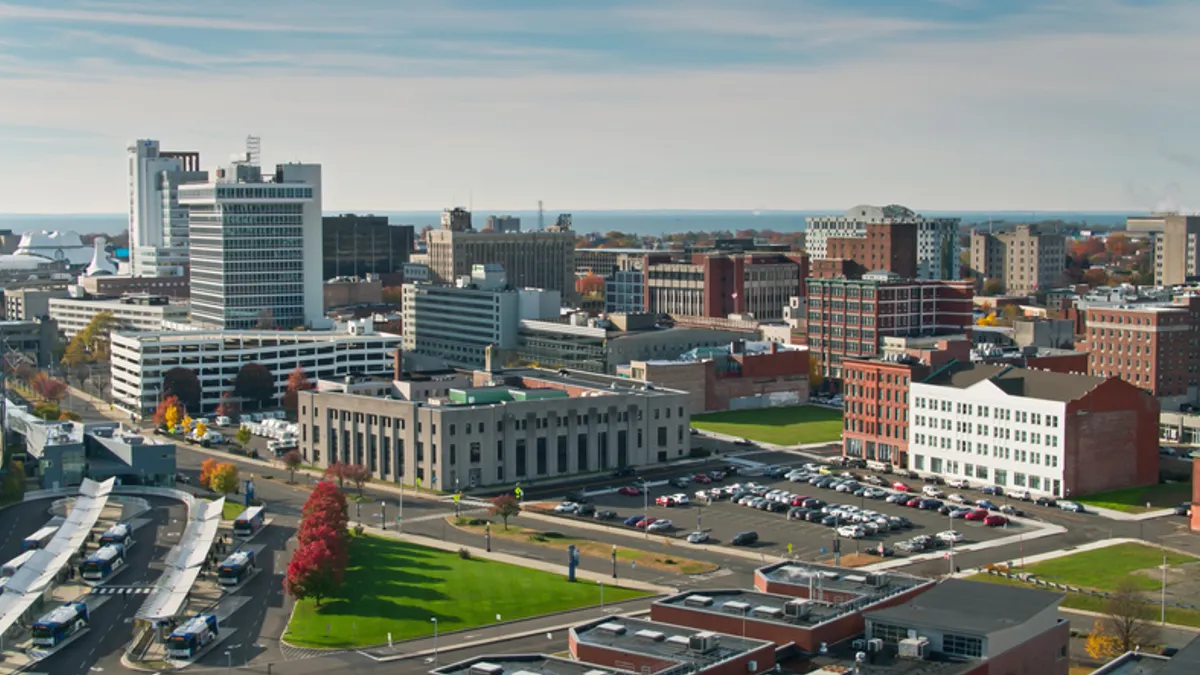
Avoid concentrating poverty. With funding from the state, Bridgeport, Connecticut, is in the process of rebuilding public housing that was demolished in the 1990s and early 2000s, according to Deputy Chief of Staff Constance Vickers. Instead of concentrating the housing in one place, the city is building it into mixed-income communities to promote greater economic diversity and all of the additional public infrastructure amenities that come with it.
Use zoning. While the housing crisis seems to be spinning out of control, zoning is a mechanism cities can flex to stabilize it, the panelists said.
Bridgeport, a city of only 16 square miles, has limited space. Changing its zoning to allow for school and office conversions into housing has helped move it toward its goal of adding 6,000 housing units by 2030, Vickers said.
“We are a densely populated city, but we’re really tiny, so we have to make use of all our land,” Vickers said.
Find partners. “Often [housing] developers have to be incentivized” to construct affordable or low-income housing, Harris said. “Most market-rate developers don’t know anything about affordable housing and vice versa.” Only a handful of companies do both, she noted.
“Partnerships are crucial. You can’t do this on your own,” said Shepherd. “That developer has to be your partner.”
Bridgeport is coordinating with several developers that are flipping properties.
“Be creative with the financing, and as the local government, if they’re coming to you for tax incentives… figure out what makes the best sense,” Vickers said. “The developer has one vision, but what is your vision for your community?”
Being inclusive and transparent with residents is also essential, Harris said.
“Listening to the community,” Vickers said, “that’s the most effective way to move forward.”