Dive Brief:
-
The American Sheriff Alliance called for full restoration of Department of Homeland Security funding in letters sent to the Senate and House Judiciary Committees this week, stating that funding gaps are delaying vital grants and hindering task-force operations and essential intelligence-sharing efforts.
-
“At a time when the national security posture is heightened due to international developments, we are already seeing the effects on local jurisdictions, particularly in critical incidents tied to military operations,” the letter states.
-
The National League of Cities also urged Congress to restore full operations at DHS. “Prolonged disruptions slow reimbursements, delay public safety and emergency management support and training, and strain the already limited resources of cities, towns, and villages,” Yucel Ors, NLC’s legislative director, public safety and crime prevention, said in an email.
Dive Insight:
Most DHS funding was halted Feb. 14 after lawmakers in the House and Senate were unable to negotiate a compromise over Democrats’ demands that the agency place restrictions on federal immigration enforcement officers. The House is expected to vote today on a Republican-backed DHS funding bill that would end the shutdown, but The Hill reports that bill would likely be “dead on arrival in the Senate.”
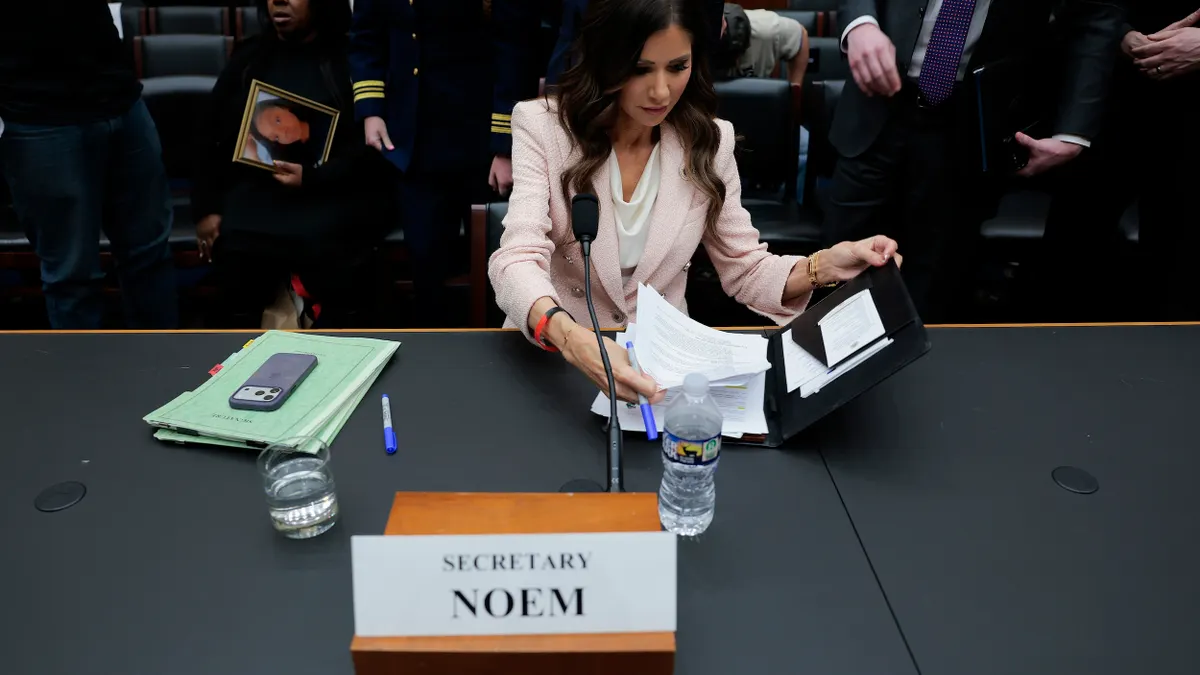
DHS Secretary Kristi Noem said during a Senate Judiciary hearing Tuesday that as a result of the shutdown, “critical national security missions — including border security, immigration enforcement, aviation security, disaster response, cybersecurity and protection of critical infrastructure — are being strained.”
The Federal Emergency Management Agency GO system, which allows state and local governments to tap into grant programs including State Homeland Security Grants, Urban Area Security Initiative and Emergency Management Grants, is offline because the personnel who would process requests are furloughed, according to a March 3 Senate Appropriations Committee press release. In addition, the Cybersecurity and Infrastructure Security Agency has canceled physical and cybersecurity assessments to detect vulnerabilities in critical infrastructure, including energy infrastructure.
ASF said in its March 2 letter that the shutdown “has essentially paralyzed local operations by delaying funding and grant rollouts and by furloughing critical personnel.” The sheriffs said their federal partners must be “fully and adequately funded” to help local law enforcement address “increasingly complex threats,” including transnational criminal organizations, narcotics trafficking, human trafficking networks, organized crime and border-related security challenges.
ASF is comprised of the National Sheriffs’ Association, Major County Sheriffs of America, Southwestern Border Sheriffs’ Coalition and the Texas Border Sheriff’s Coalition.
“A shutdown does not only affect Washington,” Donald Mihalek, executive vice president of the Federal Law Enforcement Officers Foundation, wrote in Police1. “It can directly impact the safety of towns, cities and counties across the country. For state and local agencies that depend on DHS grants, intelligence and training, sustained federal funding remains critical to maintaining operational readiness.”