

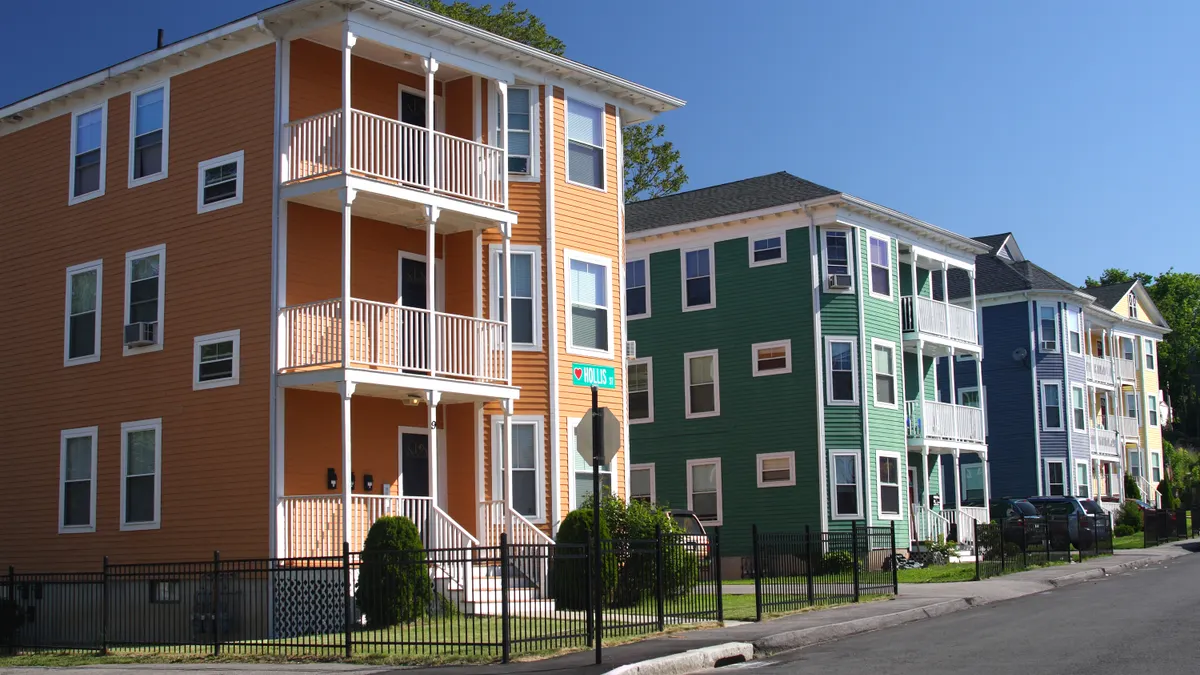
Massachusetts was once a haven for “middle” housing. In the late 19th century, “triple-deckers,” featuring three stacked apartments, lined numerous city streets.
But over the years, middle-scale housing — housing types such as duplexes, townhomes and triple-deckers that are in between single-family homes and multifamily apartments — lost favor in the state. Restrictive zoning laws and building codes pushed them to the brink of extinction.
In a three-part series, the Joint Center for Housing Studies at Harvard University examined the loss of middle housing in Massachusetts in the context of the ongoing housing crisis that the state, and the nation, is facing.
After analyzing the housing benefits of missing middle housing, as well as the barriers to its construction, the series released six recommendations for how the state can reinvigorate the market for missing middle homes and, subsequently, help boost affordable housing options.
1) Create a statewide missing middle design guide for Massachusetts and locally implemented pre-approved plan sets.
Having pre-approved designs for missing middle housing types can add efficiency and cut down on architecture fees, which can often represent more than 10% of a project’s price tag. The study points to Vermont for rolling out a pre-approved design process that also helped “gain greater acceptance of alternative housing types” from skeptical residents.
2) Stand up a missing middle training cohort and construction trades pipeline.
If the doors to missing middle housing are opened, the state will need qualified developers to build them. “Since middle housing has long been, well, missing from the new residential construction market, there is no critical mass of small-scale builders or construction economies of scale around this home type in the same way that single-family production home builders or multifamily apartment developers have proliferated,” the report notes. Austin, Texas, this year relaunched an Equitable Development Initiative offering small-scale developers training, networking and pathways to financing as a solution, according to the report.
3) Work with development-ready communities and community groups to pilot statewide missing middle initiatives — and build new homes.
In piloting missing middle initiatives, the state should prioritize working with localities that have taken steps toward easing the way for missing middle development through steps including zoning updates and financing. “Test initiatives might include working with communities to implement pre-approved plan sets, helping communities identify, advertise, and dispose of development-ready sites, or incentivizing communities to test new construction technologies,” the study states.
4) Advocate for and implement construction innovation to accelerate timelines and decrease costs in middle housing delivery.
Embracing off-site construction would speed up timelines for building middle homes, the report states. According to National Housing Crisis Task Force data, modular construction can cut construction timelines by as much as 50%. Modular and manufactured housing are often prohibited through zoning, the report states, but “technology has come a long way, and the cost-saving potential of off-site construction methods is undeniable.”
5) Create or convene novel funding sources.
Missing middle housing development is often considered “too risky” to finance through traditional routes because it lacks scale, according to the report. The study recommends introducing a Middle Housing Tax Credit program at the state level. “A statewide innovation to further missing middle housing would be to combine existing middle-income funding sources with a mandate to include middle-scale typologies, such as duplexes, triplexes, quadplexes, and cottage clusters of smaller units in program eligibility to access funding,” the report states.
6) Establish a statewide missing middle division or coordinator to lead cross-sector efforts.
Such a division would be tasked with problem-solving and efficiency monitoring for missing middle production in the state. Colorado and Oregon have both established similar divisions in recent years, the Middle Income Housing Authority and Housing Accountability and Production Office, respectively.
Massachusetts has taken steps toward addressing its housing affordability crisis in recent years, including the Affordable Homes Act in 2024.
During an Oct. 24 webinar, Amy Tomasso, author of the JCHS reports, said she believes the research is not happening in an eco chamber and said the state seemed “willing to take these recommendations and earnestly take them and move them forward.”