Dive Brief:
-
Minneapolis Mayor Jacob Frey demanded that Immigration and Customs Enforcement agents leave the city and said the city is “working towards justice as quickly as we possibly can right now” after an ICE agent shot and killed a 37-year-old woman Wednesday.
- Minnesota Gov. Tim Walz announced Wednesday that the Minnesota Bureau of Criminal Apprehension and the Federal Bureau of Investigation were jointly investigating the incident. On Thursday, however, the BCA said in a statement that the FBI had informed it that the U.S. Attorney’s Office had reversed course and the investigation would be led solely by the FBI.
- “Without complete access to the evidence, witnesses and information collected, we cannot meet the investigative standards that Minnesota law and the public demands. As a result, the BCA has reluctantly withdrawn from the investigation,” BCA said. Hennepin County Attorney Mary Moriarty said in a statement that her office “will use every available lever to ensure a local, transparent investigation takes place.”
Dive Insight:
This week, the Department of Homeland Security sent 2,000 federal law enforcement officers to the Twin Cities to arrest “fraudsters, murderers, rapists, and gang members,” it said in a post on X.
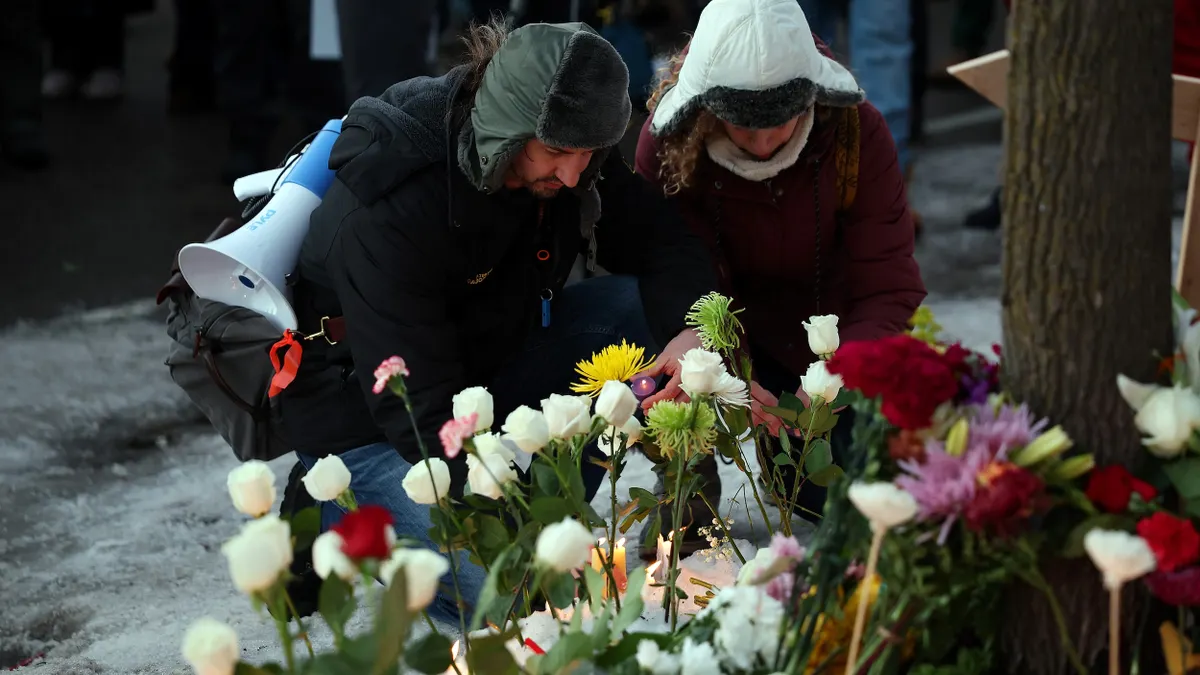
Renee Nicole Good was fatally shot in her moving vehicle Wednesday after an ICE officer grabbed the car door handle. Another officer standing in front of the vehicle opened fire, after which the car rolled forward, striking parked cars.
DHS Assistant Secretary for Public Affairs Tricia McLaughlin said in an emailed statement Wednesday that “ICE officers in Minneapolis were conducting targeted operations when rioters began blocking ICE officers and one of these violent rioters weaponized her vehicle, attempting to run over our law enforcement officers in an attempt to kill them.” She said the officer, “fearing for his life, the lives of his fellow law enforcement and the safety of the public, fired defensive shots.”
Following the shooting, Minneapolis Police Chief Brian O’Hara told National Public Radio that “we expect law enforcement to conduct a full and professional investigation.” He said “the thing that I have been concerned about this entire time, again, is not so much whether or not federal law enforcement is happening, but truly the manner how this enforcement action is being conducted.”
“Anyone who kills someone in our city deserves to be arrested, investigated, and prosecuted to the fullest extent of the law,” the Minneapolis City Council said in a joint statement on X. “We demand that ICE immediately leave our city so we can get rid of their chaos and violence that ended the life of one of our neighbors today.”
After the Trump administration announced plans for the DHS deployment, Frey signed an executive order prohibiting federal, state and local agencies from using city-owned parking ramps, garages or vacant lots for immigration enforcement operations. O’Hara said at the time that local law enforcement officers “absolutely have a duty to intervene” if they encounter federal agents violating residents’ rights or using excessive force.
The legality of local law enforcement intervening in federal immigration enforcement is murky, Logan Kennedy, assistant professor of criminal justice and criminology at East Carolina University, told Smart Cities Dive last month. While federal agents don’t necessarily have jurisdiction over local police, the federal agents “cannot be stopped from doing something in the course of their employment.”
Bryna Godar, staff attorney for the University of Wisconsin State Democracy Research Initiative, wrote in a July 2025 paper that states prosecuting federal agents for violations of state laws is a practice that stretches back to the early 1800s, but “with a mixed track record.”
Godar wrote that “states are legally permitted to prosecute federal officials for state crimes—within limits.” She explained that the “principle only applies when federal officials are reasonably acting within the bounds of their lawful federal duties. When federal officials act beyond the scope of their duties, violate federal law, or behave in an egregious or unwarranted manner, state prosecutions can move forward.”
Walz’s office said Minnesota’s State Emergency Operations Center is coordinating with Minneapolis and St. Paul police departments, and the Minnesota National Guard is “prepared to deploy if needed to assist with public safety and emergency response operations.”