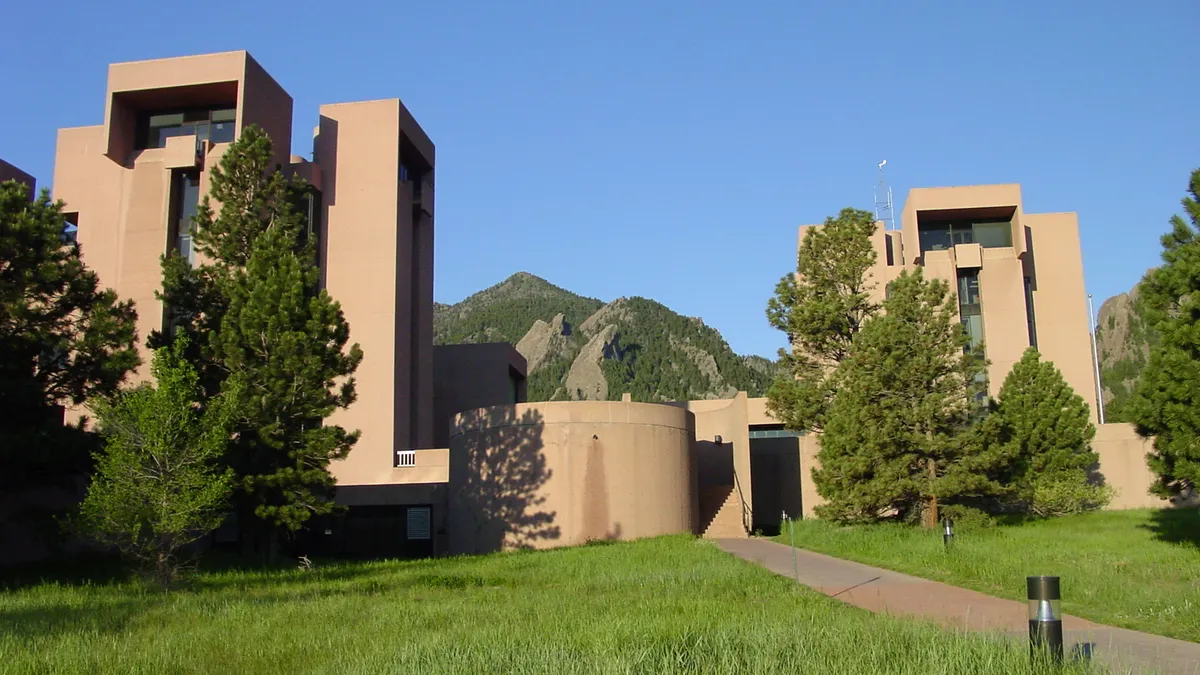
Meteorologists, climate scientists and emergency managers warn that the Trump administration’s plan to dismantle the National Center for Atmospheric Research, the nation’s leading weather and climate institution based in Boulder, Colorado, would stymie research that’s key to weather forecasts and warnings.
“It's a horrible impact on the local level, simply because so much of the research that moves weather forecasting forward comes out of NCAR,” Robert Dale, chair of the International Association of Emergency Managers USA Weather Caucus, told Smart Cities Dive.
The National Science Foundation announced Wednesday it is “reviewing the structure of the research and observational capabilities” operated by NCAR and soliciting feedback “for rescoping the functions of the work” performed by the center.
The announcement followed Office of Management and Budget Russell Vought’s Tuesday social media post stating the NSF was planning to break up NCAR and move “vital activities” such as weather research to another entity or location. Vought called NCAR “one of the largest sources of climate alarmism in the country.”
“Please don’t do this,” “Today” show meteorologist and weather anchor Al Roker posted in reply. Roker said NCAR’s research “has made the United States a leader in tracking severe weather, modeling extreme floods and even the effects of increased solar activity and how it impacts our atmosphere here on Earth,” and “benefits us all from a safety and infrastructure standpoint.”
“The main way in which local emergency management and public safety will be affected will be in the slowing of the research key to improving hazardous weather warnings and forecasts,” meteorologist Alan Gerard, CEO of Balanced Weather, said in an email. “NCAR has been a leader in doing research and development to improve the underlying science as well as the observational and modeling tools that the National Weather Service and other meteorologists rely upon to improve their services.”
In addition to its climate and weather research, Gerard said NCAR’s social science research “has been instrumental in improving how the meteorological community provides better services and communication to emergency managers and the public in general, and obviously that research could be seriously impacted as well.”
A “sledgehammer” to climate science
If NCAR closes, Dale said, “we would still have a forecast tomorrow. The problem is that they wouldn’t get any better with time, and that’s really our concern.”
Antonio Busalacchi, president of the University Corporation for Atmospheric Research, which manages NCAR, said in a statement Tuesday that dismantling the research center “would set back our nation’s ability to predict, prepare for, and respond to severe weather and other natural disasters.”
Climate scientist Katharine Hayhoe said in a social media post that dismantling the agency “is like taking a sledgehammer to the keystone holding up our scientific understanding of the planet.”
NCAR “supports the scientists who fly into hurricanes, the meteorologists who develop new radar technology, the physicists who envision and code new weather models, and yes — the largest community climate model in the world,” Hayhoe wrote.
Colorado Gov. Jared Polis said in a statement that “public safety is at risk and science is being attacked.”
“The work of NCAR goes far beyond climate science,” Polis said. “NCAR delivers data around severe weather events like fires and floods that help our country save lives and property, and prevent devastation for families.”’
Advocates are taking action
This morning, Colorado U.S. Sens. Michael Bennet and John Hickenlooper, both Democrats, said in a press release that they are “holding the Senate’s appropriation package to demand full funding of NCAR.”
Claiming that President Donald Trump “is attacking Colorado because we refuse to bend to his corrupt administration,” the senators said they will “pull every lever available to do what is right for Colorado.”
The Senate adjourned for the holidays Thursday without passing a funding package.
Busalacchi said during a press conference Thursday that some 7,000 people had written letters and called members of Congress in support of NCAR. He said UCAR is investigating whether legal action is possible.
Dale urged emergency managers and local officials to reach out to their congressional representatives to “let them know this could have a dramatic impact and reduce the ability for us to provide better services in the next five to 10 years.”
“Just make sure that your congressional representative knows what [NCAR] is, knows that it’s important and knows that lives could be saved and our economy improved with better forecasting,” he said.