Dive Brief:
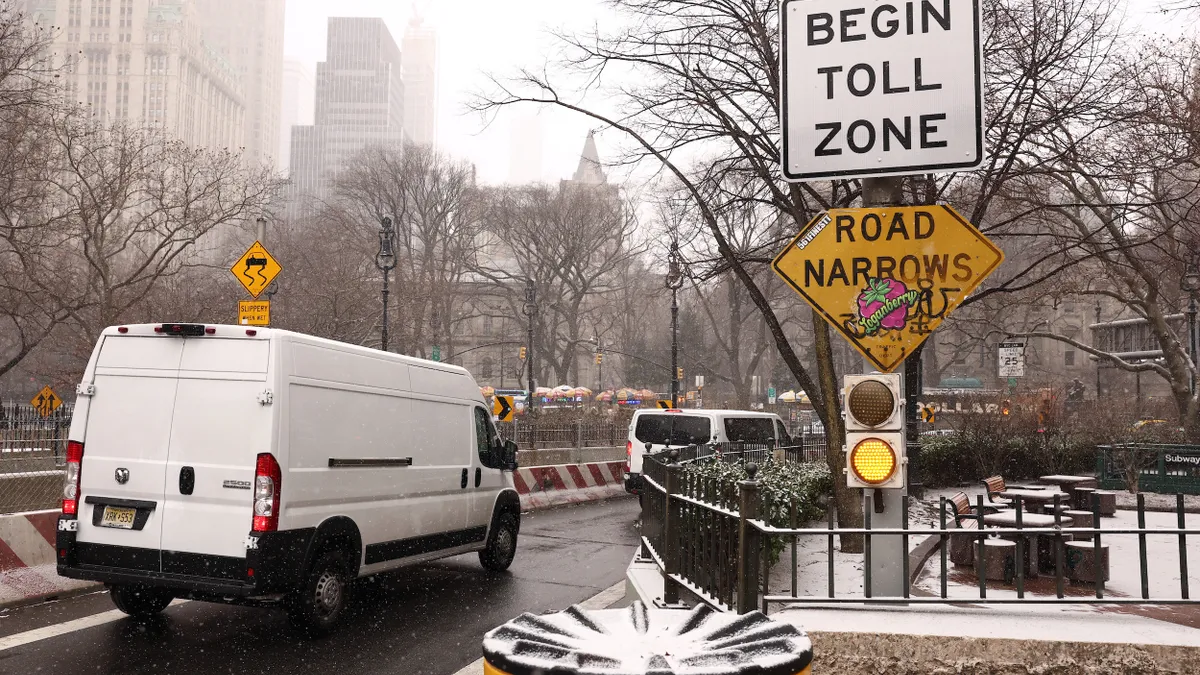
- New York’s congestion pricing program reduced average daily maximum particulate matter concentrations 22% in Manhattan’s tolling zone during its first six months compared with projections of what they would have been without the policy, according to a Cornell University study published Dec. 8 in the journal npj Clean Air.
- The PM2.5 emissions reductions extended beyond the tolling zone, which comprises local streets and avenues in Manhattan at or below 60th Street. Across the city’s five boroughs, particulate emissions declined 1.07 micrograms per cubic meter, while the wider metropolitan area saw a reduction of 0.7 micrograms per cubic meter, the study found.
- Congestion pricing’s effects on emissions in the tolling zone grew over time. Measured particulate emissions declined by 0.8 micrograms per cubic meter in the first week of the program to 4.9 micrograms per cubic meter in week 20. “This cumulative trend suggests persistent and compounding air-quality benefits within the tolled zone,” the authors said.
Dive Insight:
Congestion pricing went into effect Jan. 5, 2025, making New York City the first U.S. city to enact such a program. London, Stockholm, Milan and Singapore operate similar plans to reduce traffic and air pollution. New York City’s program was established by state law in 2019 and granted final approval by the Federal Highway Administration in 2023.
The tolling plan showed positive results in its first six months: average bus speeds within the zone increased, crashes declined 14% and transit ridership grew across the New York Metropolitan Transportation Authority system. A Dec. 1 report from INRIX, a transportation analytics company, found that while traffic congestion increased in most U.S. and global cities, congestion levels in New York City remained flat this year.
The Trump administration has threatened to shut down the program. “If this occurs, New York risks reversing the progress already made in reducing congestion and improving mobility,” Ralf-Peter Schäfer, vice president of product management for traffic at TomTom, a location technology company, said in a June 4 opinion piece in Smart Cities Dive.
The authors of the Cornell University study identified three elements for New York’s congestion pricing effort to succeed in the long term. First, the community must reinvest toll revenues in transit, active-mobility infrastructure and subsidized fares. Second, it must address delivery truck activity through incentives for zero-emission vehicles, coordinated delivery schedules and differentiated tolls. Third, the effort requires “adaptive management” such as continuous air quality monitoring, tolling rate adjustments and “iterative policy design” to sustain gains and prevent rebound effects.