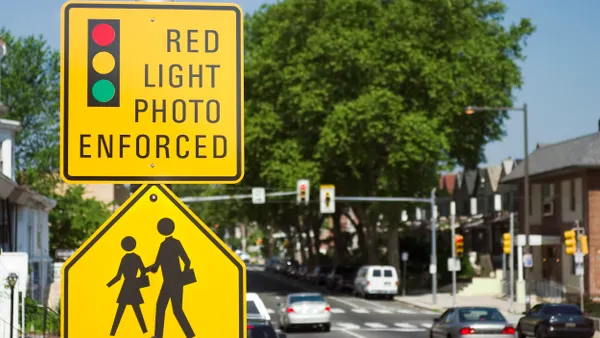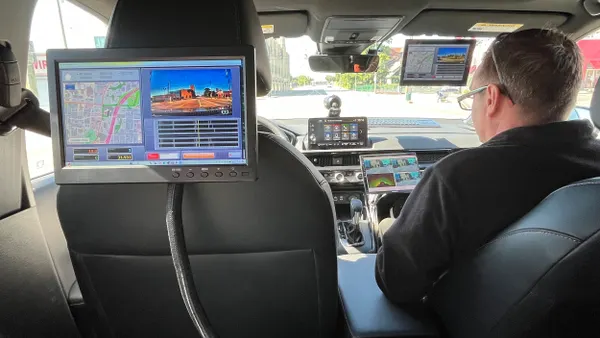
The U.S. Department of Transportation said in a December letter it would no longer approve grants for traffic safety cameras under the Safe Streets and Roads for All program, except in school or work zones, The Washington Post reported Monday.
“This Administration will not allow critical safety dollars to subsidize the purchase of speed cameras so governments can pursue unfair revenue schemes,” DOT spokesman Nathaniel Sizemore said in a statement.
According to the National Highway Traffic Safety Administration, automated speed enforcement cameras can reduce roadway fatalities and injuries by 20% to 37%.
Speeding accounted for 29% of traffic fatalities in 2023, killing nearly 12,000 people that year, according to NHTSA. Red light running killed 1,086 people and injured more than 135,000 people in 2023, according to the Insurance Institute for Highway Safety.
“Red light and speed cameras are proven to reduce crashes, and the DOT’s announcement only confirms that the department’s priorities remain misplaced,” Center for Auto Safety Executive Director Michael Brooks said in an email. “Rather than looking out for the safety of America’s roads and everyone on them, DOT has chosen to cater to the whims of politicians seeking votes from people who drive too fast, ignore traffic laws, and refuse to correct unsafe driving behaviors.”
Last year in San Francisco, speeding declined by an average of 72% at 15 sites over six months after traffic cameras were installed. New York City plans to expand its automated traffic enforcement program, which is authorized by the state.
“Automated enforcement cameras have proven highly effective at changing driving behavior to reduce speeding, red-light running, blocking bus-stops, and driving overweight vehicles on the [Brookyn-Queens Expressway],” former New York City DOT Commissioner Ydanis Rodriguez said in a statement last year.
Philadelphia’s speed camera program along Roosevelt Boulevard led to a 36% decrease in crashes, according to an April 2023 report from the Philadelphia Parking Authority.
As of 2025, 351 communities across the country have employed red-light safety camera programs, and 338 have installed speed cameras, according to the IIHS.
In a recent Verra Mobility survey of 2,000 parents or caretakers of children, 70% supported automated traffic enforcement in school zones. The company, a provider of automated traffic enforcement technology, recently announced a contract with the California cities of Glendale and Long Beach to install, operate and maintain speed safety programs.
Projects to extend curbs, which improve pedestrian safety, will also no longer be eligible for SS4A grants. Exceptions include school zones, transit stops, roundabouts, on-street parking and extensions that preserve existing traffic lanes.
“The advancement of speed and impairment prevention systems for cars remains on the back burner, and the U.S. falls further behind other developed nations in deploying effective crash prevention technology,” Brooks said.