During its current term, the U.S. Supreme Court is set to address several high-profile public safety, immigration and tariffs cases that could affect local governments. But three lesser-known cases before the court could also have significant impacts on how cities, counties, police forces and other local entities conduct day-to-day business.
“It’s really easy to miss some of these cases that may not be on the front page of the local newspaper,” said Amanda Karras, executive director and general counsel for the International Municipal Lawyers Association, during a National Association of Counties webinar, “What to Expect from the Current Supreme Court Term: Cases Impacting Local Government.”
The panelists shared their insights on the following key cases.
Pung v. Isabella County, Michigan
This case was filed by the executor of an estate that had $2,242 in unpaid property taxes. Isabella County foreclosed on the property, and it was auctioned for $76,008. Meaghan VerGow, partner with O'Melveny & Myers, said the property’s assessed value was $195,000, and the purchaser later sold it for just over $194,000.
The county kept all the proceeds from the sale. The executor sued, alleging the estate should have received the fair market value of the property minus the tax debt because the county violated the Fifth Amendment’s takings clause, which allows a government to collect taxes on private property but prohibits it from taking that property without “just compensation.” The plaintiff also alleges that the county violated the Eighth Amendment’s excessive fines clause.
“This is, I think, the headline case for local governments this term” because of its potential impact on their ability to collect tax debt, VerGow said. If the Supreme Court decides local governments have to reimburse tax-delinquent sellers, “there could be a lot of litigation over how to compute property value,” she said.
This case raises questions about how the Fourth Amendment applies to local law enforcement entering a home for emergency purposes without a warrant.
The case, which was argued before the Supreme Court on Oct. 15, involves Trevor Case, whose ex-girlfriend called the police after he threatened suicide and said he would harm any officers who came to his home. Case was well-known to local police for previous suicide threats.
After Case refused to let them inside, police entered the house to conduct a welfare check without a warrant. A police officer thought Case had a gun and shot but did not kill him. Police later found a gun in a laundry hamper near Case. He was charged with assault on a peace officer and was convicted in 2022.
Case’s attorneys filed pretrial motions to suppress the firearm evidence the police obtained from their warrantless entry, citing the Fourth Amendment. The motions were denied by the district court.
During the Supreme Court hearings, “the argument that this sort of entry is a paramount example of police helping citizens seemed to resonate with this court,” VerGow said.
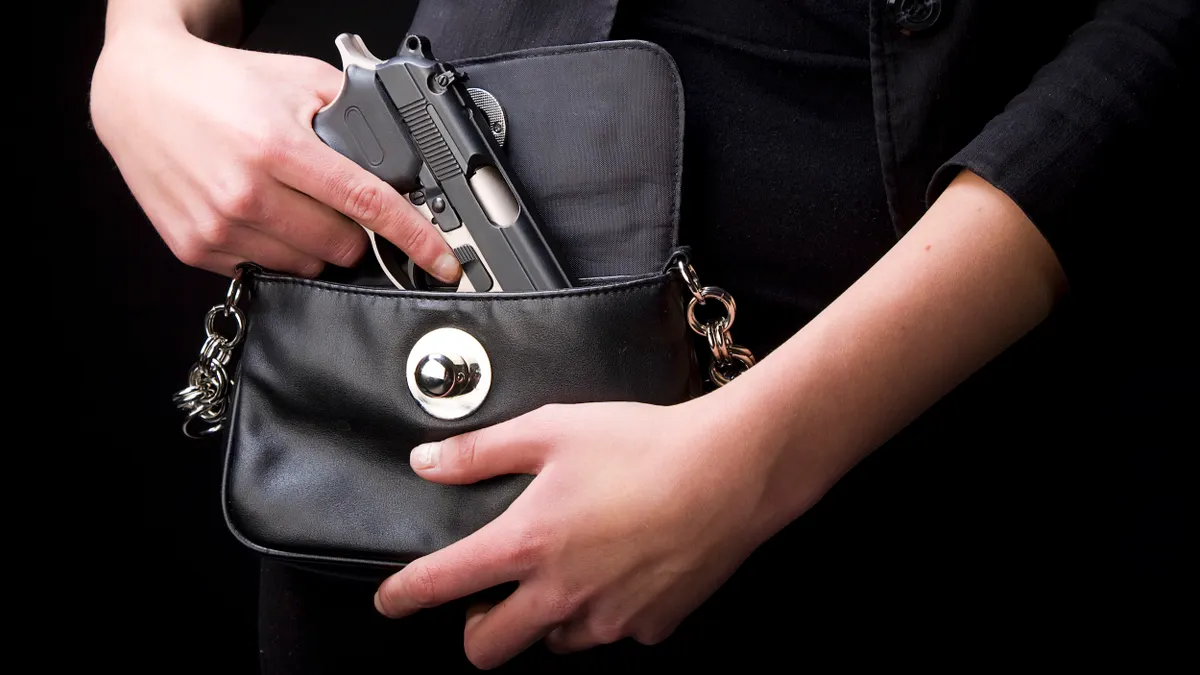
This case filed by a group of plaintiffs against the Hawaii attorney general challenges a 2023 state law that people with concealed-carry permits can’t bring their guns onto private property without the express consent of the property owner.
Gregory Garre, partner with Latham & Watkins, said the Wolford case is important in determining how the Supreme Court defines New York State Rifle & Pistol Ass’n, Inc. v. Bruen, the court’s 2022 decision that allows concealed carry. At issue is whether “sensitive” places might be excluded under Bruen and how those places are defined.
The Wolford case will likely be argued before the Supreme Court in the spring, Garre said.
Editor’s note: This article was updated to correct the spelling of O'Melveny & Myers.