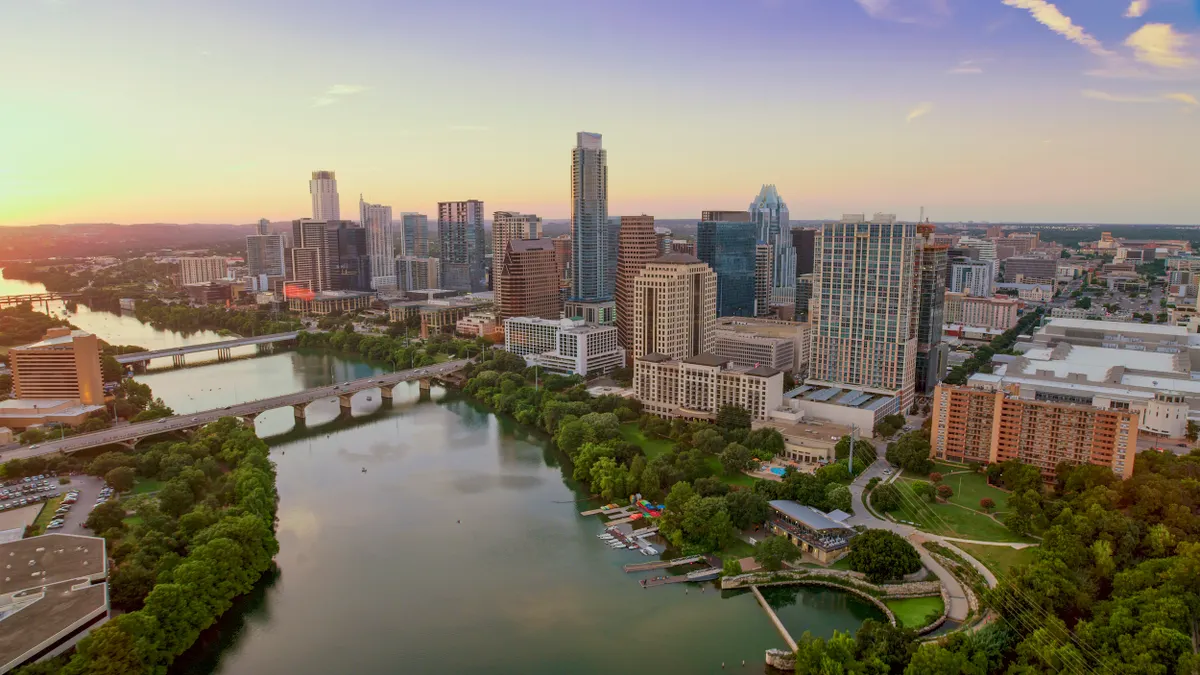
Austin, Texas, took a step last week toward construction of its first light-rail line.
The Austin Transit Partnership, a local government corporation designated to implement the project, awarded a $60 million contract to Austin Rail Constructors, a joint venture of firms Stacy Witbeck and Sundt Construction, to begin pre-construction activities.
The multibillion-dollar project will result in a 10-mile rail line with 15 stations. It will connect the University of Texas at Austin with the city’s downtown, then cross Lady Bird Lake on a new bridge that will have pedestrian and bicycle paths. Construction will begin in 2027 and be completed in 2033, the partnership said in a news release.
“Austin is building the transportation system our growing city demands,” Austin Mayor Kirk Watson said in a statement. Austin voters approved a property tax increase to fund the project by a 58% majority in a 2020 ballot proposition.
The selected construction team has participated in other large transportation projects, including the Austin-Bergstrom International Airport and rail projects in Arizona, Hawaii and Utah. “We’re bringing together the best local builders and designers alongside international experts,” ARC Project Manager Armando Tiscareño said in a statement.
The construction team will work to create opportunities for local and statewide businesses including subcontractors, material suppliers, specialty contractors and small businesses, the news release said.
The Austin Transit Partnership is negotiating with a prospective vendor for the light rail’s operations and maintenance facility. It has also opened a request for proposals to procure the light-rail vehicles.
Austin joins Canadian cities Montreal, Ottawa and Toronto and the Maryland suburbs of Washington, D.C., in building light-rail projects; Seattle expects to open a 7.5-mile light-rail extension this year. However, many U.S. cities are choosing less expensive, more flexible bus-based rapid transit over light-rail projects, said Yonah Freemark, a researcher at the Urban Institute and creator of The Transport Politic.