Dive Brief:
- The California High-Speed Rail Authority in December dropped its lawsuit to recover $4 billion in grants terminated by the Trump administration over the summer. “This action reflects the State’s assessment that the federal government is not a reliable, constructive, or trustworthy partner in advancing high-speed rail in California,” a spokesperson for the authority said in an emailed statement.
- The project will pivot toward the private sector, in partnership with the state of California, to continue construction, Authority CEO Ian Choudri told Smart Cities Dive in an October interview.
- The authority issued a request for qualifications on Dec. 19, 2025, to select a private partner to evaluate potential investment opportunities, it said in a news release.
Dive Insight:
Nearly 20 years after California voters approved a $9.95 billion bond issue to start building a high-speed rail line between San Francisco and Los Angeles, no segment of the line has been completed and no trains are running.
Construction delays, cost overruns and management issues have plagued the project. Less than a year ago, the California Office of the Inspector General reported a $6.5 billion funding gap to complete the initial segment between Bakersfield and Merced, California.
Federal funding for the project has whipsawed between Democratic and Republican administrations. During President Trump’s first term, he tried to cancel a previously awarded $929 million federal grant and threatened to claw back $2.5 billion in federal funds from the authority. The Biden administration gave it $3.07 billion, then the U.S. Department of Transportation, under the Trump administration, canceled $4 billion in unspent grants in 2025.
“We also see this moment as a new opportunity,” the authority spokesperson said. “Federal requirements have, at times, hindered project delivery by adding cost and delays without adding value – creating inefficiencies, constraining innovation, and slowing construction. Moving forward without the Trump administration’s involvement allows the Authority to pursue proven global best practices used successfully by modern high-speed rail systems around the world.”
To date, federal funds have covered 18% of the program’s expenditures, according to the spokesperson.
Choudri, who became CEO in August 2024, began confidential discussions with select private-sector financiers, concessionaires, banks and others a year ago, he said. In June, the authority issued a request for expressions of interest, which generated responses from 30 different entities, Choudri said.
“Interest from the private sector in investing in California’s high-speed rail project is strong and continues to grow,” Choudri said in a statement. He also sees opportunities to commercialize authority assets, such as real estate or the right-of-way for fiber-optic corridors.
State funding will be the other pillar of the project's financing. California committed $1 billion annually through 2045 toward the project from the state’s cap-and-invest program, which enables greenhouse gas emitters to buy and sell allowances at auctions based on their needs, with some of the proceeds going to the state’s Greenhouse Gas Reduction Fund.
“By leveraging private sector innovation and best practices against strong, stable state funding, we can maximize the value of California’s investment and accelerate delivery of high-speed infrastructure throughout the state,” Choudri said.
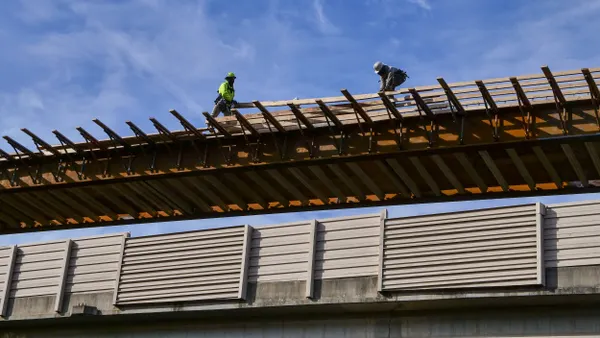
In November, the authority took its first step toward laying track this year, issuing a request for proposals to build the necessary infrastructure, including track, signals and the overhead electrical system, along a 119-mile rail line between Merced and Bakersfield.