Dave Roberts and Julie Luther Kelso are planners with Crafton Tull, dedicated to innovative solutions to strengthen communities. Ryan Hale is founder of Laneshift (a division of Crafton Tull), with a mission of strengthening people and places through active transportation.
In cities and towns across America, the movement toward bikeable and walkable neighborhoods is accelerating. From rural hamlets in the Midwest to booming metros in the South, residents are asking for safer, healthier and more accessible transportation alternatives.
Achieving this vision is no small task.
Truly connected communities require a seamless synthesis of dynamic forces: political courage, cultural adoption and immersive public engagement.
That may sound daunting, but the good news is that the path is already clear. Communities that invest in both infrastructure and culture are proving that safer streets, healthier lifestyles, stronger economies and accessibility are well within reach. The opportunity is not just to build trails, but also to reimagine how cities connect people — and possibility.
Consensus starts on the sidewalk
Planners often point to the same obstacles that derail community connectivity projects: funding and political will. Because local leaders juggle endless priorities — street maintenance, utilities, public safety — bicycle and pedestrian facilities often slip down the list. But when leaders and residents experience their neighborhoods on foot or by bike, support skyrockets.
Consider the power of a walk audit: Invite the mayor, council members, planning commissioners and even the fire chief to stroll three blocks of sidewalk. They’ll see the cracked pavement, utility poles blocking wheelchairs and missing curb cuts. They’ll feel the rush of cars passing at 40 miles an hour with no buffer for cyclists. What was once an abstract “amenity” becomes an urgent necessity. At the same time, this exercise can also highlight what is working well and help leaders identify ways they can build upon these existing strengths throughout the community.
Immersive experiences transform political calculus. Once leaders feel the built environment, they can’t unsee its gaps — and they’re far more likely to champion investment. This is how consensus is built: not in council chambers, but in the street.
Culture is infrastructure
For decades, the mantra was “build it, and they will ride.” This has worked in some communities but not all. A community might, for example, rally funds to construct a trail near a park, only to discover months later that usage lags. Why? Because infrastructure without culture is like a stage without actors.
The Connected Community Model flips this thinking. On one side of the equation is infrastructure: safe, comfortable, connected places to walk, bike, roll and run. On the other is culture: welcoming, accessible and encouraging for active transportation users. Both are essential. A bike lane unused can be viewed as wasted asphalt; a culture without safe streets is wasted aspiration. But together, they create a thriving ecosystem of mobility.
Because few grants fund culture directly, municipal creativity is crucial. Communities must pair every ribbon-cutting with programming that inspires people to use the new facility. Think bike-to-school campaigns, safety classes, community rides. The message is simple but radical: build and activate.
Success doesn’t require massive multimillion-dollar projects out of the gate. In reality, smart cities build momentum with high-visibility, high-impact projects that prove value quickly. A safe crossing near a school, a protected bike lane connecting a park to a neighborhood, a stretch of ADA-compliant sidewalk — these early wins build credibility and trust.
From there, momentum snowballs. Communities with leaders trained in grant writing are particularly well-positioned. Aligning projects with federal and state funding opportunities can yield tens of millions of dollars for long-term investment. Success breeds success, and small starts can catalyze transformative systems.
Learning by walking and riding
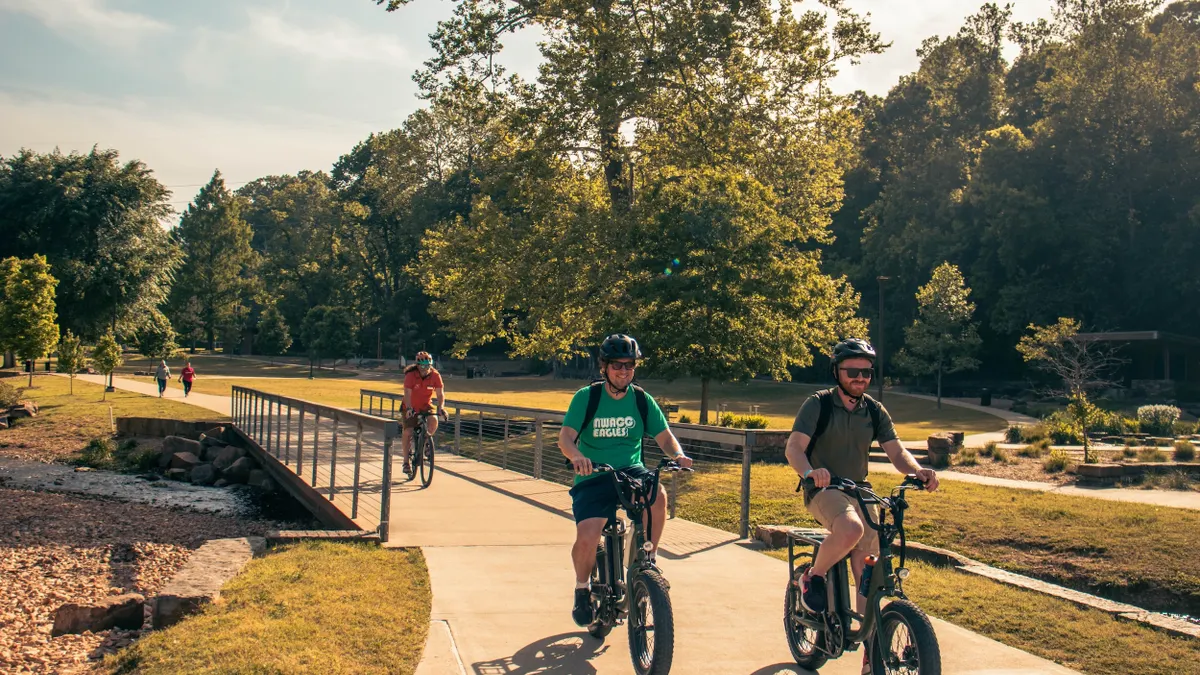
Education is often treated as a side benefit in planning. But when it comes to active transportation, it is the engine of transformation. Programs such as Laneshift’s Active Transportation Academy put participants directly on bikes and sidewalks, helping them experience infrastructure as their constituents do. This moves beyond theory into lived, embodied understanding, reshaping how leaders approach design and investment.
The academy provides real-time experiential learning that often brings smiles and memories from childhood bike riding, providing a foundational element for personal and professional change. Participants consistently report that what began as a technical exercise ended as a personal conviction. Did they feel safe riding beside traffic without a buffer? Could they imagine their child crossing that intersection on foot? Once those questions are lived, not just asked, the answers transform how decisions get made.
Skeptics often ask: Can these projects change a community? The evidence is clear. In Northwest Arkansas, active transportation has become an economic engine. Years of careful, data-driven planning by regional teams — including firms like Crafton Tull — have yielded measurable outcomes: $159 million in annual economic impact from biking alone.Beyond dollars, the region has seen improved accessibility through the provision of transportation options and choice, healthier lifestyles and a stronger sense of community identity.
Most importantly, outcomes are tracked and documented. Data on mode share, safety and usage tells a story that keeps political and public support alive. In a world awash with competing priorities, measurement and storytelling are the lifelines of momentum.
The road map to connectivity
For a century, city design has been heavily influenced by the automobile, with fewer choices available for walking, biking, rolling and running, often at the expense of health, accessibility and the environment. But connected communities show that another path is not only possible, but better.
Imagine zoning codes rewritten to encourage trail-oriented development. Picture arterial corridors redesigned as vibrant spines of commerce, housing and culture. Envision children riding safely to school, parents walking to grocery stores and seniors navigating neighborhoods — all facilitating meaningful connections and relationships. What may appear nostalgic is, in fact, a forward-looking strategy for smarter, more resilient cities.
The life cycle of successful connectivity projects follows a predictable — and repeatable—path. It begins with discovery: understanding how people already move, what barriers they face and what aspirations they hold. Then comes envisioning: engaging residents to shape a shared vision. Plan development follows, translating dreams into concrete designs. Implementation requires prioritization, funding alignment and political will. And none of it ends at construction; ongoing programming and cultural activation are essential.
This roadmap is not theoretical. Communities across the country are walking it — and proving that success is not only achievable but scalable.
This is a moment of unprecedented urgency and possibility. Community health outcomes demand a rethink of car dependency. Economic realities make accessible mobility essential. Public appetite for healthier, safer neighborhoods has never been stronger. And thanks to the Connected Community Model, the path from appetite to action is clear.
The message for city leaders is to act now. Start small, but start smart. Pair infrastructure with culture. Measure relentlessly, and tell the story. Most of all, invite the community to walk and ride with you — they will show what is possible.
Connected communities don’t happen by accident. They are built through deliberate collaboration, immersive education and the courage to reimagine what streets are for. The destination is a vibrant, resilient, accessible community. And the road to get there? It starts with a single step — or pedal stroke.