Dive Brief:
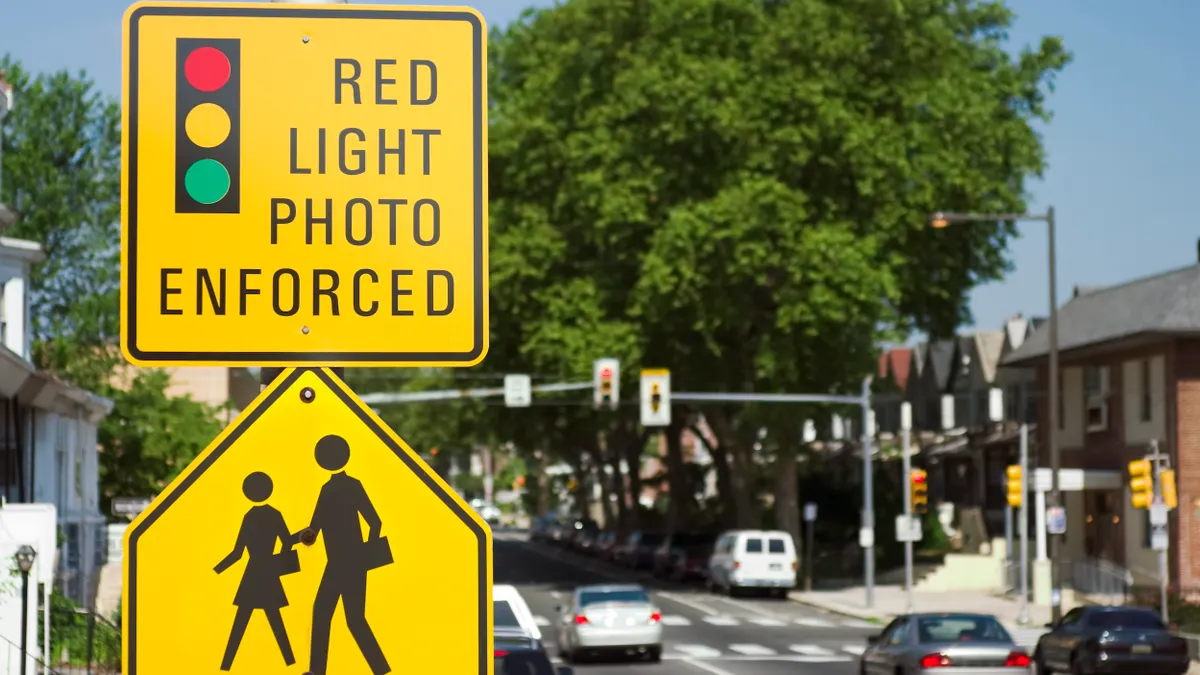
- The New York City Department of Transportation finalized a contract with Verra Mobility to quadruple the number of red-light camera installations at intersections across the five boroughs, the company announced today.
- The city began activating additional red-light cameras in January, aiming to add 50 intersections per week over five weeks. The DOT says it will complete the expansion to all 600 intersections by the end of this year.
- The $998 million, five-year contract also includes speed safety cameras, automated bus lane enforcement and cameras to detect overweight vehicles on the Brooklyn-Queens Expressway.
Dive Insight:
New York City’s red-light program, authorized by the state, has operated for 30 years and achieved a 73% decrease in red-light violations, a 65% decline in T-bone crashes and 49% fewer rear-end collisions at camera-installed intersections, according to the NYC DOT.
"The data on red light cameras couldn't be more clear — they change driver behavior and save lives," New York City Councilmember Lincoln Restler said in a Jan. 9 statement.
Verra Mobility has managed the city’s red-light camera program since its inception. Its new contract, which went into effect Jan. 1, will also upgrade legacy equipment across various programs. The contract also commits to 33% inclusion of minority- and women-owned business enterprises, community partnerships and public education efforts, the company said.
Speed camera enforcement has proven effective in San Francisco and Philadelphia. As of 2025, 351 communities across the country have employed red-light safety camera programs, and 338 have installed speed cameras, according to the Insurance Institute for Highway Safety.
"Red light cameras are a quick and commonsense solution to preventing crashes and tragedy on our streets,” Families for Safe Streets Co-chair Kate Brockwehl said in a Jan. 9 statement. A vehicle struck Brockwehl in 2017 in Lower Manhattan. She still feels the physical and psychological trauma caused by the crash, she said.
The U.S. Department of Transportation said in December that it will eliminate grants for traffic safety cameras under the Safe Streets and Roads for All program, except in school or work zones. New York City’s program is generally self-funded and has generated nearly $364 million in revenues from its inception through June 2023.