Dive Brief:
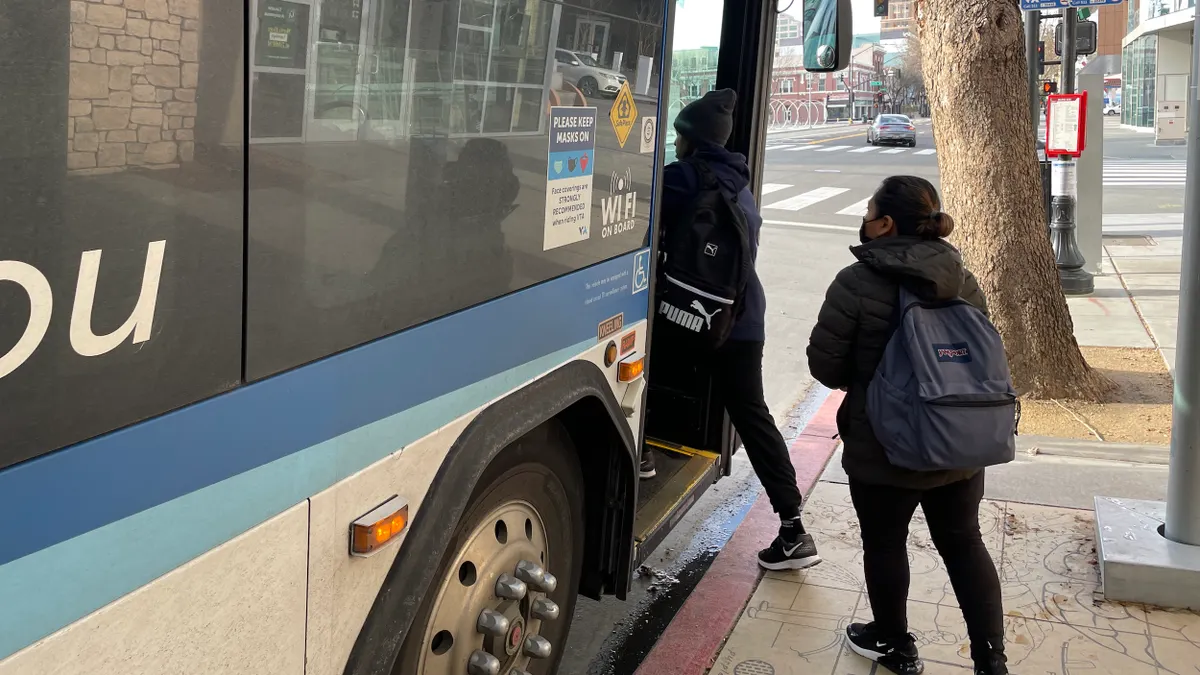
- The city of San José, California, increased transit bus speeds 20% on 24 routes citywide using AI-powered transit signal prioritization, city officials announced today.
- The system uses real-time traffic data to give green signals to buses, thereby improving on-time performance and reducing traffic congestion, the city said in a news release.
- This is one example of how the city invests in AI to make city services faster, safer and more responsive to residents, it said.
Dive Insight:
San José began testing bus signal priority on two routes in 2023. The pilot program reduced bus red-light wait times by 50%, enabling more buses to stay on schedule, it said. Those results led to the citywide rollout.
The city partnered with Lyt, a traffic technology software provider, using connected vehicle and machine learning technologies to improve traffic flow. A transponder in each bus communicates with the traffic signals.
“The traffic light already knows where the bus should be, based on the schedule,” San José Chief Innovation Officer Stephen Caines explained. “Lyt runs the software that brings all these pieces together, and they are the ones who are effectively optimizing the traffic signaling through their technology.”
Lyt CEO Tim Menard said in a statement that the bus priority program delivers “everyday improvements for riders, strengthening transit as an essential service for the people who depend on it.”
Caines said state and federal funds covered 90% of the project cost, making the city’s investment more manageable. “If you are a city that wants to place an ambitious bet on technology, you're not just limited to what you currently have to offer,” he said. “There's really innovative ways you can fund these projects.”
The only problem the city has had, Caines said, is that the buses are running so much faster that they tend to get ahead of schedule.
The faster and more reliable buses are “saving our commuters and working families time and proving that local government can deliver results where it matters most,” San José Mayor Matt Mahan said in a statement.
The city has also tested AI to detect road hazards like potholes, debris and malfunctioning traffic signals and AI vision sensors to alert drivers to pedestrians crossing roadways at night to better protect them.