Dive Brief:
- Transit agencies, municipalities and shuttle bus operators continued to grow their fleets of zero-emission buses during the August 2024 to July 2025 period, outpacing growth in the previous period, according to Calstart, a national clean transportation advocacy group.
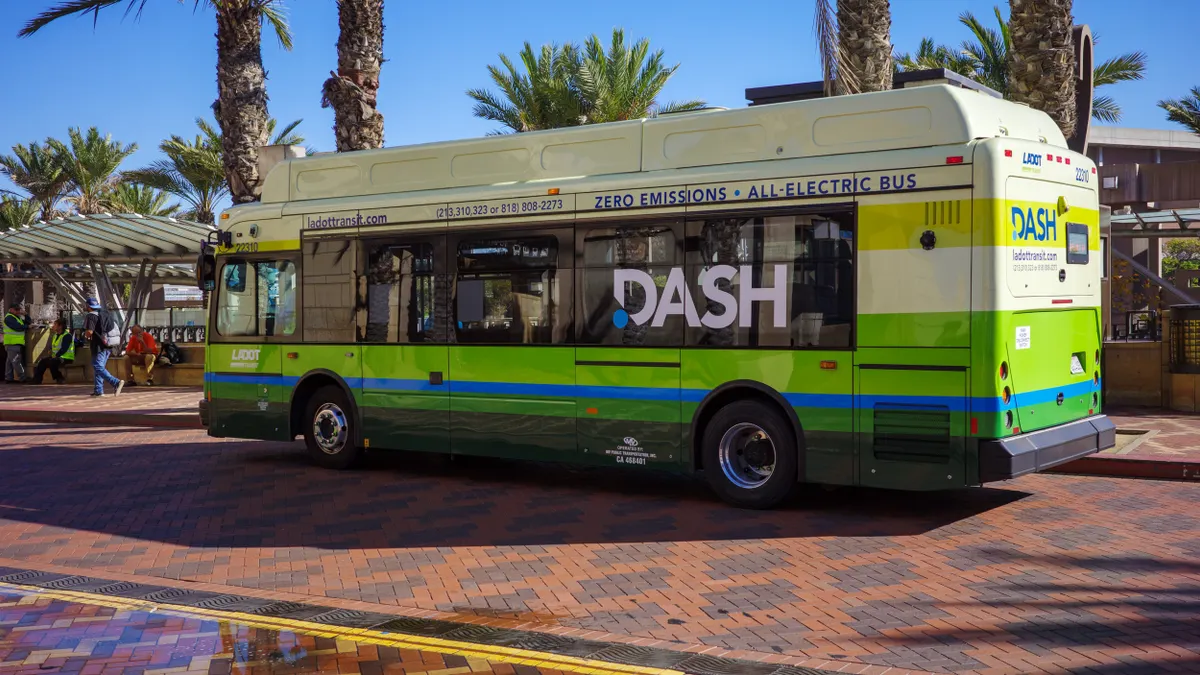
- A total of 8,116 full-size zero-emission buses have been funded, ordered, delivered or are on the road nationwide, a 16% increase over last year’s count, the group reported.
- Calstart projects the number of full-size ZEBs — those 30 feet long or longer — will nearly double by 2030, to more than 15,600, but it said changes in federal policy and funding could impact the rollout.
Dive Insight:
The Federal Transit Administration’s Low or No Emission Grant Program and its Grants for Buses and Bus Facilities Program have helped agencies procure ZEBs with funding from the 2021 Infrastructure Investment and Jobs Act. A July 2025 federal policy revision allows grant recipients to change their proposals from "no emissions" to "low emissions," which can include hybrid-electric buses or those powered by propane or compressed natural gas.
Because Calstart data only goes through July 2025, “shifts in federal policy are not reflected in our reporting,” Mike Hynes, the group’s deputy director for transit, said in an email. “While today, the full impact of the federal funding shifts is still emerging, it is clear that stable state funding, voucher programs, and infrastructure investments will be key to keeping projects moving forward and to the continued scale of zero-emission bus adoption.”
California leads all other states in ZEB adoption with 2,623 full-size vehicles, followed by New York, Washington and Florida. California, Washington, Indiana and Wisconsin added the most ZEBs in Calstart's latest report. “States that maintain predictable incentives and financing pathways will be best positioned to continue scaling zero-emission bus adoption,” Hynes said.
While fuel-cell buses are growing rapidly, Hynes said, the balance of battery-electric buses and fuel cell-electric buses “remains relatively consistent.” Battery-electric buses make up the large majority of all full-size ZEBs.
Smaller ZEBs — generally used for paratransit, shuttles or on-demand services — number nearly 1,400 in the U.S., with just nine powered by fuel cells, according to the report. Airports operate 342 zero-emission buses of all sizes for both passenger and employee shuttle services.
Calstart noted that the continued growth of ZEBs came despite limited bus manufacturing capacity in the U.S., limited supplier availability and long waits for vehicle delivery. “The key issues shaping 2026 will include vehicle production capacity, charging and fueling infrastructure readiness, and how states respond if federal funding becomes less predictable,” Hynes said.