
Dive Brief:
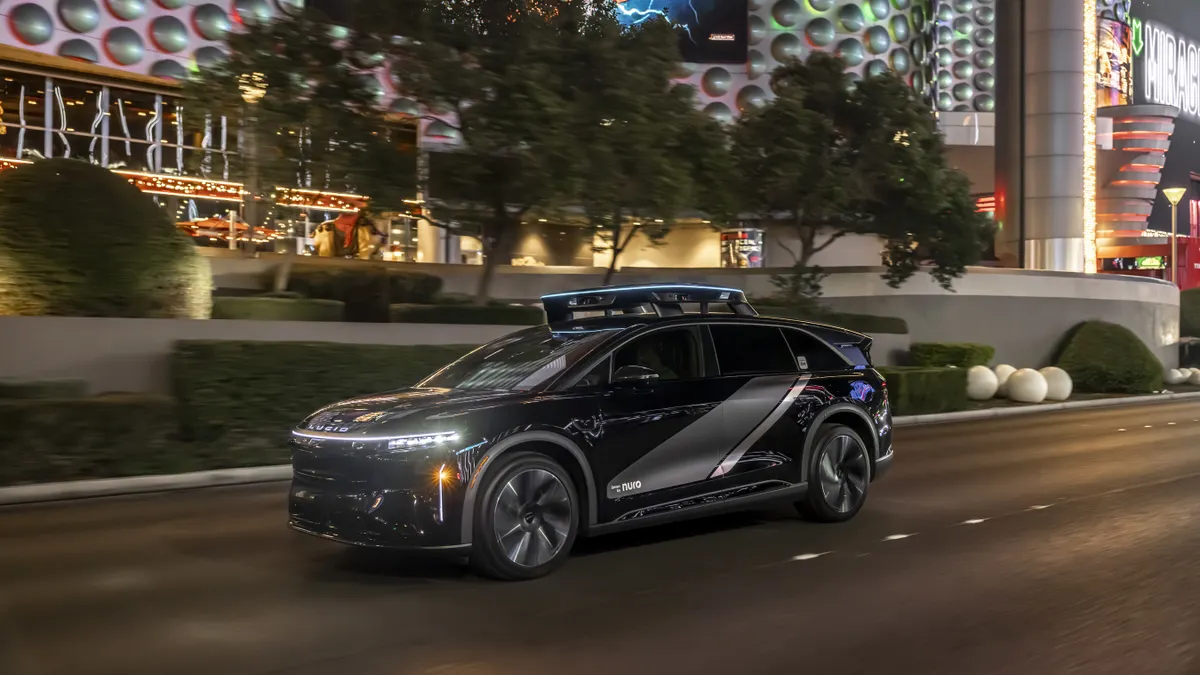
- Electric automaker Lucid Group, autonomous driving technology developer Nuro and Uber Technologies unveiled a production-intent robotaxi based on the Lucid Gravity SUV at the Consumer Electronics Show on Monday, the companies announced in a joint press release.
- Each vehicle will be outfitted with Nuro’s autonomous driving technology and an in-cabin passenger experience designed by Uber. The first Gravity robotaxi deployments on Uber's ride-hailing network are planned for the San Francisco Bay Area later this year.
- "Uber is proud to partner with Lucid and Nuro to bring a state-of-the-art robotaxi to market later this year," said Sarfraz Maredia, global head of autonomous mobility and delivery at Uber. "By combining leading expertise in electric vehicles, autonomy and ride-hailing, we're building a unique new option for affordable and scalable autonomous rides in the San Francisco Bay Area and beyond."
Dive Insight:
In September 2025, Lucid closed on a $300 million investment from Uber to add up to 20,000 Gravity robotaxis to its ride-hailing platform over the next six years in dozens of global markets. The unveiling this week at CES offered the public the first look at the robotaxi prototype, which will be similar to the production version.
“Our engineering, range and interior comfort offers a unique platform, and when combined with Nuro’s technology and Uber’s scale, we are collectively building an experience like no other,” said Kay Stepper, VP of ADAS and autonomous at Lucid, in a statement. ADAS refers to advanced driver assistance systems, such as automatic emergency braking and lane departure warnings.
The companies also announced that on-road testing of the robotaxis began in the Bay Area last month. Nuro is leading the testing of the vehicles, which are being monitored by human safety drivers.
Each of the Gravity SUVs is outfitted with high-resolution cameras, solid-state lidar and radar that provides 360 degrees of perception for autonomous driving, per the release. The robotaxis will also use a high-performance compute platform based on Nvidia’s DRIVE AGX Thor system-on-a-chip with real-time AI processing to support Level 4 autonomous driving capabilities, which enables a vehicle to drive itself within a defined area.
Nuro refined its autonomous driving technology through years of commercial autonomous deployments of its compact delivery vehicles, per the release. The testing is part of the company’s safety and validation framework that includes evaluating dozens of safety-critical systems across the vehicle’s entire autonomous driving technology stack, including an end-to-end AI foundation model using neural networks.
Nuro’s testing also includes closed-course tests and computer simulation of a wide range of driving scenarios a commercial robotaxi may encounter.
“By bringing together Nuro’s proven level 4 autonomy, Lucid’s advanced vehicle architecture and Uber’s global reach, we’re building a robotaxi service designed for real-world operations and long-term growth, said Dave Ferguson, co-founder and co-CEO of Nuro, in a statement.
The in-cabin experience designed by Uber includes interactive screens that let riders personalize their trip. Customers can control features such as heated seats, climate controls and the vehicle’s audio system. The Gravity robotaxis will comfortably seat up to six passengers with generous space for luggage, per the release.
Passengers are also provided with an “in-vehicle visualization" screen that shows what the robotaxi “sees” in real-time. Riders can follow the vehicle’s planned route and maneuvers such as yielding to pedestrians, stopping at traffic lights, changing lanes and dropping off a passenger.
Uber also added options for passengers to contact customer support or request the vehicle to pull over. The robotaxis also feature integrated LED lighting that display the rider’s initials to help identify the correct vehicle.
Pending validation of the final design, production of the Gravity robotaxis is expected to begin at Lucid’s factory in Casa Grande, Ariz. later this year.