Dive Brief:
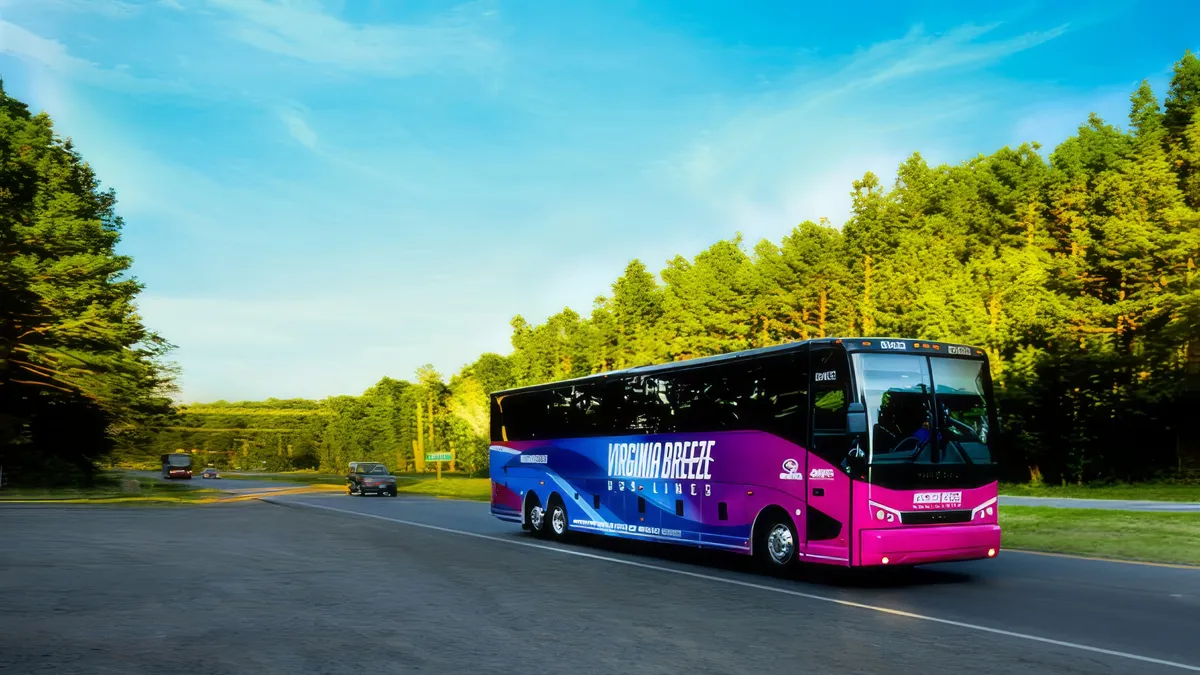
- Virginia’s first state-supported cross-state bus route began service today, connecting Virginia Beach to inland cities and terminating at Harrisonburg, Virginia, along Interstate 81.
- The route connects 10 cities and five counties in the commonwealth, serving colleges, universities and Richmond International Airport.
- The Tidewater Current service operates one bus daily in each direction, connecting with northbound and southbound bus routes at Richmond, Charlottesville, Staunton and Harrisonburg.
Dive Insight:
The new service is the fifth state-supported bus route in the commonwealth’s Virginia Breeze system, which contracts with private operators for its routes.
“Expanding the Virginia Breeze intercity bus network is part of our commitment to providing more transportation choices for all Virginians,” Mariia Zimmerman, director of the Virginia Department of Rail and Public Transportation, said in a statement. “The Tidewater Current creates an important east-west connection across the Commonwealth, helping people travel safely, affordably, and conveniently while supporting tourism and economic opportunity.”
By connecting with north-south bus routes, Tidewater Current passengers can reach Union Station in Washington, D.C., where they can continue on Amtrak or other intercity bus lines.
The Virginia Breeze system carried over 68,000 passengers in 2025, a 5% increase over the prior year, according to the Virginia DRPT.
The buses are equipped with restrooms, power outlets and free Wi-Fi.
State-supported intercity bus routes are gaining popularity, Joseph Schwieterman, director of the Chaddick Institute for Metropolitan Development at DePaul University, said in a 2024 interview.
Colorado, Maine, North Carolina, Oregon and Washington are among the states subsidizing intercity bus services, often with funding from the Federal Transit Administration’s formula grants for rural areas program, also known as Section 5311. This formula grant program provides states with capital, planning and operating assistance to support public transportation in rural areas with populations of less than 50,000.