Dive Brief:
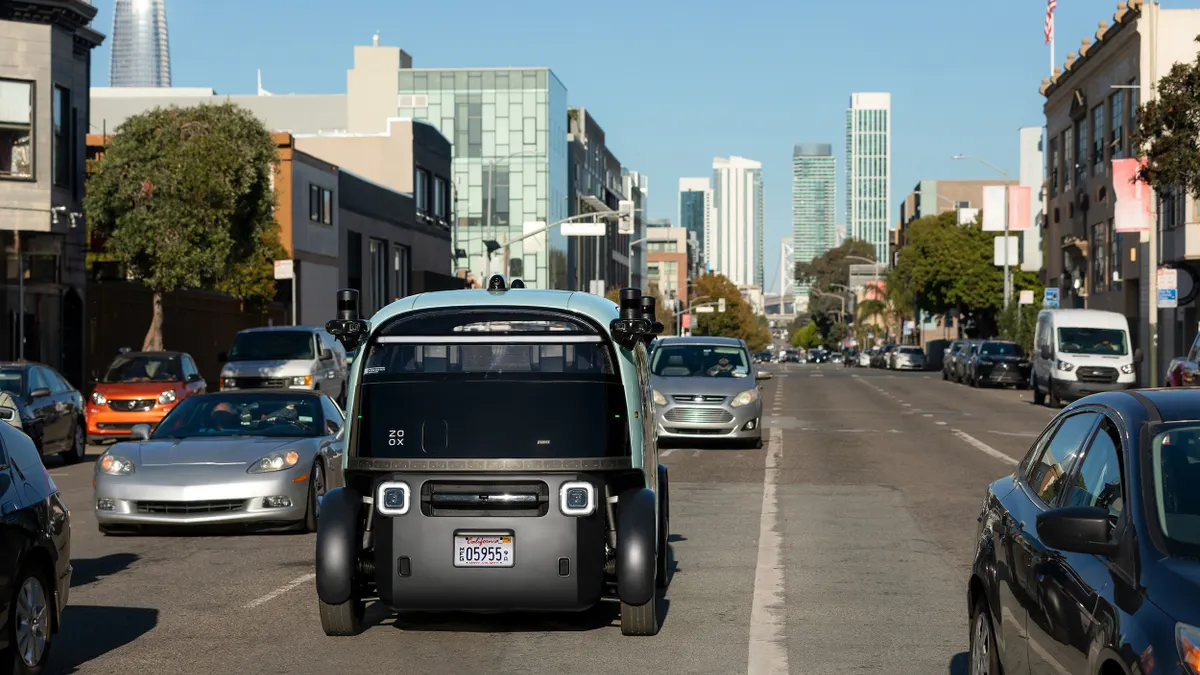
- The National Highway Traffic Safety Administration issued a temporary exemption allowing Zoox purpose-built robotaxis to operate paid public rides in the U.S., the agency announced Thursday. Purpose-built robotaxis such as Zoox’s bidirectional vehicles have no steering wheel or foot pedals.
- The agency’s first such exemption allows up to 2,500 autonomous Zoox vehicles to be deployed annually for two years, subject to enhanced oversight, NHTSA said in a press release.
- Zoox, an Amazon subsidiary, said it is working with regulators in Nevada and California, where it serves riders in Las Vegas and San Francisco, to meet the requirements for paid rides.
Dive Insight:
NHTSA’s exemption came as part of a series of actions aimed at accelerating AV innovation, it said. The agency will streamline the application process for automakers to temporarily sell a limited number of vehicles that do not meet current motor vehicle safety standards, work with a consortium to develop national AV safety standards and give the NHTSA administrator authority to issue temporary exemptions to certain previously manufactured vehicles.
“By removing unnecessary barriers to innovation, developing industry guidance, and providing strong enforcement oversight while we create performance requirements, NHTSA is taking a balanced approach to AV regulation,” NHTSA Administrator Jonathan Morrison said in a statement.
Zoox said it would start charging customers in Las Vegas next month. In addition to its two current locations, Zoox named Miami and Austin, Texas, as the next two cities to offer public rides after months of testing. As of March, Zoox was also testing in Atlanta, Dallas, Los Angeles, Phoenix, Seattle and Washington, D.C.
“We are grateful to [Transportation] Secretary [Sean] Duffy, the administration, Administrator Morrison, and NHTSA for their engagement and their commitment to paving the way for Zoox and our fellow travelers to keep innovating and developing this critical technology here in the U.S.,” Zoox said in a news release.
Waymo launched its first purpose-built robotaxis last month, and Tesla recently began production and testing of its purpose-built, two-seat Cybercab. There is no official word on when or where Cybercab rides will be available.