
In the year following COVID, more than 6,300 businesses packed up and moved across state lines. While taxes and labor costs often dominate the headlines behind numbers like these, day-to-day friction plays a quieter but far more powerful role in those decisions.
For business owners, interacting with local government isn’t a one-time milestone. It’s an ongoing relationship that unfolds through licensing applications, renewals, tax filings, compliance requirements, payments and routine communications. Each interaction leaves an impression.
Those moments add up. They shape whether business owners see their local government as a capable partner or an obstacle standing between them and growth.
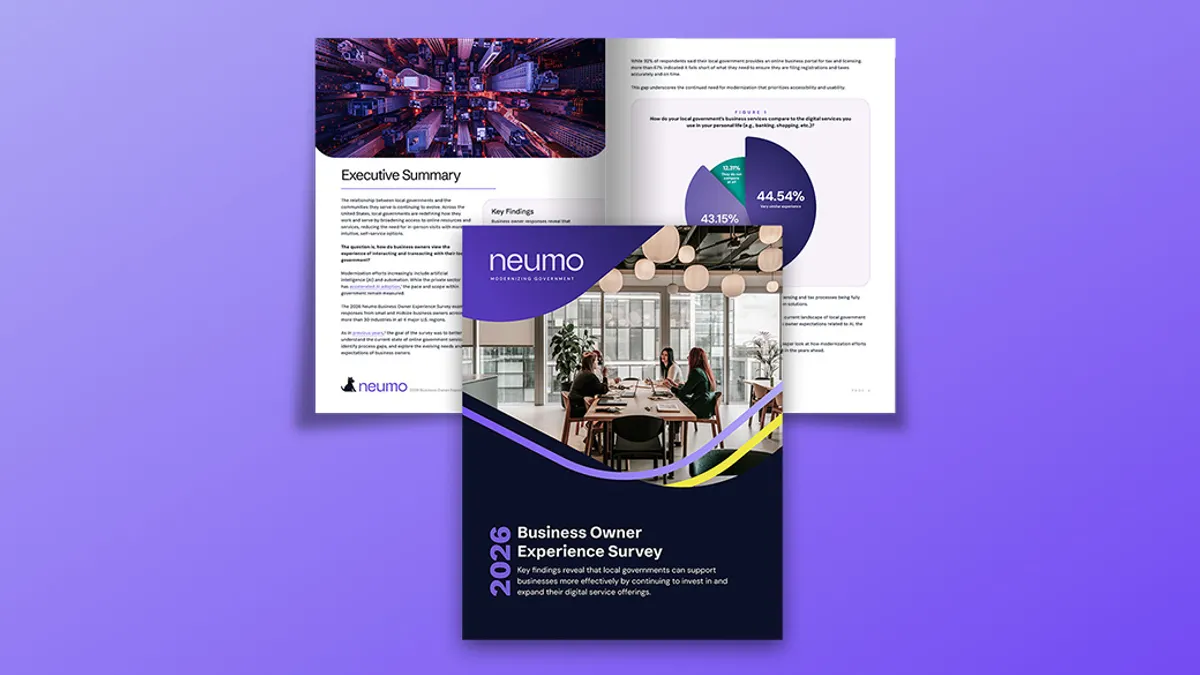
The 2026 Neumo Business Owner Experience Survey stresses just how much expectations have changed. Business owners now measure government services against the digital experiences they rely on every day, from online banking to e-commerce platforms.
When government processes feel fragmented, unclear, or outdated, the consequences extend well beyond inconvenience. They cost time, money and trust. In an increasingly mobile economy, they can influence where a business chooses to stay, invest, or leave.
For local governments, improving the business owner experience can no longer survive on making incremental tweaks to improve processes. It requires completely rethinking how government services are designed, delivered and communicated through the lens of the people using them.
The current state of the business owner experience
The 2026 Neumo Business Owner Experience Survey findings paint a picture of uneven progress. While many local governments have invested in online tools, fully digital, end-to-end experiences remain the exception rather than the rule.
- Only 1 in 5 local governments offers a fully digital business license application experience, meaning most business owners still encounter partial digital processes that ultimately require printing forms, mailing documents, or visiting offices in person.
- Even after completing applications online, more than 35% of business owners reported visiting a government office in person just to pick up their license certificate, highlighting how disconnected workflows create unnecessary friction.
- Renewals tell a similar story. More than half of all business licenses are still renewed by mail or in person and fewer than half of business owners complete renewal payments fully online. For businesses juggling staffing shortages, rising costs and market uncertainty, these extra steps add up quickly.
- The burden becomes even more apparent in tax compliance. Only 2 in 10 local governments offer an online business portal with automatic tax calculations, leaving nearly 80% of business owners to manually calculate taxes, penalties and interest on their own.
- Unsurprisingly, two-thirds of business owners reported paying a late fee or penalty due to confusing paperwork or processes, a cost they often absorb despite trying to comply in good faith.
These gaps don’t suggest a lack of effort by governments. Rather, they point to systems that were built over time, often in silos, without a cohesive experience in mind.
Time is the hidden cost businesses feel the most
Beyond frustration, the survey reveals a more tangible impact and a far more critical type of currency to business owners—lost time. When asked how much time they spend annually on licensing and tax paperwork, many business owners estimated relatively low numbers.
Yet the data suggests that time spent traveling to offices, waiting in lines, manually calculating taxes and correcting errors is frequently underestimated.
For small and midsize businesses, time away from operations directly affects everything from revenue to staffing to customer service. Every additional step in a government process becomes a tradeoff between compliance and core business priorities. More than likely, the last thing a local government wants is for business owners to forego compliance because it’s too cumbersome and cutting into their bottom line.
Improving the business owner experience, then, cannot merely be about making things more convenient. It’s about actively reducing the hidden costs that slow economic activity at the local level.
What business owners expect moving forward
If the first half of the survey highlights where processes fall short, the second half makes clear where business owners want government to go next.
- A striking 93% of respondents said it is important for government business licensing and tax services to be available online.
- 90% said they would be more likely to file and pay on time if their local government offered a fully digital process.
- 79% said they would be comfortable with licensing and tax processes being fully automated through AI, provided those systems are reliable and transparent.
These findings directly link digital access with improved compliance through simple clarity and usability, not through enforcement. Contrary to common assumptions, business owners are also far more open to automation than many government leaders expect.
What business owners consistently emphasize, however, is not technology for its own sake. They want systems that reduce guesswork. Automatic calculations, clear instructions and intuitive interfaces were repeatedly cited as ways governments could make it easier to stay compliant.
Building a better experience requires a shift in perspective
One of the most important takeaways from the 2026 Neumo Business Owner Experience Survey is that modernization should be guided by experience, not just infrastructure. Many local governments already have online portals, licensing tools, digital forms, or payment systems.
Yet business owners still report friction because those tools don’t always work together or reflect how people actually move through processes.
Improving the business owner experience means stepping into their shoes and asking the right questions. Where do they get stuck? Where do they have to leave a digital process and switch to paper or in-person steps? Where does silence replace guidance?
By addressing these moments, local governments can move beyond partial digitalization toward experiences that feel coherent, predictable and supportive.