Dive Brief:
-
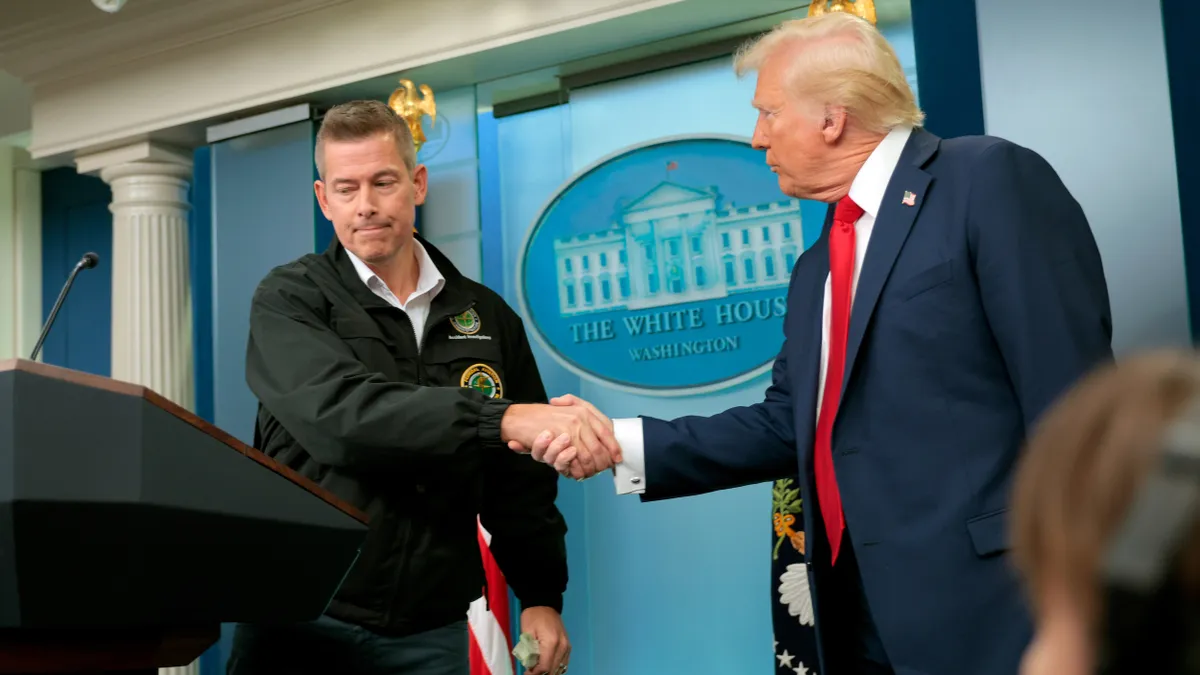
A federal judge quashed subpoenas the U.S. Justice Department issued in January seeking documents related to the enforcement of federal immigration laws from the mayors of Minneapolis and St. Paul, Minnesota, and a host of state and county officials.
-
“The fact that connections between the information sought in the subpoenas and any possible criminal violation range from extremely weak to nonexistent only adds to the overwhelming evidence that these subpoenas were not issued to investigate, but to harass, coerce, and retaliate,” Patrick Schiltz, chief judge for the U.S. District Court of Minnesota, wrote in his opinion, which was unsealed Monday.
-
Calling the judge’s action “extremely rare,” Minnesota Attorney General Keith Ellison said in a statement, “In America, we settle our political differences at the ballot box, and it should disturb every American that [President] Donald Trump is weaponizing the criminal justice system against people he disagrees with.”
Dive Insight:
The Trump administration launched Operation Metro Surge, the largest immigration-enforcement operation in Department of Homeland Security history, in Minnesota in December. Minneapolis Mayor Jacob Frey immediately issued an executive order prohibiting federal, state and local agencies from using city-owned parking ramps, garages or vacant lots to stage immigration enforcement operations.
The surge resulted in ongoing protests in Minneapolis and the death of two U.S. citizens, Renee Good and Alex Pretti. “During the surge, there were widespread reports of DHS agents engaging in abusive and dangerous tactics seemingly designed to escalate tensions and destabilize the community,” Schiltz wrote.
State and city officials in Minnesota filed a lawsuit on Jan. 12 asking the court to declare the federal immigration surge unconstitutional and unlawful and to prohibit agents from conducting operations in the state “over the objection of the Governor of Minnesota and the Mayors of Minneapolis and Saint Paul.”
The DOJ on Jan. 20 issued the subpoenas seeking documents from the Minnesota governor's office, the Minneapolis mayor's office, the St. Paul mayor's office, the Minnesota attorney general's office, the Ramsey County Board of Commissioners and the Hennepin County Board of Commissioners seeking records relating to enforcement of federal immigration laws going back to Jan. 1, 2025.
John Kincaid, a government and public service professor at Lafayette College and director of its Meyner Center for the Study of State and Local Government, said at the time that the subpoenas of elected officials were “highly unusual” because those “are usually reserved for acts of corruption or civil rights infringements and are usually issued after an extensive investigation.”
Citing the 10th Amendment’s “anti-commandeering rule,” Schiltz wrote that the federal government cannot “command the States' officers, or those of their political subdivisions, to administer or enforce a federal regulatory program" or “coerce or retaliate against states or political subdivisions who decline to help the federal government enforce federal laws.”
“The State of Minnesota and its political subdivisions have the right — a right grounded in the bedrock constitutional principle of federalism — to decline to devote their resources to furthering the Trump administration's enforcement of federal immigration laws,” Schiltz wrote. “On their face, therefore, the subpoenas are directed to investigating activity that is not only legal, but constitutionally protected from interference by the very federal government that issued the subpoenas.”
The Justice Department said in an unattributed emailed statement Tuesday that it “takes the unlawful obstruction of federal law enforcement operations extremely seriously and will continue to act in full compliance with the law to investigate these matters.”
Frey said in an emailed statement that he was grateful for the decision. “My job is not to stay silent when Minneapolis residents are killed, families are torn apart, and businesses are closed,” he said. “My job is to stand up for the people I represent, the families who call our city home, and the thousands of people who showed up and spoke out.”
This article was updated to include a Justice Department comment.