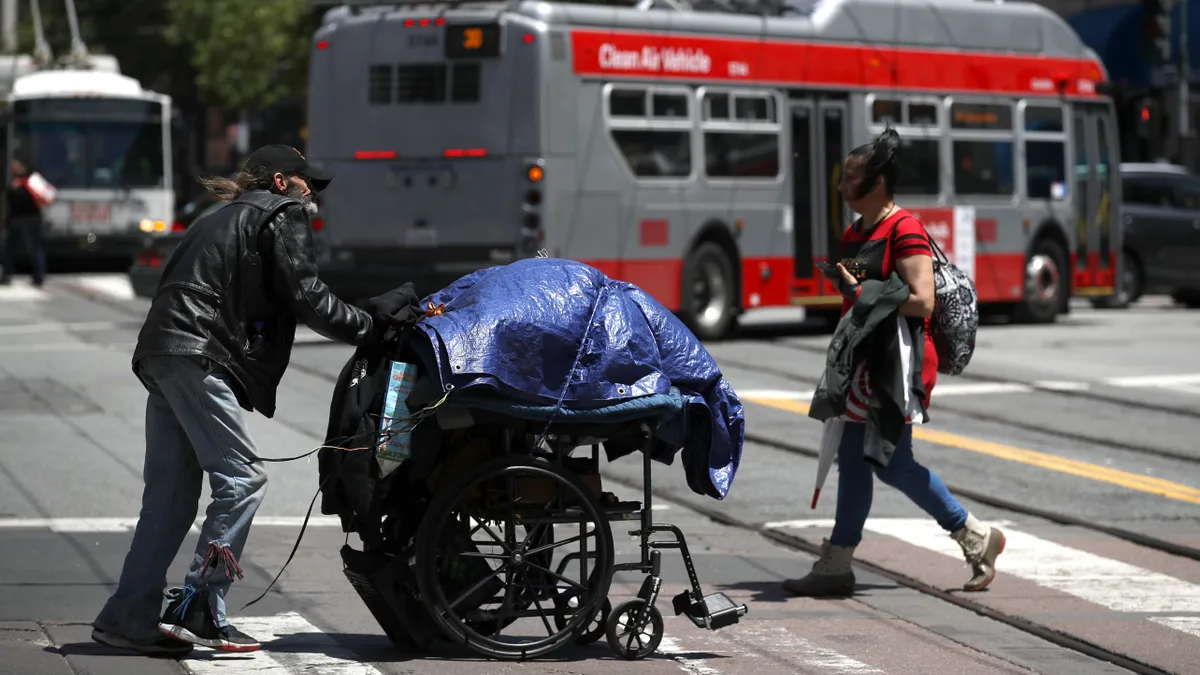
City leaders across the U.S. are brainstorming solutions for millions of their constituents who may lose federal Supplemental Nutrition Assistance Program benefits this weekend.
But the bottom line, said Allentown, Pennsylvania, Mayor Matt Tuerk, is “there’s nothing a city can do that is going to replace SNAP. My primary job right now is to try to get SNAP funded.”
Tuerk, who chairs the U.S. Conference of Mayors’ Children, Health and Human Services Committee, estimates that 20% to 25% of Allentown’s 127,000 residents receive the federal food stamps.
Nationally, the U.S. Department of Agriculture reports that in fiscal year 2024, an average of 41.7 million Americans received SNAP funds every month. The average payout per person was $187.20 per month, for a total of nearly $100 billion in federal spending last year. That funding is scheduled to end Nov. 1 as a result of the government shutdown.
Cities and states fight back
Five days before that deadline, Tuerk and fellow mayors who were attending the Accelerator for America Fall Advisory Council Meeting in Nashville were hoping their efforts, along with action at the state level, would convince the feds to at least partially fund SNAP in November.
The mayors’ actions included an Oct. 23 letter urging USDA Secretary Brooke Rollins to “utilize all available resources, including the SNAP contingency fund and any additional administrative authorities, to ensure participants continue to receive benefits without interruption.”
But a day later, the USDA issued a memo stating the SNAP contingency fund is only for emergencies, and it would be illegal to use it to cover regular SNAP benefits. The memo also said the feds won’t reimburse states that pay SNAP benefits out of their own budgets.
Attorneys general and governors in 25 states plus the District of Columbia legally challenged that decision on Oct. 28.
A state of Washington news release announcing it was joining that lawsuit stated: “Despite USDA’s claim of insufficient funds, the agency has access to billions of dollars in SNAP-specific contingency funds appropriated by Congress for this very purpose. Furthermore, USDA has funded other programs with emergency funds during this shutdown, but has refused to fund SNAP, leaving millions of Americans without the assistance they need to buy food. The federal government is clearly making a deliberate, illegal, and inhumane choice not to fund the crucial SNAP program.”
Action at the state level
While most states have said they can’t afford to fund SNAP benefits themselves, Newsweek reports that nine states have pledged millions of dollars to either pay their SNAP recipients directly or finance food banks and other organizations that can help people who lose SNAP benefits.
Virginia, which has about 850,000 SNAP recipients, created the first-ever Virginia Emergency Nutrition Assistance program. VENA will use money from the state’s surplus fund to provide benefits for SNAP recipients through at least November. The state is also earmarking another $1 million for local food banks.
Louisiana issued a state of emergency on Oct. 23 to provide funds for SNAP recipients — but only until Nov. 4.
California, with about 5.5 million SNAP recipients, will be the hardest-hit state. Gov. Gavin Newsom announced the state is providing up to $80 million to support local food banks. As he did during the COVID-19 pandemic, Newsom is also deploying the California National Guard and California Volunteers to assist with food bank operations.
Action at the city and county level
Pennsylvania is one of the states suing the USDA over the SNAP contingency fund, and Tuerk and other mayors are lobbying their federal representatives for help.
“I know I’ll hear from people who are struggling to put food on the table if they can’t get SNAP funded and don’t know where else to go,” Tuerk said. “People’s expectations are the mayor can fix it; the mayor can resolve it. Mayors can’t solve every problem, but we can sure as hell try.”
Tuerk said Allentown officials are planning to help residents connect with food pantries and steer them to state resources for rent assistance, utility payments and other necessities they may have to forgo to put food on the table.
Barbara Buffaloe, mayor of Columbia, Missouri, said the city will restart CoMoHelps, a coalition it launched during COVID. This collaboration between the city of Columbia, Boone County, the Heart of Missouri United Way, the Community Foundation of Central Missouri and the Veterans United Foundation is designed to support local nonprofits impacted by the government shutdown.
“Our first act is amending an ARPA [American Rescue Plan Act] contract we had with the food bank to give them additional funds. We’re doing that in coordination with our county,” Buffaloe said.
Action at the nonprofit level
As food banks across the nation gear up for masses of hungry families, so are other community organizations.
United Way of New York City has reactivated its Emergency Assistance and Community Needs fund to help support community organizations like food pantries, churches and other groups that work with large numbers of SNAP recipients.
“Since COVID, our food pantries have really struggled to meet the demand,” said UWNYC Chief Impact Officer Kanchana Suggu, noting that so far this year, there have been 47 million visits to New York City food banks — an 87% increase since 2019. “Our pantries are reeling, and the government shutdown has become a huge concern for them.”
Suggu said UWNYC’s goal is to raise $1 million for EACN, but just a few days before the projected end of SNAP benefits, “we have a long way to go” to meet that goal.
Suggu said the plan is to begin releasing EACN funds during the week of Nov. 2 to five community organizations — one in each borough.
UWNYC is also working with the community in other ways. Suggu said UWNYC is supporting organizations that are partnering with larger grocery stores on plans to distribute their excess food while also looking into mobile food distribution. During the pandemic, she said, UWNYC worked with DoorDash to deliver food to vulnerable residents. DoorDash also announced it’s waiving some fees for food banks and SNAP recipients in November.
“We’re strengthening and coordinating the local safety nets to create a unified, citywide safety net system,” Suggu said. “We’re bringing community-based groups together and letting them know what the city is thinking.”
Editor's note: We have updated this article to clarify that United Way New York City supports organizations that partner with grocery stores to distribute excess food.