Dive Brief:
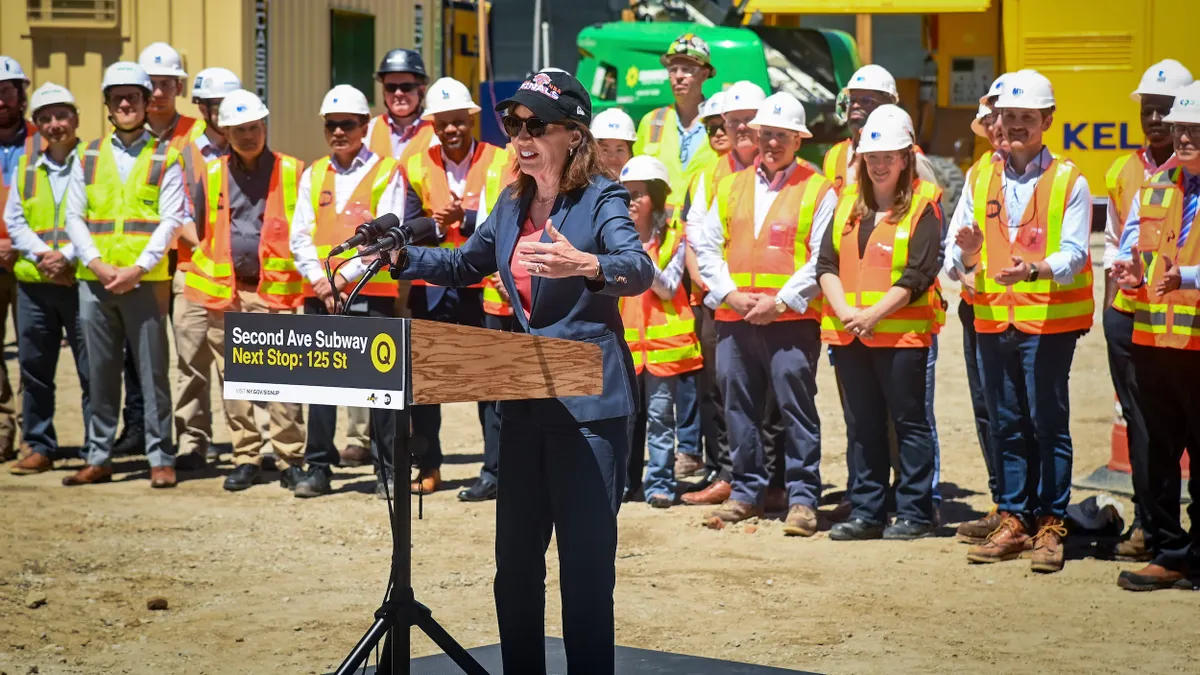
- New York Gov. Kathy Hochul, Metropolitan Transportation Authority Chair and CEO Janno Lieber and other dignitaries broke ground Monday on phase 2 of the Second Avenue subway line in Manhattan.
- The project will extend the Q Line subway from 96th Street and Second Avenue to 125th Street and Lexington Avenue in East Harlem, where it will connect with three subway lines and the Metro-North commuter railroad.
- Tunneling will begin early next year, when a tunnel boring machine will be lowered into the ground at Second Avenue and 120th Street, then move west to 125th Street and Malcolm X Boulevard, the MTA said in a press release.
Dive Insight:
The MTA prevailed against the Trump administration, which last year withheld $18 billion in funding for the New York-New Jersey Hudson Tunnel project and the Second Avenue subway extension in Manhattan. “This was a win for East Harlem; it was a win for New York,” Hochul said at the groundbreaking ceremony.
The project, estimated to cost between $6.9 billion and $7.7 billion, was awarded a $3.4 billion federal capital investment grant in 2022.
“East Harlem is a historically underserved neighborhood which has one of the largest concentrations of affordable housing in the United States,” the MTA said in a press release. About 70% of residents in the area rely on public transit.
"This project is good news for East Harlem riders and for all New Yorkers, who can look forward to faster commutes, better access to more neighborhoods, and more time and money back in our lives,” Riders Alliance Policy and Communications Director Danny Pearlstein said in an emailed statement.
Based on lessons learned from building the first phase of the Second Avenue subway, phase two will reuse a tunnel segment built in the 1970s from 110th Street to 120th Street, relocate underground utilities in advance and employ performance-based design-build contracts, the MTA said.
“We're going to keep it on budget, we're going to keep it on schedule, and we're going to make sure that it is a great value for the United States, as well as for New Yorkers,” Lieber said at the groundbreaking.
The Q train operates from Coney Island in Brooklyn to 96th Street in Manhattan. A potential next phase of the line would continue it west across 125th Street to Broadway, the MTA said. Preliminary engineering and design is budgeted for fiscal year 2027. If approved, tunneling could continue by using much of the same equipment from phase 2, saving time and money, the MTA said.