Dive Brief:
-
The U.S. Supreme Court on Monday heard oral arguments in Suncor Energy v. County Commissioners of Boulder County, a case that will decide whether a lawsuit brought by the city and county of Boulder, Colorado, holding Exxon Mobil and Suncor Energy accountable for the costs of local climate damage can move forward.
-
The arguments centered on whether municipal lawsuits against fossil fuel producers for climate change impacts are constitutional, whether state law or federal jurisdiction regulates interstate pollution under the Clean Air Act and whether the Supreme Court should take up the case or allow it to continue moving toward trial in Colorado state courts.
-
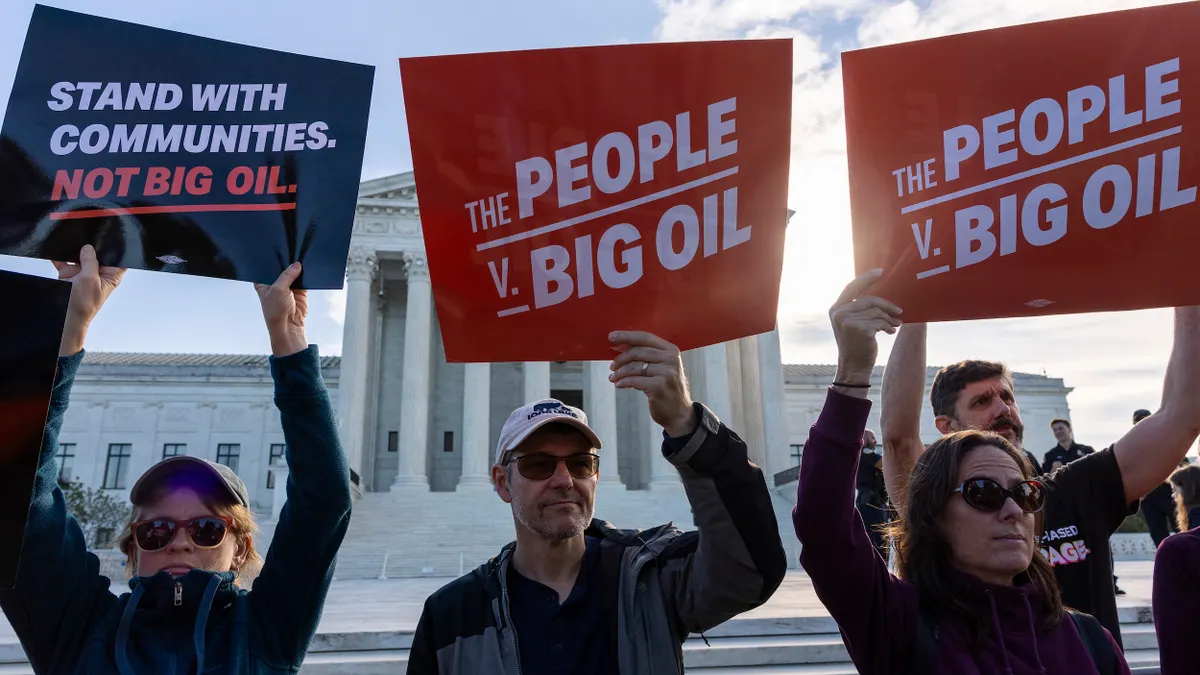
Environmental advocates held rallies on Monday in Boulder and Washington, D.C., urging the Supreme Court to allow communities to advance lawsuits holding oil and gas companies accountable for climate change impacts. Dozens of municipal governments, 11 states, the District of Columbia and two tribal governments have filed lawsuits similar to Boulder County’s.
Dive Insight:
The city and county of Boulder sued Suncor Energy and Exxon Mobil in 2018, alleging the companies deceived the public about the dangers of fossil fuels and continued to produce them despite knowing the risks. The Colorado Supreme Court ruled in May 2025 that federal law, including the Clean Air Act, did not preempt Boulder’s claims and the case could proceed toward trial.
Suncor and Exxon Mobil petitioned the U.S. Supreme Court to review the state Supreme Court’s opinion. Suncor Energy v. County Commissioners of Boulder County asks the high court to consider “whether federal law precludes state-law claims seeking relief for injuries allegedly caused by the effects of interstate and international greenhouse-gas emissions on the global climate.”
“If Boulder’s claims are allowed to go forward, some 90,000 [local governments] across the country will have the ability to make national and international energy policy by asking juries to impose catastrophic damages on selected fossil fuel producers,” Suncor’s attorney, Kannon Shanmugam, said during Monday’s hearing.
Justice Elena Kagan compared the case to suits brought by states and local governments against tobacco companies in the 1990s and opioid companies in the 2010s. “This is chapter three,” she said.
Several of the justices questioned whether the Supreme Court has jurisdiction to hear the case and whether it was ripe for the high court. “I understand that you have several other federal issues that you have raised that are still pending in the state court, so why shouldn't we wait and hear all of these claims once the state courts are done with their federal considerations?” Justice Ketanji Brown Jackson said in questioning Shanmugam.
Justice Samuel Alito recused himself from the case.
During the rally in front of the Boulder County Courthouse Monday, Boulder Mayor Aaron Brockett said Suncor and Exxon Mobil are attempting “to stop our case before we ever have our day in court.”
“We are asking the court to let us have that day, because this is not an abstract issue for Boulder. It is a daily reality for our community,” he said. “People across Boulder have experienced the impacts of a changing climate, from hotter summers and extreme heat to drought, declining snowpack, worsening wildfire risk and devastating fires.”
In a statement following the oral arguments, H. Sterling Burnett, director of the Arthur B. Robinson Center on Climate & Environmental Policy at the Heartland Institute, said that energy production and use is interstate commerce and therefore “solely the responsibility and authority of Congress.”
“The court should make clear that localities and states may not make national policy directly or indirectly through the courts,” he said.
Republican lawmakers in the House and Senate introduced a bill in April to prohibit lawsuits against fossil fuel energy producers because of their greenhouse gas emissions and preempt any states’ attempts to regulate such emissions.