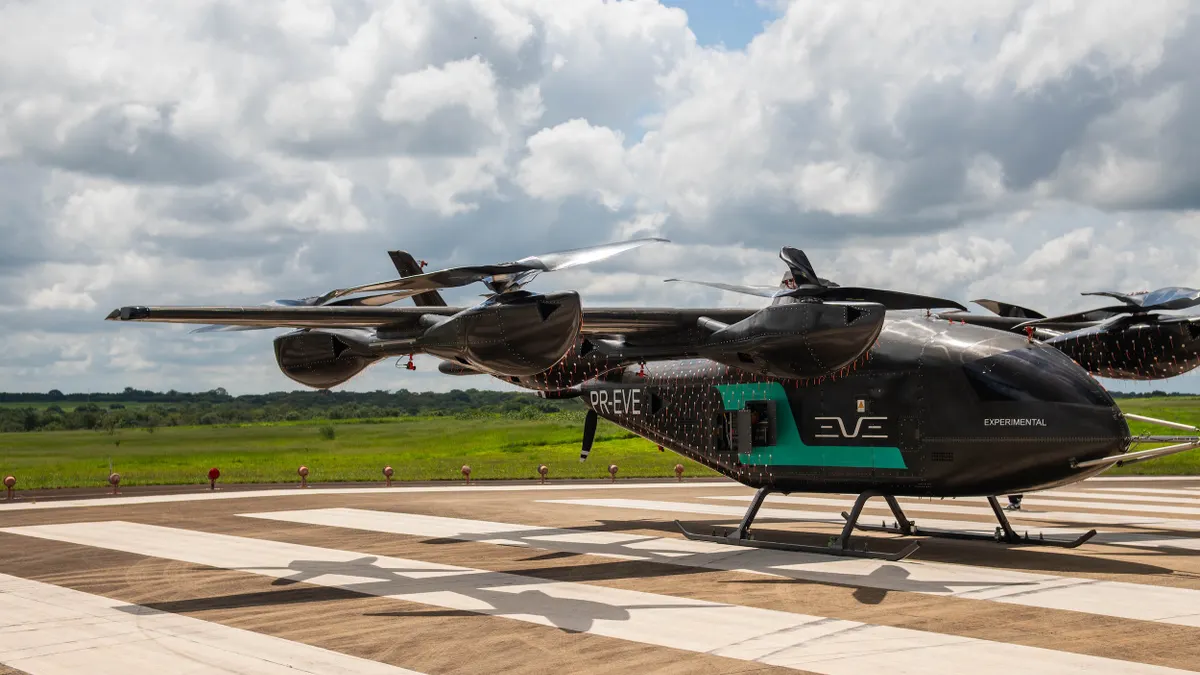
Eve Air Mobility is aiming to launch its air taxi in 2028, which would operate within cities and to outlying airports, the company’s chief commercial officer, Megha Bhatia, told Smart Cities Dive.
Unlike its competitors, who seek to both manufacture aircraft and operate air taxi services, Eve will follow a more traditional role. “We're experts with being [original equipment manufacturers] in the ecosystem, so we're going to continue to focus on that model,” Bhatia said. Air taxi operators would purchase and fly the electric vertical takeoff and landing aircraft, she said.
Bhatia sees a growing market for air taxis. “Urban cities are only going to continue to grow,” she said, adding that these aircraft could relieve traffic congestion in crowded environments. The company has 2,700 customer orders, the largest in the eVTOL industry, according to Bhatia. Eve also plans to offer service and maintenance for its air taxis and provide pilot training, she said.
Some air taxi developers are racing to begin commercial flight operations by the end of this year, and Boeing subsidiary Wisk Aero plans to begin autonomous commercial flights by 2030.
Bhatia said Eve is following the proven path to safety and operability. “We're not in the race to be first,” she said. “We want to ensure we have the right product that matches the mission and the use case that our customers want.”
Based in Melbourne, Florida, Eve is developing a four-passenger, piloted air taxi with a range of about 60 miles. Its prototype aircraft has completed 59 successful flights, including hover maneuvers and low-speed flights.
While other air taxis use propellers that tilt upward for takeoff and landing, Eve’s fixed rotors transition flight control to a rear-mounted propeller that pushes the plane in forward flight, Bhatia explained. This allows for less downtime, lower maintenance and fewer component failures because there are fewer rotating parts, she said.
“We want to be able to optimize the performance of the eVTOL so that it can maximize the number of flights it can carry out per day,” Bhatia said.
Although Eve is not part of the Federal Aviation Administration’s eVTOL Integration Pilot Program, which aims to launch operations in six states this year, Bhatia said the company is “closely engaged” with the U.S. Department of Transportation as well as transportation officials in Florida and other states.
Eve spun off from Brazil-based aircraft manufacturer Embraer’s business accelerator in 2017. Embraer retains 72% of Eve’s public stock and counts United Airlines among Eve’s investors, Bhatia said.