Dive Brief:
- The Federal Railroad Administration proposed a new rule governing noise standards for trains operating at speeds exceeding 160 mph and a special approval process for trains operating above 220 mph. Existing regulations only cover trains operating up to 160 mph.
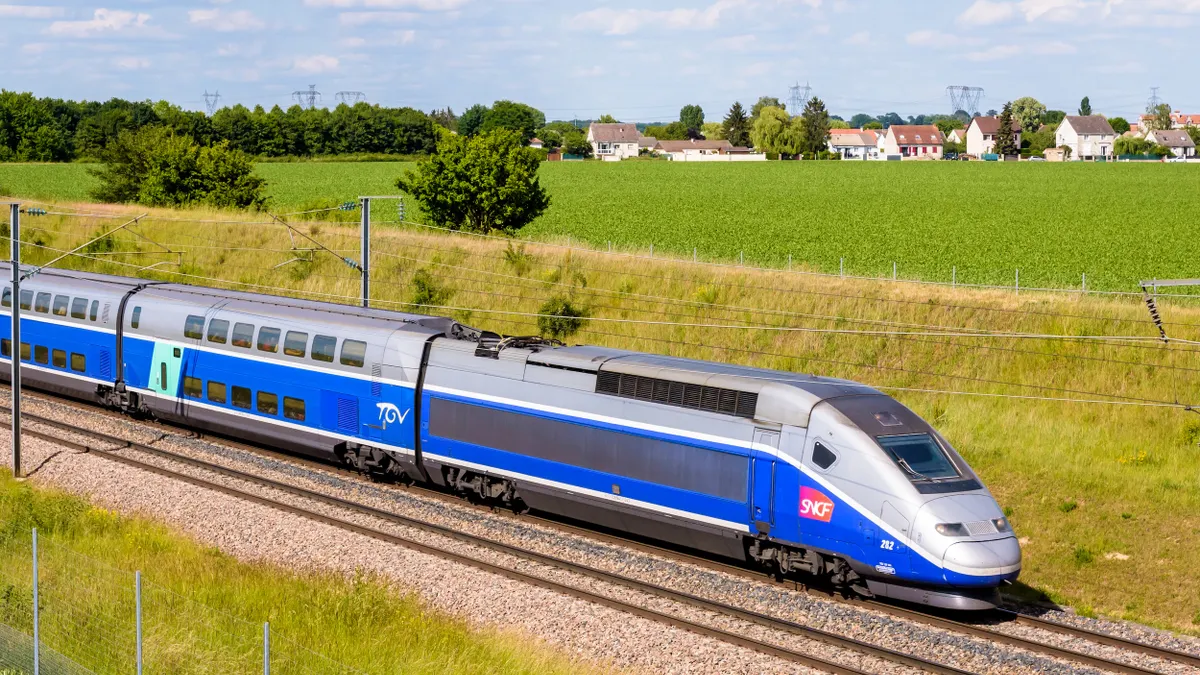
- The agency is basing its upgraded noise standards on European Union regulations, an established standard that is largely consistent with U.S. standards. Some passenger trains in Italy, Spain, France and Germany run at speeds up to 224 mph.
- The standardized rule would provide cost benefits to high-speed rail operators and project developers in the U.S. and is authorized by the 2021 Infrastructure Investment and Jobs Act.
Dive Insight:
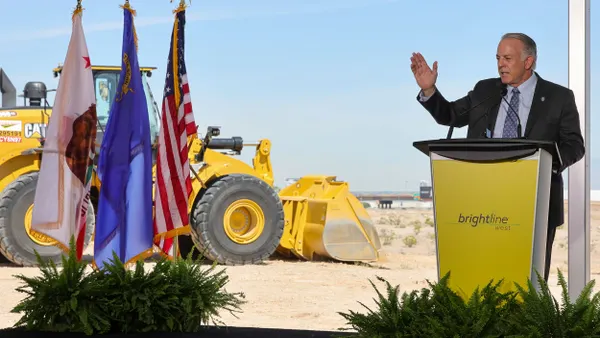
While Amtrak Acela trains in the Northeast Corridor can reach speeds up to 160 mph, two high-speed rail projects underway in California and Nevada plan to operate 220 mph trains. At current speeds, mechanical and propulsion noise — such as tracks and locomotives — combine with some aerodynamic noise to create the total noise experienced as a train passes. However, above 160 mph, aerodynamic or wind noise dominates, according to the FRA.
“One of the reasons we don’t have true high speed rail in the United States is because current rules disadvantage trains that generate most of their noise from sources other than their engines and rolling stock instead of approaching the issue holistically,” FRA Administrator David Fink said in a statement. “Updating this rule will remove a major obstacle railroads currently face when trying to operate high speed trains.”
The FRA estimates the new rule could save high-speed rail developers $100 million over the next 30 years.
The U.S. Department of Transportation, under the Trump administration, canceled $4 billion in grants to the California High-Speed Rail Authority and ended support for a proposed Dallas-Houston high-speed rail line. But the DOT isn’t closed to all HSR projects.
“This administration is cutting through the red tape that has stopped rail innovators from building in America before,” Transportation Secretary Sean Duffy said in a statement. “We’re making it attractive to businesses and investors to partner with USDOT and develop high speed rail here in the U.S.”
Comments on the proposed rule are due by Oct. 2, but those received after that date may be considered, the FRA said.