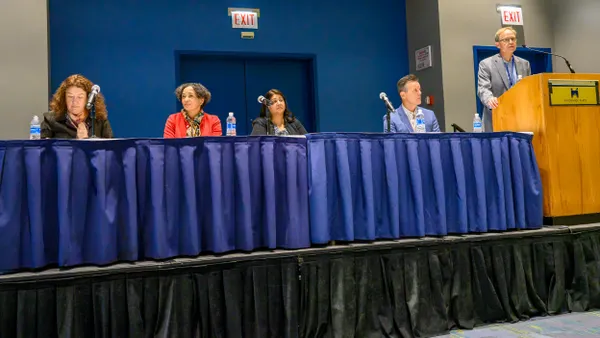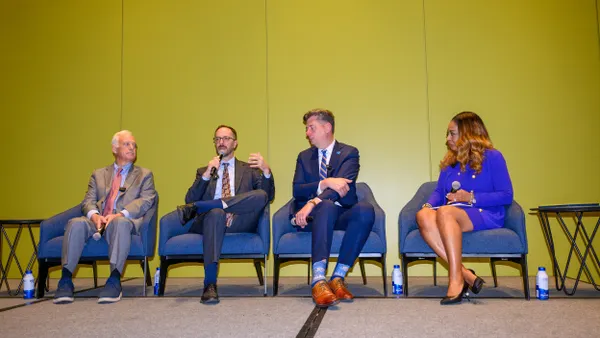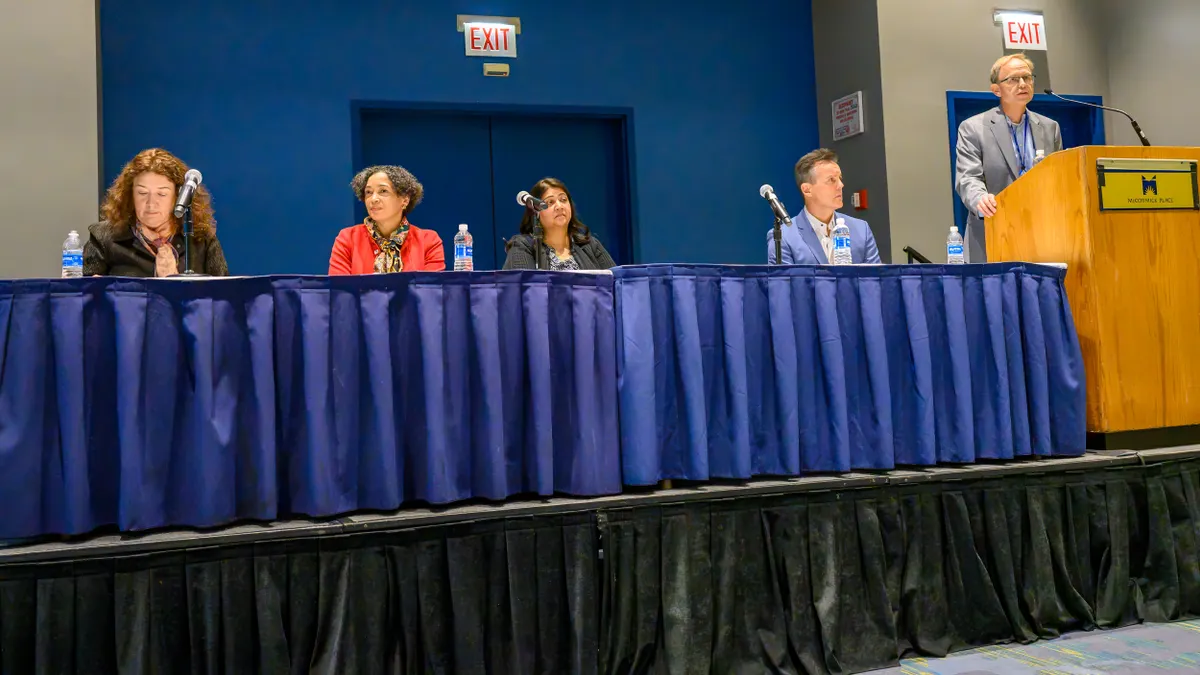
Three leaders of big-city transit systems explained how they addressed revenue shortfalls and put their systems on a stronger footing during an Oct. 5 panel session at the American Public Transportation Association TransForm conference in Chicago.
Saving Chicago from a fiscal cliff
“In 2023, we all saw the crisis coming,” said Thomas McKone, Chicago Transit Authority chief financial officer and treasurer. The region’s transit system, which also includes Metra commuter rail and Pace suburban bus services, anticipated a 2026 budget gap of over $770 million, growing to $1.2 billion in 2027 without additional funding.
“From where we were sitting, we were highlighting the value of transit and the essentiality of the services and the system that we provide,” McKone said. “It's clear that ridership was not going to return to those pre-pandemic levels, at least not in the short term.”
Without additional funding, the regional transit system faced substantial fare increases, drastic cuts in service or both, the Regional Transportation Authority of Northern Illinois warned in 2022. The RTA went to the state legislature for help. “A lot of the legislators looked not only to U.S. examples, but they looked to European examples for what transit service could use in the region,” McKone said.
The result was $1.5 billion in funding for public transportation agencies and support for transit-oriented development. The legislature also restructured the Chicago region’s transportation management under the Northern Illinois Transit Authority.
New York’s congestion pricing pays off
New York’s controversial congestion pricing program came from a 2019 state law designed to reduce traffic congestion in Manhattan and generate revenue for the New York Metropolitan Transportation Authority. The state has since fended off lawsuits and the Trump administration’s hostility toward the program.
“Before the program launched, there were fears that the businesses would shutter and that the sky would fall,” MTA Chief Financial Officer Jai Patel said on the panel. None of the dire predictions came true. “In the first year post-implementation, the region's economy remained strong.”
Patel added that transit ridership across the system increased while vehicle noise complaints, crashes, injuries and traffic deaths decreased.
“Congestion pricing has met its revenue expectations and cost less than what we had projected in operating expenses,” Patel said. The program “was proof that government can do things better and bigger.”
Seattle: Trains across the water
In March, the world’s first light rail floating bridge carried trains across Lake Washington, connecting downtown Seattle with Mercer Island, Bellevue and Redmond, Washington. With the Crosslake Connection, light rail now carries over 160,000 daily riders, said Victoria Baecher Wassmer, deputy CEO for finance and business administration at Sound Transit.
A 2008 voter-approved ballot measure authorized Sound Transit to build the line and add regional express bus and commuter rail services. Additional funding for the transit agency comes from a sales and use tax, excise taxes, car rental tax and property tax, Wassmer said. “The strong financial policies and management practices show that we're responsible stewards of taxpayer resources,” she said.
The FIFA World Cup matches in Seattle saw record ridership on the system, according to Wassmer. For the July 6 match, the system had 312,000 boardings, “which is really extraordinary,” she said.
The agency has ambitious expansion plans through 2052, Wassmer said. “We're going to be nearly doubling our track miles, and we're going to be making some changes in our commuter rail, and we're adding bus rapid transit.” The plan, funded by a 2016 ballot initiative, has had to adapt to rising inflation costs. While some projects are being deferred, all light rail projects are moving forward, according to a May 29 update.