Dive Brief:
-
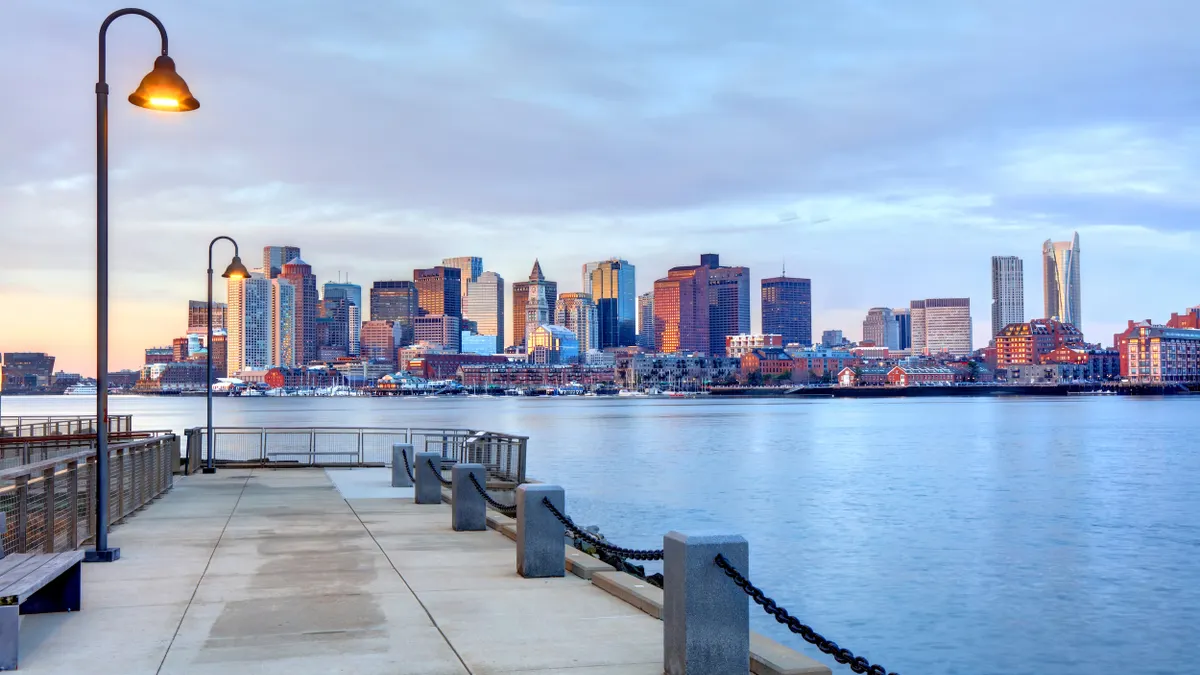
The city of Boston and the Mass Clean Energy Center announced Thursday $500,000 in funding for a year-long project exploring the feasibility of capturing thermal energy from Boston-area waterways to deliver large-scale heating and cooling.
-
The Boston Thermal Energy Network Project, known as BosTEN, is a closed system that would deliver thermal energy captured from the Charles and Mystic rivers, Boston Harbor, the Fort Point Channel and the bedrock beneath the rivers to nearby buildings through sealed infrastructure without drawing water from the waterways.
- “By exploring thermal energy, we’re opening an opportunity to keep our buildings comfortable year-round while maintaining stable electricity costs and paving the way for other cities across the Commonwealth to do the same,” Boston Mayor Michelle Wu said in a statement.
Dive Insight:
Growing demand for electricity to power data centers and transportation electrification, along with the Trump administration’s deprioritizing of renewable energy, make it imperative for cities to investigate thermal energy networks, Johanna Partin, founding principal of Transformative Strategies Consulting, told Smart Cities Dive last year.
Last month, Massachusetts Gov. Maura Healey signed an executive order to increase Massachusetts’ energy supply, directing state agencies to identify opportunities for geothermal energy, expedite licensing and permitting, and address hurdles to advancing thermal energy sources in the state.
“Thermal energy networks offer a smart, scalable way to meet growing demand while cutting pollution and easing pressure on our grid,” Healey said in a statement Thursday.
The Boston Green Ribbon Commission, made up of public agencies, universities, hospitals and commercial real estate representatives, will use the $500,000 grant to work with government entities, utilities and district energy providers to collect data and address underground infrastructure and regulatory barriers to implementing thermal energy at scale throughout the Boston region, according to a news release.
“Water-sourced thermal energy networks have proven around the world to provide affordable, reliable, and renewable energy for buildings and neighborhoods,” Brian Swett, Boston’s chief climate officer, said in a statement. “With our extensive Boston Harbor shoreline and major rivers, I’m excited to evaluate the potential for such thermal energy networks in Boston as we create an energy grid that supports a decarbonized, resilient, and affordable Boston.”
Cities across the nation are beginning to explore thermal energy networks.
In 2023, Eversource launched a networked geothermal pilot in Framingham, Massachusetts, using heat from the earth to warm buildings in winter and pump heat from them back into the ground in summer. The pilot includes 36 buildings, 24 of them homes.
“This is what fighting climate change on a local level looks like,” Nikki Bruno, vice president of clean technologies for Eversource, said during the project’s groundbreaking.
Center Point Energy launched a networked geothermal pilot in Minnesota and began gauging local governments’ interest in collaborating in 2024.
New York Gov. Kathy Hochul signed the Utility Thermal Energy Network and Jobs Act in 2022, requiring investor-owned utilities to pilot thermal energy networks, but no projects have been approved. A pilot in Syracuse, New York, that recovers existing heat from the Onondaga County Metropolitan Syracuse wastewater treatment plant is among the projects under review.
“Thermal energy networks represent a critical next step in New York’s transition toward an equitable, affordable, low-carbon energy future,” the Building Decarbonization Coalition, the Alliance for a Green Economy and the Alliance for Clean Energy New York stated in a March 9 letter to New York State Public Service Commission Secretary Michelle Phillips. “By shifting energy-intensive heating and cooling loads from the constrained electric system to efficient thermal infrastructure, TENs can defer costly grid reinforcements and enhance reliability in high-demand areas.”