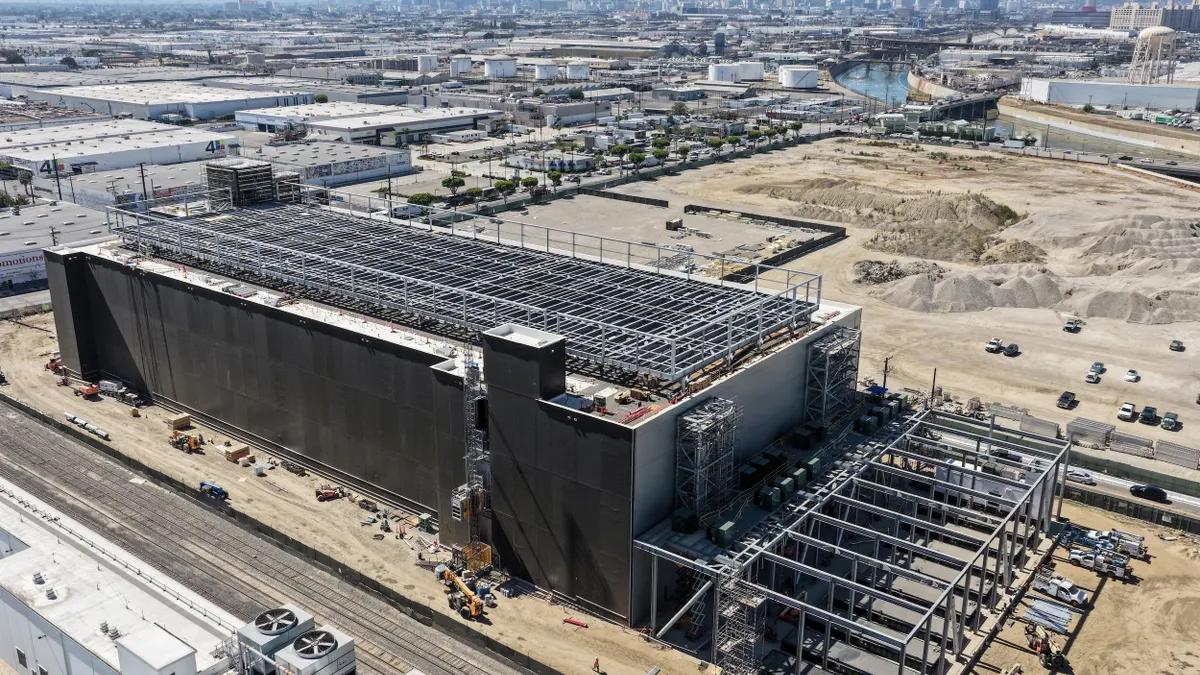
When Intel announced it was investing $28 billion to build two chip factories in Licking County, Ohio, two hours north of his city, Cincinnati Mayor Aftab Pureval took note. The mega-complex would surely be an economic boon for his state, but Pureval was most impressed by why the tech giant chose to build in the Ohio River Valley.
“Two of the big reasons they chose that location were, number one, its access to fresh water, and number two, our climate resiliency — the fact that we’re impacted by climate change, but we’re not seeing the droughts, the wildfires and the hurricanes that a lot of other places are seeing,” Pureval told Smart Cities Dive. “Once a large investment like that was made with those considerations in mind, it became real for me to say that if private companies are making such a potentially risky bet on our region, that could be a harbinger for things to come.”
Oliver Kroner, the director of Cincinnati’s Office of Environment and Sustainability, had been thinking about the city’s climate appeal since 2018, when he saw a map of the Hurricane Katrina diaspora showing that thousands of people had relocated from New Orleans to Cincinnati after the catastrophic storm.
“It’s really hard to say the singular reason anyone moves or relocates,” he said. “But there are more and more and more people who I meet every day who came here either because they were forced away from their previous home due to a climate-related event or they considered climate resilience when they relocated.”
With Pureval’s support and backing, the Cincinnati OES last month released the city’s Climate Migration Readiness Plan, which Kroner believes is the nation’s first municipal guide to preparing for climate refugees. Citing data showing that climate migration and broader domestic relocation trends could result in more than half a million new residents in the Cincinnati region by 2050, the plan outlines guiding principles to ensure neighborhoods remain stable, residents aren’t displaced, housing supply and infrastructure investments align, and the city remains welcoming and friendly.
“An opportunity if we prepare for it”
The climate migration plan points to several reasons why new residents are choosing Cincinnati. “Our abundant fresh water, lower disaster risk, and established resilience may make Cincinnati a safer place compared to those experiencing the most severe impacts of climate change,” it says. The city, which has about 315,000 residents, is less expensive to live in than many others but has a robust economy. It is home to 52 distinct neighborhoods, high-quality schools, 5,000 acres of green space, a secure water source in the Ohio River and a growing population, the report states.
Migration flows have been increasing Cincinnati’s population since 2010, reversing a decades-long trend of people moving out of Midwestern cities to the suburbs and the Sun Belt, according to the report. Even as federal immigration policy has slowed the influx of newcomers from other countries over the past two years, Cincinnati has continued to grow because of “the domestic flow of people north,” the report says.
The climate migration report is one way the city is making sure it’s prepared for that influx, Kroner said. “We can help make sure this is something we can steer rather than disrupting life for the people who live here already,” he said. “This is an opportunity if we prepare for it but a risk if we don’t.”
With a 74.7% gap in poverty rates between its wealthiest and poorest neighborhoods, Cincinnati’s lower-income residents “face a higher risk of displacement and being underserved if climate migrants arrive,” the report states.
“The benefits of growth can’t just be for a handful of people,” Pureval said. “The investments and the policy decisions we’re making now are certainly to drive population growth, but we also want to drive home-ownership growth, housing unit growth, expanded public transit, more jobs, increased wages.”
Housing, transit and infrastructure
Cincinnati — like most U.S. cities — is already dealing with an affordable housing shortage and “doing everything we can to accelerate housing development,” Kroner said. The climate migration plan builds on zoning updates and targeted housing recommendations for neighborhoods that are already under way to ensure housing availability and protect affordability because “the right housing built too late, or in the wrong place, still produces price shocks,” the report states. To that end, it recommends prioritizing high-density housing, building along transit corridors and implementing inclusionary zoning to secure affordable housing.
“By changing our system of how we create housing, we’ll be able to create housing on an ongoing basis to catch up to not just what we need right now, but to accommodate for future growth,” Pureval said.
Cincinnati is already working toward the plan’s goal of improved public transportation by rolling out its first bus rapid transit, Pureval said. It is addressing energy affordability by building solar arrays and will continue to expand that investment, he said, because “it’ll be even more important to stay on top of renewable energy.”
Resilient infrastructure will be crucial as the population grows, Pureval said. In 2023, the city sold an interstate railroad it owned for $1.6 billion and put that money into a trust fund that will allow it to build infrastructure without raising taxes, he said. With funding from the 2021 bipartisan infrastructure bill, the city is working with Ohio and Kentucky to build the Brent Spence Companion Bridge, which will include pedestrian and bike paths connecting communities to transit and employment centers. It is also shoring up the main artery connecting downtown to the city’s west side, he said.
The city, he said, “is using technology and innovation to make sure that our built environment can withstand the extreme changes of weather that we’re seeing.”
Green infrastructure will also be key, Kroner said. “We have state-of-the-science water treatment and water supply, but we have work to do with our sewer system and stormwater management,” he said. Cincinnati is under an Environmental Protection Agency consent decree to eliminate sewer overflows and backups, and increasingly intense storm events place additional burdens on the system, he said.
“Extreme pressure on social service providers”
Then there’s the social infrastructure — ensuring that all residents have equitable access to services, civic life and economic opportunities. Capacity at schools, emergency rooms and primary care facilities must be closely monitored as newcomers arrive, the report states.
“Sure, we want to be welcoming,” Pureval said, “but if we have so many folks coming in all at once, that will put extreme pressure on our social service providers. So, we really have to be intentional about that growth, which is why we’re taking this so seriously now.”
Cincinnati may be the first city to codify its planning with a report, Kroner said, but it’s not alone in thinking about the impacts of climate migration. “Many cities are increasingly aware and acknowledging that this is something that will likely shape their future,” he said. “I think most of the thought has gone to the more at-risk locations and how they will adapt, but there’s a different side of that story that we have to think about.”
Climate migration will become a huge factor in shaping the economy and politics, Kroner added. “This is a fascinating period.”