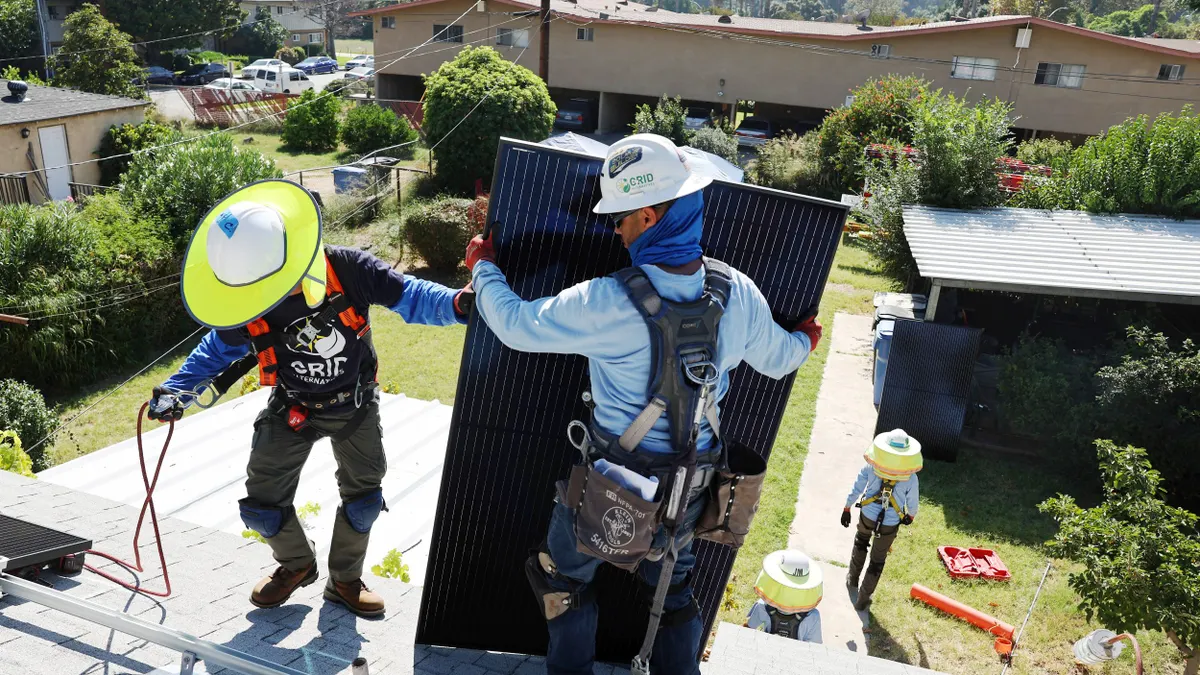
A long-dormant brownfield site in Cincinnati is being transformed into one of the largest renewable energy investments in the city’s history. The $24 million Center Hill Solar Array project, which broke ground last month, is expected to generate enough clean electricity to power about 1,700 homes each year while reducing greenhouse gas emissions by roughly 16,000 metric tons annually, according to a press release.
“This was a way for us to take a major climate step forward,” Oliver Kroner, director of Cincinnati's Office of Environment and Sustainability, told Smart Cities Dive. “We were able to turn this liability of a site into a community asset.”
Cincinnati and Austin, Texas-based UPower Energy are jointly developing 10 megawatts of solar energy on the city-owned Center Hill Landfill site through a partnership in which the city will own 4.9 megawatts of generation and UPower will own 4.9 megawatts that it contracts to the city, Kroner said. Together, the arrays will generate approximately 18.2 million kilowatt-hours of clean energy annually, according to the city.
The electricity produced by the solar arrays will serve city facilities through the grid, “helping stabilize municipal energy costs and protect taxpayers from future rate volatility," the press release states.
The site is expected to be operational by early 2027.
Hybrid financing structure
The city launched the project as a result of the 2022 Inflation Reduction Act, which created tax incentives for clean energy developments on brownfields, Kroner said. The Center Hill Landfill “closed a long time ago, and we’ve really struggled to find real use for the land, which is in our urban core,” Kroner said.
Cincinnati chose UPower to help develop the 64-acre site because of the company’s low-impact mounting system, Kroner said. Unlike traditional solar array poles that need to bore deep into the ground, UPower’s house-shaped system doesn’t need to penetrate the landfill cap and can endure the landfill’s shifting, he explained.
The city received a Solar for All grant to finance the project. When the Trump administration abruptly ended that program in July, Cincinnati and UPower worked together to develop the financial partnership, Kroner said.
Aware that owning energy generation outright would offer the greatest long-term cost advantages and project control — but that city funds alone couldn’t cover the whole scope — the city and UPower landed on the two-part structure. The city took ownership of the portion it could afford, and private capital, secured through a power purchase agreement, financed the rest, Kroner said. A federal Investment Tax Credit should cover about half the project’s costs, according to the press release.
As the city and UPower developed the model, “it became very clear that it was a major economic step forward in developing the site in a way that saves a lot of money — millions of dollars over its lifetime,” Kroner said.
Cost savings and climate benefit
The city’s investment in municipal solar, which includes a 100-megawatt farm in Highland County, “is part of what will protect us from the extreme uncertainty we are seeing, around the nation and world, when it comes to rising energy costs,” Cincinnati Mayor Aftab Pureval said in the press release. “It is part of what puts us on the map and what makes me so confident about our future as a city.”
Kroner said the Center Hill Solar Array is key to the city’s Green Cincinnati Plan. “I don’t see any real pathway to our carbon neutrality goals without big investments in clean energy like this,” he said. “And here we found a way to do it in a method that produces cost savings in addition to climate benefit.”
As residents are pinched by rapidly escalating energy bills, “we’re trying to take ownership of our energy future in a way that saves ratepayers day in and day out,” he added.
The redevelopment also improves a blighted property where illegal dumping had been common, Kroner said. “This is an environmental justice site,” he said. “It brings new economic activity and new value to what has been a desolate zone.”
Areas surrounding the solar arrays will be reseeded with pollinator-friendly plants, “so you get all those benefits, too,” Kroner said.
The Center Hill model is “replicable and scalable in a very real way,” he added. “We’re not the first to do it. There are certainly other landfills that have figured this out, but I think that the approach is gaining momentum.”