Dive Brief:
- The Federal Emergency Management Agency Review Council’s long-awaited final report, released Thursday, recommends a fundamental reorientation of disaster response, giving states and local governments primary responsibility for managing disasters while streamlining recovery and mitigation grant and assistance programs.
-
“How do we respond to a disaster at the federal level? First, we recognize that it’s locally executed,” Review Council member Michael Whatley, former chair of the Republican National Committee, said during a Thursday meeting to release the report. “Locally executed, state-managed and federally supported — that was our North Star.”
-
The council recommends rolling out 10 guiding principles and key recommendations over two to three years so states and local governments can build fiscal and operational capacity before they take on the new responsibilities.
Dive Insight:
President Donald Trump established the FEMA Review Council in January 2025 to advise him on FEMA’s ability to address disasters and recommend changes to how the agency operates. Two months later, he signed an executive order shifting more responsibility for disaster preparedness to state and local governments.
A December meeting to discuss the council’s final recommendations was abruptly canceled amid news reports that then-Department of Homeland Security Secretary Kristi Noem’s office had severely edited the report.
The council solicited input from state and local governments, nonprofits and faith-based organizations, the research community and residents affected by disasters and held “listening sessions” in 13 cities, according to the report. Review Council member Mark Cooper, chief of staff for former Louisiana Gov. John Bel Edwards, said it was “one of the most extensive public engagement efforts to assess and strengthen FEMA and DHS in its history.”
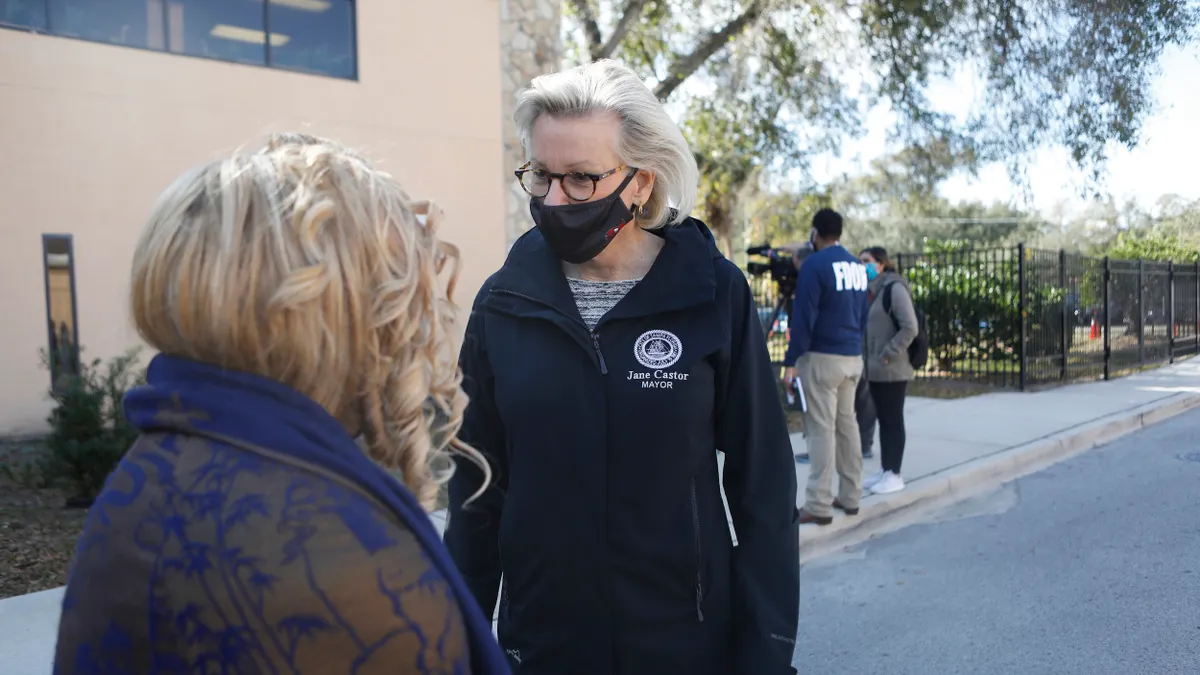
Tampa, Florida, Mayor Jane Castor, also a Review Council member, said the report’s recommendations “are going to dramatically impact cities and counties in a positive way.” Effective federal disaster response programs will be preserved while bureaucratic assistance processes are simplified into a single application with one direct payment covering housing, transportation and other immediate needs, she said. Federal disaster response will be fortified through workforce training, equipment funding and national emergency management standards, she added.
The recommendations affect states and local governments in the following ways.
Realign federal disaster declaration thresholds
- Reserve federal assistance for “truly significant events” that exceed state and local capacity
- Set minimum annual expenditure requirements before states can request a federal declaration
- Reset Per Capita Indicator threshold to use Consumer Price Index and a methodology that evaluates all circumstances
Build local government capacity
- Increase investment in workforce training and professional credentialing for emergency management and equipment upgrades
- Expand urban search and rescue teams (already locally owned and operated)
- Potential one-time increase in Emergency Management Performance Grant to help states absorb new responsibilities
Let states manage hazard mitigation
- Replace Hazard Mitigation Grant Program with state-managed funding structure
- Give local governments responsibility for conducting environmental reviews, eliminating federal duplication of efforts
Transfer emergency shelter responsibilities to states and local governments
- Focus single direct-payment FEMA program on survivors with uninhabitable homes after a disaster
- Streamline applications and direct payments for housing, transportation and immediate needs
Provide direct funding for public assistance
- Use predefined event criteria (parametric approach) for funding
- Provide funding to states and local governments within 30 days of a federal disaster declaration based on the population impacted and severity of event
- Reduce audit duplication, eliminating federal, state and local redundancies
Transfer federal flood policies to the private market
- Incentivize replacement of National Flood Insurance Program with private-sector flood insurance marketplace
- Place state insurance commissioners in charge of overseeing transition
Reduce administrative costs
- Require localities to submit a standardized audit from their public auditor or a licensed accounting firm
- Use state-to-state staffing agreements instead of private contractors
Promote a “whole community” approach
- Integrate private sector, faith-based and nonprofit organization resources before disasters occur
- Improve interoperable communications
- Implement joint planning, exercises and reviews between federal, state and local agencies
Public comments on the report are open until June 8, according to a FEMA post on Facebook.