Eric Becker is an associate principal at OZ Architecture and a former volunteer firefighter with the Timberline Fire Protection District in Boulder County, Colorado. OZ Architecture has partnered with fire districts and public safety agencies across Colorado and the Mountain West for more than 30 years.
Many fire stations in service today were built for a job that no longer exists.
According to the National Fire Protection Association (NFPA), more than two out of every five fire stations were more than 40 years old in 2020. But age alone isn’t the issue; well-designed civic buildings should serve their communities for 50 years or more. The challenge is that many stations were planned around an outdated model of firefighter service.
Roughly two-thirds of fire department calls are now medical in nature. Today’s facilities must accommodate a faster tempo, medical response and expanded responsibilities that include prevention, training and community engagement. At the same time, growing awareness of firefighter health risks, from cancer exposure to behavioral health challenges, is reshaping how stations are designed, organized and operated.
For local officials responsible for planning and funding public safety infrastructure, a fire station’s design is not simply a construction decision. It is an operational decision that will shape emergency response, firefighter health and training capacity for the next half century.
Design for the way firefighters work today
Some fire districts are rethinking how their stations support prevention, mitigation, preparedness and community health. South Metro Fire Rescue, with 30 stations throughout the south Denver metro area, is updating its stations with a more consistent focus on first responder health and well-being, response efficiency and long-term durability.
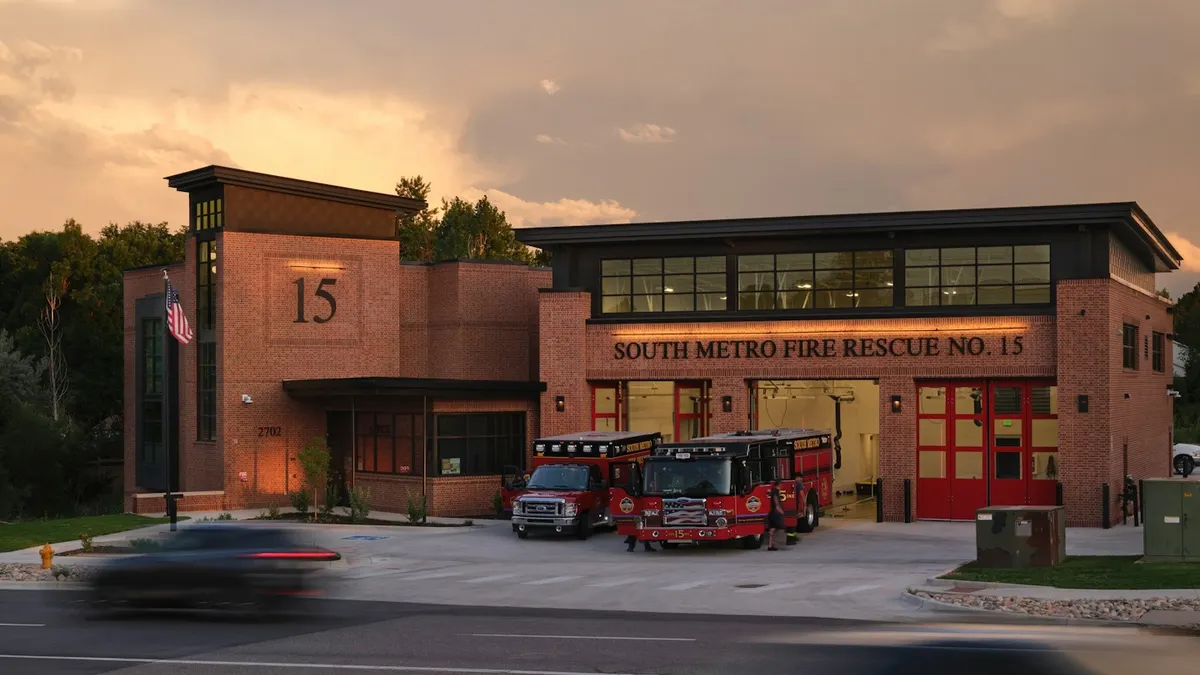
The district’s recently completed Station No. 15 in Centennial, Colorado, represents what's possible when civic leadership treats a fire station as a long-term commitment to the people who staff it and the community they protect.
SMFR responds to everything from emergencies in dense residential neighborhoods to high-altitude mutual aid calls

that can take crews from city streets to 13,000 feet in a single shift. In this environment, seconds matter. Station No. 15 is organized around movement, supporting three shifts of six firefighters and three apparatus bays, all designed to shorten the distance and friction between rest, readiness and response. Sleeping quarters, work areas and shared spaces all prioritize access to the bays, allowing crews to move through the building quickly.
The station is also designed to safeguard its occupants’ health, actively reducing contamination and supporting rest between calls.
Research from the CDC/NIOSH shows firefighters are 9% more likely to receive a cancer diagnosis and 14% more likely to die from cancer than the general population. Roughly 20% meet the diagnostic criteria for PTSD at some point in their careers. Station No. 15 is designed to guide firefighters through a clear three-step decontamination sequence: they remove and deposit their gear directly into a laundry intake adjacent to the bays, then shower and transition into clean locker and dressing areas. A communicating lock system maintains privacy and one-way flow.
The station also incorporates training space into the building to strengthen readiness while making better use of long-term operational resources. Building in training capability converts the ongoing expense of off-site training into a one-time capital investment.
At Station No. 15, a training mezzanine directly above the apparatus bays allows crews to practice search and rescue drills, ladder deployment and emergency egress without leaving the station.
3 principles local leaders must consider
Station No. 15 aligns with a district-wide commitment to building facilities focused on readiness, health, durability and adaptability. Any community can apply the same framework. Here are a few principles worth carrying into the next budget conversation:
Reframe station age as a balance-sheet problem. The costs of an outdated facility show up in crew health outcomes and operational costs long before they show up in the facilities budget.
Build health and decontamination standards into the program from day one. The science on firefighter occupational exposure has advanced considerably, and the facilities being approved today should reflect that progress.
Think in systems. Districts that establish a shared framework for their modern facilities get more consistent stations built, faster and at lower long-term cost. One well-designed station is a good investment. A district-wide standard is a multiplier.