Aging infrastructure and climate disruptions are keeping water professionals up at night as external stressors increasingly affect the water supply, the American Water Works Association’s 2026 State of the Water Industry report found.
The more than 2,100 water professionals who took part in the annual AWWA survey rank the water industry’s current health at an average of 4.72 on a scale of 1 to 7, which is largely consistent with the survey’s 23-year history. But their prediction about the industry’s health in five years is 4.53 — the lowest it’s been in eight years.
“External pressures — from global supply chains to extreme weather — are now part of the everyday operating environment for utilities,” Brent Tippey, AWWA president-elect for 2026-27, states in the report. “We need strategic foresight, supportive policy, and innovations that help utilities maintain reliability even when conditions shift overnight.”
The sector’s ability to confront gaps in climate resilience, digital modernization and sustainability frameworks will be essential in coming years, according to the report.
Half of respondents say they’re very or fully prepared for long-term water supply needs — a 5 percentage point drop from the previous year — while 16% say they’re not at all prepared for long-term demands. Eleven percent of respondents report their water supply experiences frequent or chronic stress, and one-third indicate that “an increase in withdrawal or a decrease in supply could result in difficulties providing drinking water,” the report states.
“Planning for long-term water security has never been more challenging. Uncertainty is increasing from things like accelerating climate variability and the rapid expansion of tech-based industries,” T.J. Stroebl, market development leader at Kurita America and AWWA president-elect for 2027-28, states in the report. “The future is a moving target and hitting it will require more resilient strategies that allow for pivoting on shorter time scales.”
The report lists these seven top areas of concern for water professionals:
1. Aging infrastructure
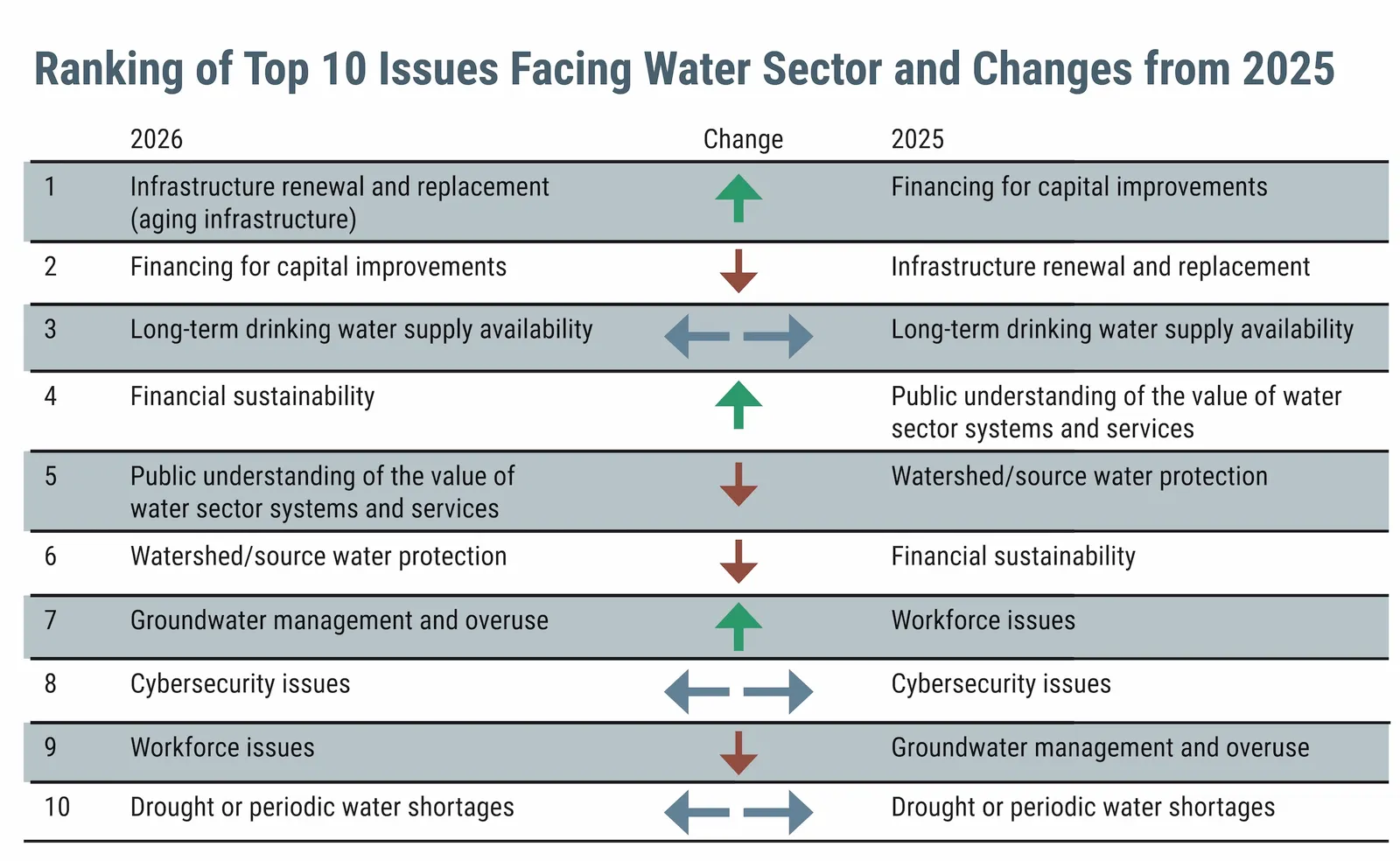
Infrastructure renewal is water professionals’ top concern in this year’s survey, “reflecting the perennial challenges of maintaining operations and adopting new treatment technologies with infrastructure that was built up to a century ago,” according to the report.
Infrastructure renewal and replacement and financing for capital improvements have dominated the list of top concerns facing the water sector in the last decade. Financing ranked highest last year, but infrastructure renewal returns to the top spot in this year’s report.
Emergency repairs and system failures often or always lead to overtime requests, more than half of the survey respondents say. This stretches budgets as well as the workforce, affecting morale and long-term retention, the report states.
Just under half of water utilities are currently funding asset renewal and rehabilitation, the survey found. “Given that much of America’s water infrastructure is aging, this relatively low number is concerning and suggests deferred maintenance may be building up,” the report states.
Drinking water utilities need $2.1 trillion to $2.4 trillion for infrastructure upgrades through 2050, requiring an additional $56.6 billion be invested every year to prevent water rates from more than doubling, according to AWWA. “The survey makes clear that annual, long-term investment isn’t optional anymore,” AWWA CEO David LaFrance states in the report.
2. Natural hazards
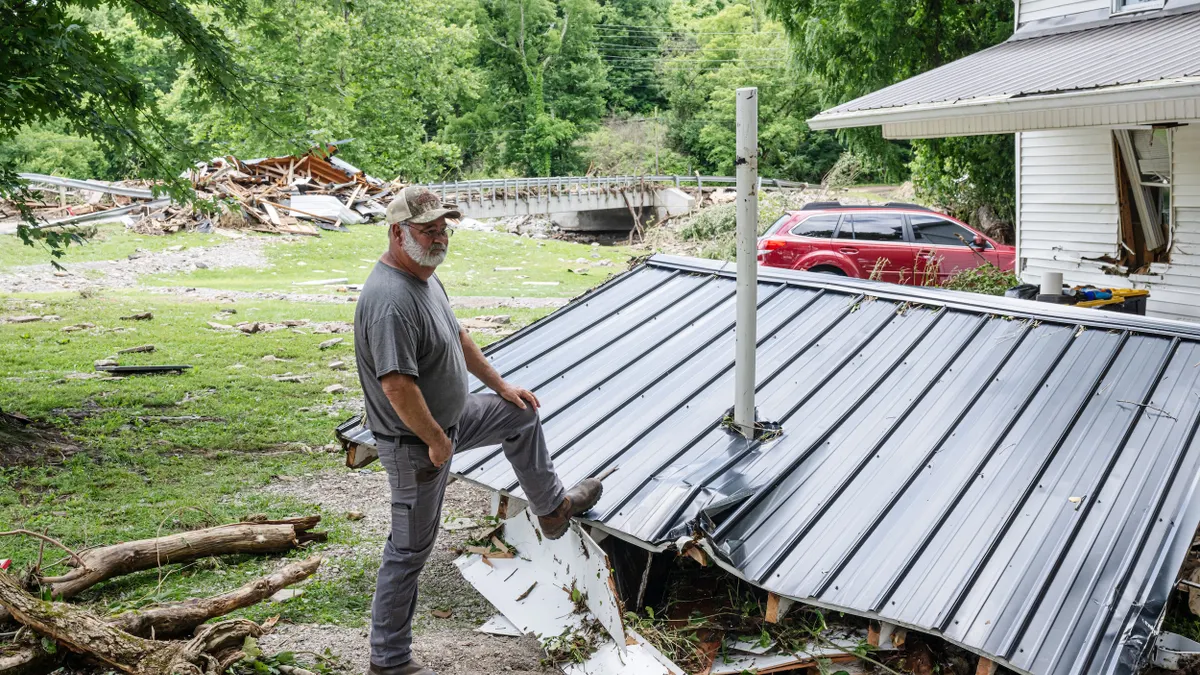
Droughts, wildfires and extreme weather events are among the natural hazards that have the most negative impact on the sector.
“The deep uncertainty surrounding climate variability, with the possibility of more frequent and more severe hazards and events in the future, requires consideration of adaptive measures that are resilient to a range of possible climatic conditions,” the report states.
3. Cyberthreats
Nearly three-quarters of survey respondents say ensuring cybersecurity and privacy is a top priority. Water professionals “want robust safeguards before generative AI is widely adopted,” the report states.
Nearly half of water utilities don’t have established priorities governing AI use, leaving them vulnerable to cyberattacks, according to the report. Nearly a quarter of small systems say they have little to no ability to implement cybersecurity practices.
“Utilities clearly recognize the importance of investing in technology and cybersecurity, but many still face real challenges in execution,” Nicholas Santillo Jr., former chair of the Water Sector Coordinating Council, states in the report.
4. Tariffs and supply chain disruption
Tariffs implemented in 2025 have increased the cost of equipment, materials and critical infrastructure and contributed to project delays and construction challenges, the survey found. Supply chain disruptions are also having considerable impact on costs, and utilities are attempting to manage supplier relationships to secure more predictable costs.]
5. Regulatory inconsistencies
While protecting drinking water supplies from contaminants is a top priority, water executives say they’re frustrated by increasingly stringent PFAS regulations that could outpace their operational capabilities and available technologies.
Removal of PFAS, microplastics and pharmaceuticals from drinking water dominates water executives’ treatment concerns, but advanced treatment systems require significant investments, the report states. Water executives also expressed frustration that federal PFAS cleanup efforts often focus on treatment but don’t address source water protection.
6. Public perception
Addressing customer service expectations is a top priority for water professionals as customers increasingly expect access to mobile apps, online portals and instant notifications.
At the same time, water professionals are concerned about the public’s understanding of water systems’ value in an era of misinformation and viral social media, the survey found.
AWWA consumer research shows that education and outreach programs are increasingly important for strengthening public trust. Two-thirds of water utilities have a fully implemented customer communications plan, it says.
7. The aging workforce and employee retention
The water sector’s aging workforce still ranks as a top concern, but it has fallen from the third spot in 2023 to ninth in this year’s survey. “Institutional knowledge is being lost as experienced operators retire without adequate succession planning,” the report states.
Water professionals cite recruitment and retention difficulties, high turnover rates and insufficient pay scales to attract qualified candidates as factors contributing to workforce concerns. They call for standardized training programs, more vocational education and internship opportunities.
Correction: This article has been updated to correct the terms of the AWWA elected leaders. Brett Tippey is president-elect and will serve in 2026-27; T.J. Stroebl will serve as the association's president in the 2027-28 term.