Dive Brief:
-
New York City broke ground last week on a $35.7 million stormwater management and recirculation project designed to mitigate flooding in Harlem and East Harlem while reducing Central Park’s reliance on the city’s drinking water to replenish its water bodies.
-
The new system will reduce stormwater flows to local sewers by 90%, or approximately 132 million gallons annually, and conserve about 175 million gallons of potable water each year, a Central Park Conservancy spokesperson told Smart Cities Dive in an email.
-
The city, state and private donors funded the project. New York City is providing $19.6 million, the New York State Environmental Facilities Corporation gave a $10 million Green Resiliency Grant, Central Park Conservancy donors pledged $3.5 million and the New York City Council allocated $2 million. Two local officials contributed a total of $600,000.
Dive Insight:
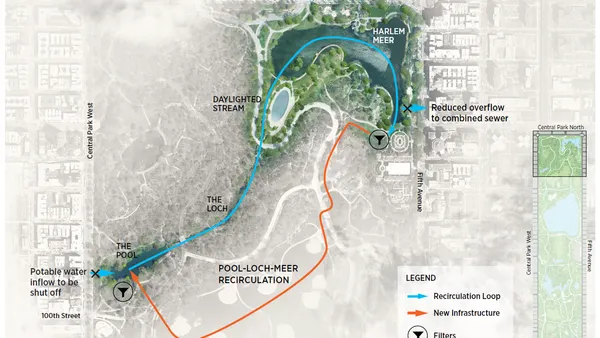
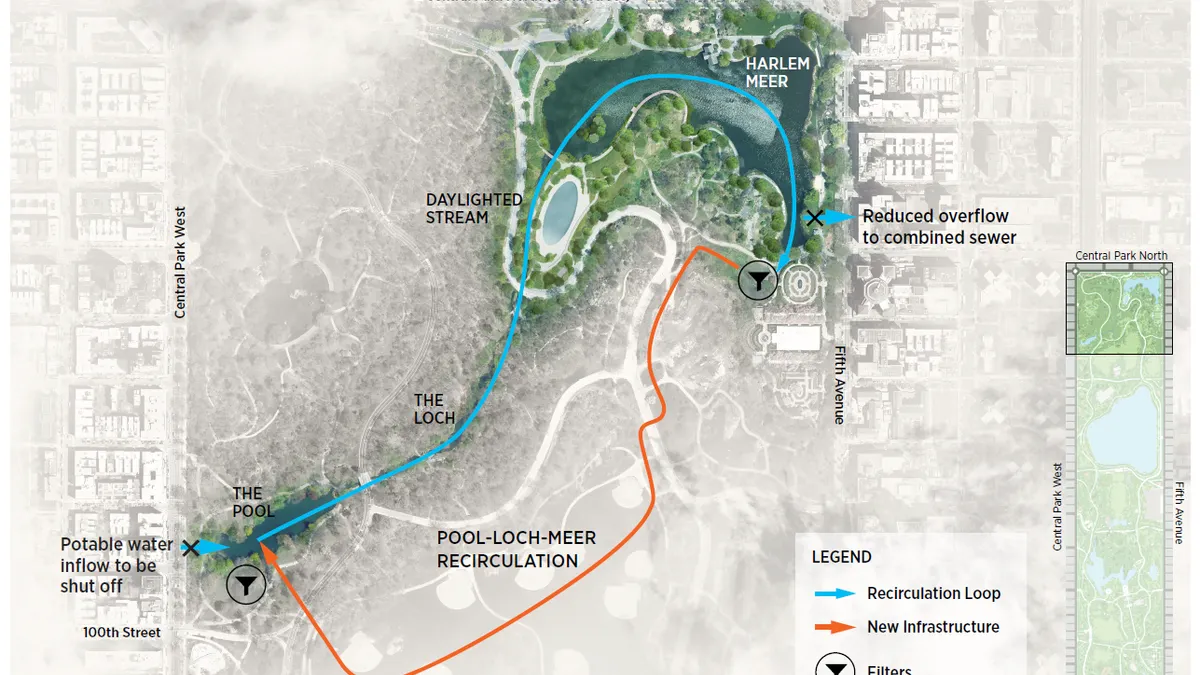
The North End Recirculation Project will filter and recirculate water between the Harlem Meer and a stream and pool in Central Park during dry weather, reducing the park’s reliance on the city’s drinking water supply and preventing algal blooms in the three water bodies.
The system will use weather forecast and watershed data to automatically lower the meer’s water level so it can capture incoming rainfall, preventing overflow to sewer systems in the adjacent Harlem and East Harlem neighborhoods, the conservancy spokesperson said.
“The North End Recirculation System is our most ambitious infrastructure project to date,” Central Park Conservancy President and CEO Betsy Smith said in a statement.
The project is expected to be completed in fall 2028.
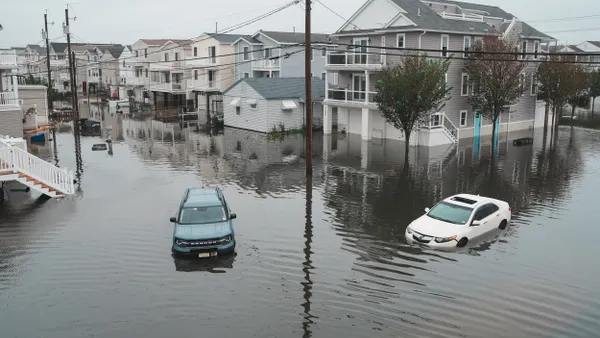
Extreme rainfall has increased by about 60% since the 1950s in New York City and throughout the Northeast, according to the Fifth National Climate Assessment. Average annual rainfall in New York City is projected to increase by up to 14% by the 2050s and 22% by the 2080s, and the number of extreme rainfall events is expected to increase, according to a New York City Panel on Climate Change assessment.
“The amount of rainfall the city is facing has only increased year after year, and that is something that's intensifying with the climate crisis, and we know that our sewage system is built at best to be able to accommodate about 1.75 inches of rainfall per hour,” New York City Mayor Zohran Mamdani said during a press conference announcing the project.
The city is working to mitigate stormwater flooding in neighborhoods throughout the five boroughs, using strategies like cloudburst management, Bluebelt systems and permeable pavement — “basically, any kind of an approach that can absorb excess rainfall and allow the city a moment to breathe,” Mamdani said. “For too long, there's been a sense of, ‘it floods; that's what happens,’ and we don't want to accept that any longer.”
New York City is building Brooklyn’s first Bluebelt system in Prospect Park, upgrading a freshwater lake’s drainage infrastructure and building new ponds and rain gardens to collect rainwater. In Queens, the city is turning three concrete roadway medians into green infrastructure “sponges” designed to absorb stormwater and prevent extreme weather flooding.