Dive Brief:
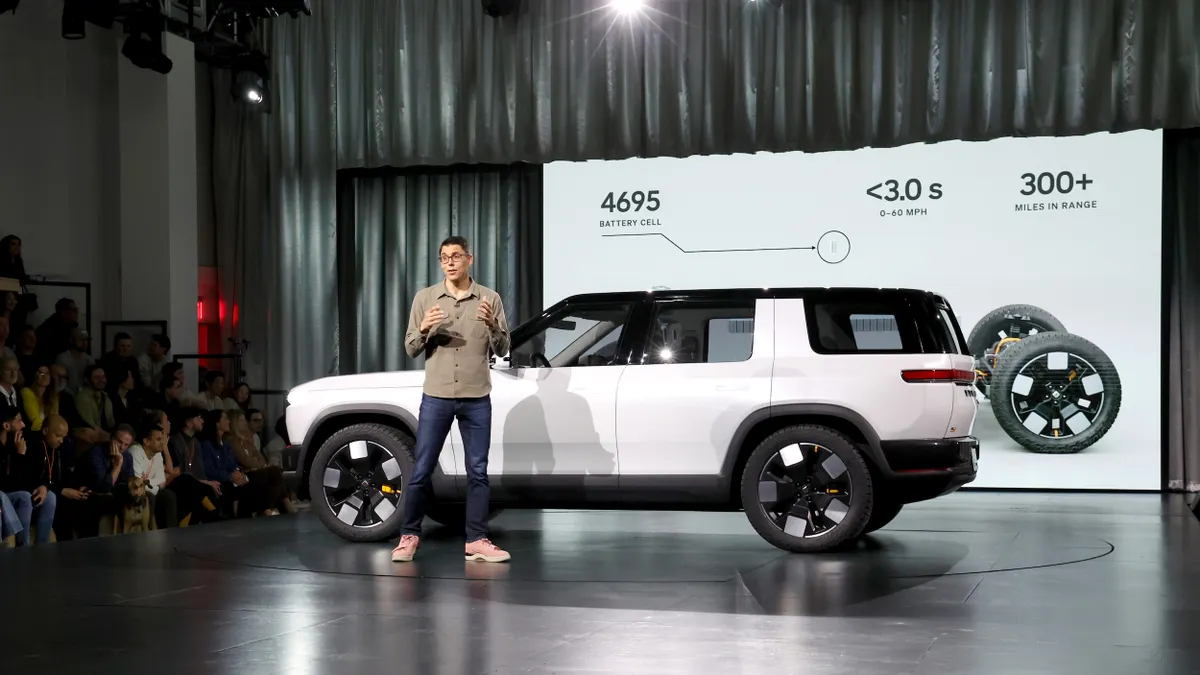
- Uber entered an agreement with electric vehicle maker Rivian to deploy 10,000 fully autonomous vehicles for itself and its fleet partners, with an option to purchase up to 50,000 robotaxis by 2030, Rivian announced yesterday.
- The Rivian vehicles will roll out first in San Francisco and Miami in 2028, expanding to 25 cities in the U.S., Canada and Europe by the end of 2031, according to a news release.
- Uber’s partnership with Rivian follows a January agreement with EV automaker Lucid Group for up to 20,000 robotaxis. Uber expects to have autonomous vehicles in 15 cities by the end of this year, CEO Dara Khosrowshahi said during the company’s Feb. 4 earnings call.
Dive Insight:
Uber intends to carry the largest share of autonomous ride-hailing trips globally by 2029, according to a company presentation in February. The company also partners with Waymo, May Mobility and Hyundai subsidiary Motional.
“The Uber-Rivian deal is a smart, disciplined bet,” Zach Greenberger, CEO of Nexar and former chief business officer at Lyft, said in a statement. However, Waymo, which started in Phoenix in 2017 and now operates in 10 U.S. cities, has a strong lead in the robotaxi industry.
“With regard to Waymo, their lead is real, and nobody should pretend otherwise,” Greenberger said. “The broader signal from this deal is actually about Uber: by positioning itself as the distribution layer for robotaxis, agnostic to which autonomy stack wins, they've turned an existential threat to their business model into a potential profit center.”
Uber closed a $300 million investment in Lucid in September and has committed to an initial $300 million investment in Rivian following signing, subject to regulatory approval, according to the news release. Uber will invest up to $1.25 billion in Rivian by 2031, contingent on meeting undisclosed autonomous milestones by specific dates. “Uber is paying for proof of concept in stages, not writing a blank check,” Zacks Investment Research Stock Strategist Ethan Feller said in a statement.
Feller noted that Uber has more than 25 AV partnerships, “cementing itself as a piece of modern technological infrastructure. Whichever autonomous vehicle technology matures first, passengers will likely hail it through Uber.”
Uber offers autonomous rides in Atlanta and Austin, Texas, through Waymo; in Arlington, Texas, via May Mobility and in Las Vegas with Motional. Khosrowshahi said that robotaxis are a “growth driver” in the cities where they operate.