In April, the U.S. Environmental Protection Agency launched a water reuse action plan aimed at normalizing and accelerating water recycling. But fragmented regulation, limited capital budgets for infrastructure and the “yuck factor” around water reuse can make it a tough sell to both local water agencies and the residents they serve, according to industry specialists and local officials.
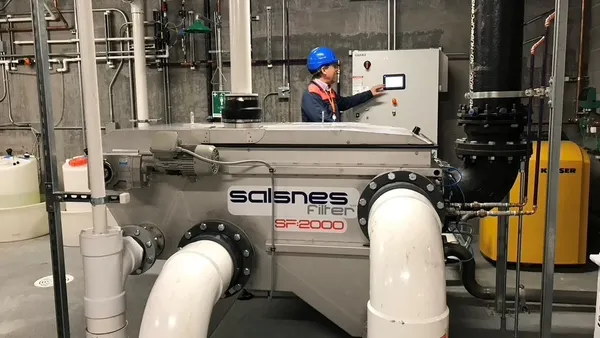
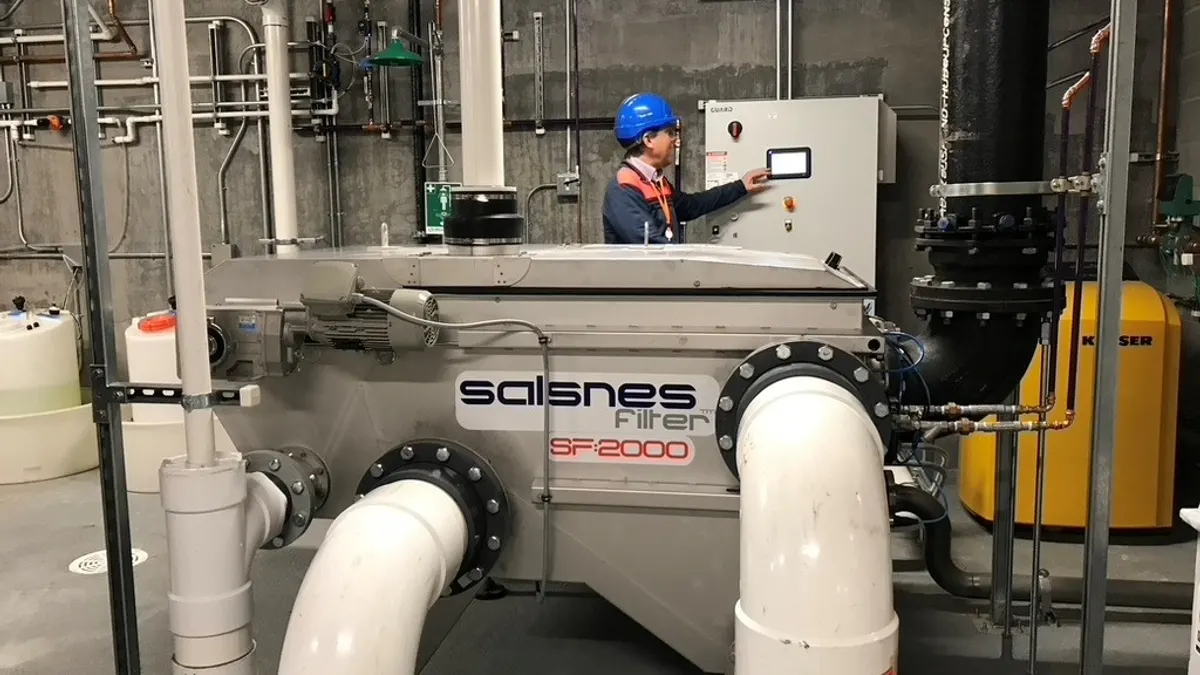
Onsite water reuse systems, which capture, treat and reuse a building’s wastewater, rainwater, air conditioning condensate and foundation drainage for non-potable uses like toilet flushing, irrigation, dust control or cooling, are emerging as an alternative to centralized systems. San Francisco adapted the first on-site water reuse regulations, and water-hungry cities like Austin, Texas, are starting to follow suit.
“We have a ballooning price tag for our water and wastewater infrastructure across this country, and there’s a significant spending gap in terms of what’s being spent versus what needs to be spent,” Aaron Tartakovsky, co-founder and CEO of on-site water reuse company Epic Cleantec, told Smart Cities Dive. “On-site water reuse is an incredibly helpful tool to shift the responsibility and bring in the private sector to help. It takes a lot of the burden off of cities while helping them achieve these lofty water recycling goals.”
San Francisco recognized “the opportunity for buildings to reimagine how they use water” earlier than most, and the city developed “a very unique and first-of-its-kind” ordinance and permitting program enabling commercial buildings to capture and reuse water for non-potable use in 2012, Taylor Nokhoudian, water resources program manager for San Francisco’s Public Utilities Commission Water Resources Division, told Smart Cities Dive.
San Francisco’s attempts at centralized water reuse had been stymied by the city’s hilly topography and the long distances between treatment plants and users, according to a Swiss Federal Institute of Aquatic Science and Technology report. The recycled water never made it to buildings where owners had installed the expensive “purple pipes” required to receive it. In the early 2000s, real estate developers who were pursuing the U.S. Green Building Council’s Leadership in Energy and Environmental Design’s highest-level certification began approaching SFPUC to look into on-site reuse, which is incorporated into the LEED Gold program.
“San Francisco, like many cities, initially had envisioned a large centralized recycled water capability,” Tartakovsky said. “But then they realized that it was going to be incredibly expensive and complicated to send that recycled water everywhere it needs to go. You have to dig up streets, you have to put in pipes.”
Nokhoudian, who manages San Francisco’s Onsite Water Reuse Program, said the local ordinance “really enabled projects to understand what it takes to install a system safely and operate it safely.” She is also a co-chair of the National Blue Ribbon Commission for On-Site Water Systems, created in 2016 to support on-site water reuse systems in individual buildings and at the local level. Water and wastewater utilities and public health agencies from 16 states are collaborating to advance policies and laws, share research and develop guidance materials around water reuse, she said.
The Blue Ribbon Commission is working to promote consistent regulatory frameworks for onsite water reuse nationwide, “so that a designer that’s installing a system in California can have similar design standards to something that’s being installed in New Jersey or New York or the Midwest,” Nokhoudian said.
Establishing national regulations for on-site water reuse is challenging, she said. “Certainly, water is local, so every community has different drivers and faces different challenges. But what brings us together is this need to diversify our water supply portfolios and look to decentralized systems as one tool in the toolbox to help with that.”
An “ecosystem of support”
In 2021, San Francisco amended its non-potable water ordinance to require all new commercial buildings over 100,000 gross square feet to install on-site reuse systems to treat wastewater and residential and mixed-use buildings to treat gray water. That “landmark ordinance” has helped streamline permitting for developers and codified the roles and responsibilities of the four city agencies — SFPUC, the Department of Public Health, Public Works and the Department of Building Inspection — involved in water reuse oversight, Nokhoudian said.
Establishing the non-potable water ordinance has created a market for private-sector companies to work with developers, creating an “ecosystem of support,” Nokhoudian said. That has been a boon for companies like Epic Cleantech. “We will obviously work in tandem with them,” Tartakovsky said.
Salesforce Tower, the tallest building in San Francisco, is one of 70 buildings in the city that are reusing onsite water, according to SFPUC spokesperson Nancy Crowley. Working with Epic Cleantec, the building is meeting 76% of its water needs with water recycled from the building, Tartakovsky said.
“We’ve had the capability to recycle water for a long time,” Tartakovsky said. “The challenge is that all of the regulations and frameworks have been built around the centralized model. So, the question then is, okay, if we want to do this in buildings, who governs this? Who permits this? How do we make sure it’s safe?”
As water shortages and rates increase nationwide, more cities are starting to look at on-site reuse. Austin last month authorized an additional $4 million for Austin Water’s Go Purple pilot program, which offers incentives for new developments to connect to the city’s reclaimed water system or install onsite water reuse systems. There are now 36 onsite water reuse projects in Austin, according to Austin Water.
“A lot of cities recognize now, especially in the western United States, that recycled water needs to be part of the long-term strategy,” Tartakovsky said. “We have more demand for essentially a fixed supply. So, how do you do more with that supply?”
Onsite water reuse can also reduce pressure on aging stormwater and wastewater infrastructure, according to Tartakovsky. “It’s not the silver bullet,” he said, “but it’s certainly a critical tactic in the collective playbook that cities and states should be looking into.”