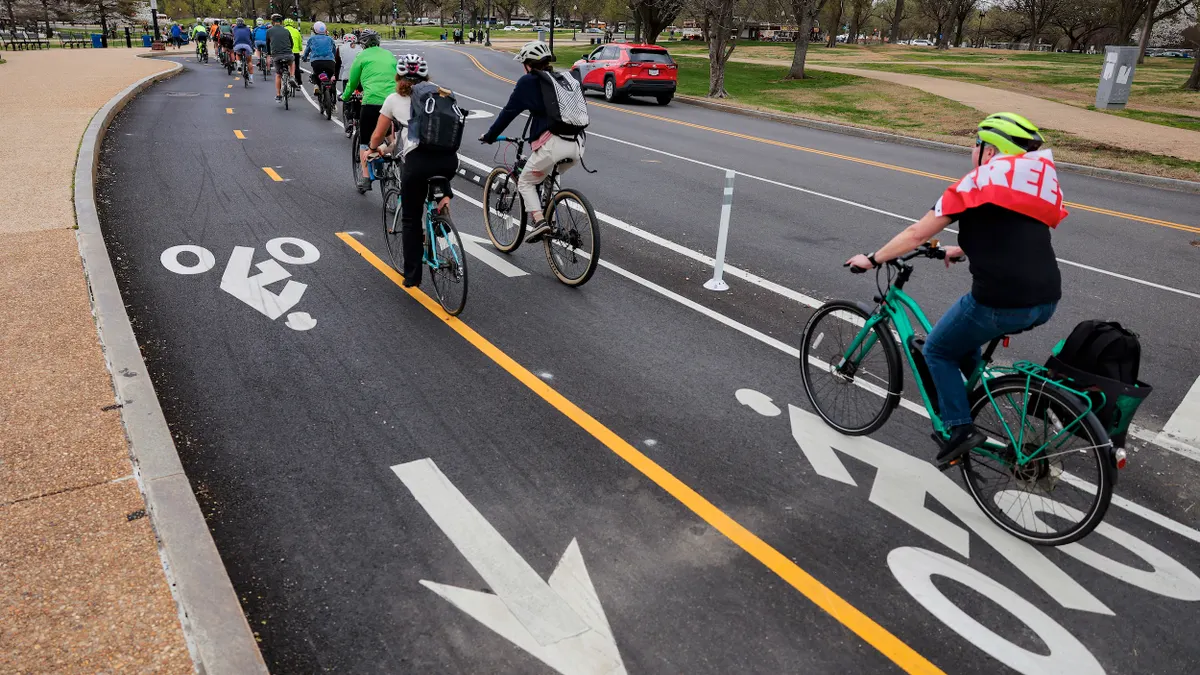
The Federal Highway Administration has deleted five measures from a list of “proven safety countermeasures” from its web page, eliminating bicycle lanes, road diets, speed safety cameras, variable speed limits and speed limits that are appropriate for vulnerable road users, a comparison of the highway administration’s current web page with an archived version shows.
"Attacking proven safety measures makes no sense in the middle of a roadway safety epidemic that killed more than 36,000 Americans last year," Rep. Rick Larsen, D-Wash., said in an emailed statement. “It’s not political to say bike lanes and speed cameras improve safety; it’s a statement of fact.” Larsen, ranking member of the House Committee on Transportation and Infrastructure, said he has requested a briefing from the FHWA to explain its actions.
The FHWA defines “proven safety countermeasures” as “strategies effective in reducing roadway fatalities and serious injuries on our Nation’s highways.”
The highway administration did not publicly announce or explain its decision to remove these measures, according to NPR, which first reported this story. The FHWA did not respond to a request for further information from Smart Cities Dive.
The U.S. DOT said in December that it would no longer approve grants for traffic safety cameras under the Safe Streets and Roads for All program, except in school or work zones.
More than 39,000 traffic deaths took place on U.S. roads in 2024, according to the National Highway Traffic Safety Administration. NHTSA attributed speeding to 29% of those deaths.
“Given America’s pathetic road safety record in recent history, [Transportation] Secretary [Sean] Duffy should be supporting virtually any tech proven to reduce traffic fatalities,” Center for Auto Safety Executive Director Michael Brooks said in an emailed statement. “Opposing proven traffic safety countermeasures like speed enforcement to score short term political points with entitled speeders is not consistent with DOT’s mission.”
Speed safety cameras “can substantially reduce speeding,” according to the Insurance Institute for Highway Safety. In 2025, 338 communities operated speed safety cameras, per IIHS data. “They are important tools for a comprehensive approach to safety,” an IIHS spokesperson said in an email. “Getting drivers to pay attention and slow down protects everyone using our roads.”
In San Francisco, speeding declined by an average of 72% at 15 sites equipped with speed safety cameras, where before-and-after data were available. Earlier this year, the New York City Department of Transportation expanded its automated traffic safety enforcement programs, including speed cameras. Daily violations at speed camera locations have decreased 94% since the start of the program in 2014, according to a 2024 NYC DOT report.
“The data is clear — speed safety camera programs are effective in improving driver behavior, slowing traffic, reducing speed-related fatalities, and improving the safety of all road users,” a Verra Mobility spokesperson said in an email. “Speed safety camera programs are a proven, important tool to make streets safer for all users.” Verra Mobility manages New York City’s automated traffic enforcement program.