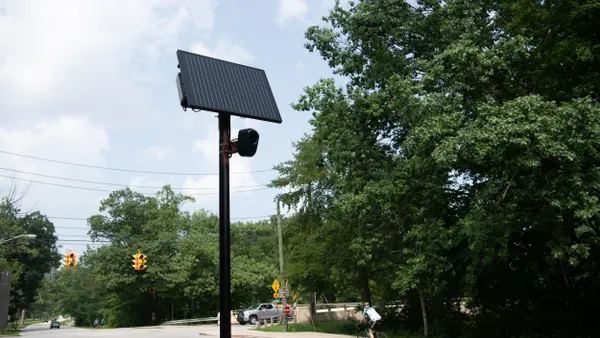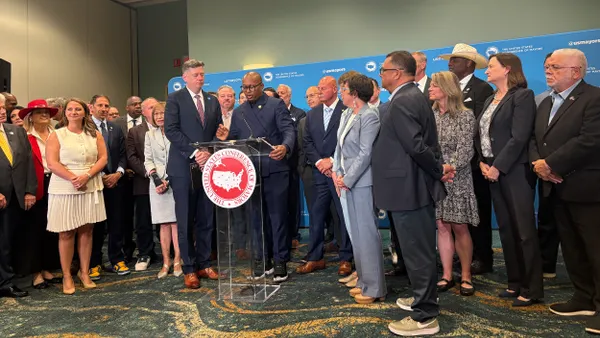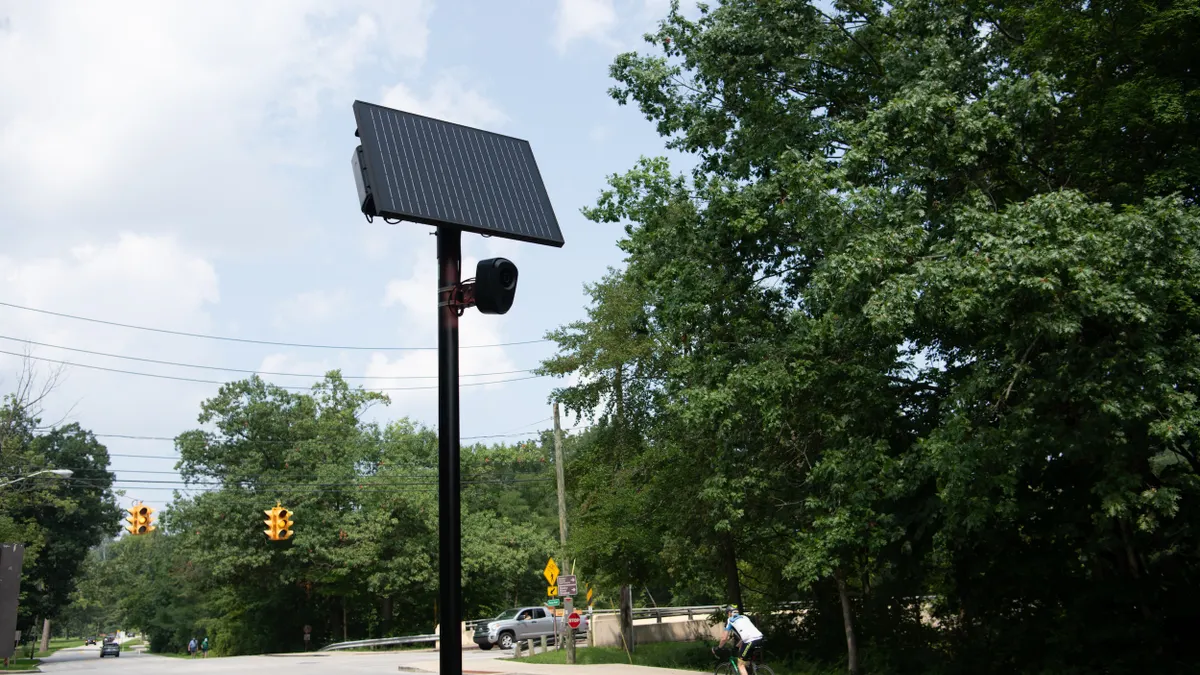
In any given hour, law enforcement officers can scan thousands of license plates using automated license plate reader technology like Flock Safety — and they’re capturing much more than just a license plate number, Kimberly Przeszlowski, an assistant professor of criminal justice at Quinnipiac University, said during a recent Sciline webinar.
“Flock calls it a ‘vehicle fingerprint,’” Przeszlowski said. “It’s similar to what a fingerprint could tell you about an individual. Beyond the plate, it can tell you the make and model of a vehicle, the camera location, the date and time stamp, and vehicle characteristics — not only body type but color. Depending on the settings, it can also capture characteristics like damage to a bumper or a bumper sticker.”
The cameras are capable of tracking individuals’ patterns of activity, and they’re being integrated with other technologies like automatic drone deployment, AI and facial recognition through real-time crime centers, said Johnny Nhan, a criminology and criminal justice professor at Texas Christian University. Przeszlowski said hundreds of real-time crime centers are operating nationwide.
“These things are not science fiction anymore,” Nhan said. “It creates a bit of a slippery slope.”
The panelists offered advice and insights for city leaders who are grappling with adoption of the technology as well as resident concerns about its use and potential abuse.
1. Be wary of free trials and vendor marketing.
License plate reader companies are savvy, “and at the end of the day, it’s a huge commercial enterprise,” Nhan said. “Some of the Flock users I've talked to compare it to Costco or to drug dealers. They give you a free sample, some free cameras, and you get hooked because it's effective at certain things. Then it's contract time.”
Steven Keener, director of the Center for Crime, Equity and Justice Research and Policy at Christopher Newport University, said he’s heard multiple cases of police departments getting “hooked” on ALPRs after accepting a free sample. “In one meeting, with the mayor and the police chief in the same room, the chief said to the mayor, ‘If you take this away from me, I don't know how we're going to do this without this tool now.’ That idea, ‘I don't know how we're going to adapt back to what we were doing before this technology existed,’ is something to watch,” he said.
Nhan also pointed out that the companies frequently offer bundling deals: “if you add this on, we’ll give you a discount. … It grows from there.”
Keener also warned of ALPR companies sending local leaders public relations playbooks to control the narrative. “I've been surprised by how much of a top-down PR playbook there is,” he said, adding he has heard “almost word-for-word defenses of the technology from city council members in different jurisdictions.”
2. Get public input before ALPRs are installed.
All too often, mayors and city council members tell concerned residents that “the cameras are here now, so we just have to deal with it and put guardrails up,” Keener said. “There’s something to be said for reversing the process, so that there’s some form of public input before the next kind of surveillance shows up.”
Harrisonburg, Virginia, provides “the model going forward for a municipality” Keener said. After canceling its Flock contract and taking the cameras down, the city passed an ordinance that requires public input before any future surveillance technology is installed.
3. Write detailed rules about how the technology will be used.
“There’s still a lot we don’t know when it comes to ALPRs,” Przeszlowski said. “They're not standardized: the policies, the retention, the access control, the data sharing, the oversight, you can go on and on, and all of it varies considerably from jurisdiction to jurisdiction and state to state.”
The “gold standard” for policies and procedures governing the use of ALPR technology is still developing, Nhan said, and right now “policy is all over the place.” He pointed to the example of a police department that has fended off resident complaints by creating a “transparent and robust” policy based on input from public forums and the American Civil Liberties Union.
4. Distribute surveillance equitably.
In Virginia’s Hampton Roads region, a federal judge forced officials to release the locations of all publicly funded ALPR cameras last year, Keener said. “It was a big deal, because until then we had little data on where these cameras are officially placed.”
Keener’s team overlaid the locations with sociodemographic variables and found more cameras in areas with a higher share of Black residents and higher poverty rates. “If you live in a predominantly Black neighborhood in this region, your default is surveillance,” he said.
In Norfolk, Virginia, cameras are concentrated in formerly redlined areas where disinvestment and underinvestment has been prevalent. “The story we think comes out of our study is that we're investing surveillance in neighborhoods that have been disinvested in, and we're replicating the same things we've done in the past,” he said. “We're just doing it in a more tech-washed manner.”
5. Stay on top of who has access to the data.
Last summer, Immigration and Customs Enforcement tapped Flock data at five Virginia localities without their knowledge through “side-door access,” Keener said. “Essentially, the federal government, in this case ICE, gets access from friendly departments, and that’s the most common way it’s happening.”
ALPR data is shared between departments, which makes the technology valuable during investigations that cross city and county lines, “but that’s where the vulnerabilities show up,” Keener said.
A Connecticut law that took effect Oct. 1 allows departments to share data only with neighboring states without a probable-cause warrant and prohibits data from being shared for immigration enforcement purposes, Przeszlowski said.
6. Document the technology’s effectiveness.
Nhan said he was involved in a study looking for links between the proliferation of Flock cameras and reductions in crime rates or the number of crimes solved. “I couldn’t do that,” he said, largely because the way police departments collect data isn’t standardized.
Przeszlowski said collecting data about outcomes is imperative to producing evidence about whether the technology is effective or efficient. But, she said, “officers in a real-time crime center aren’t there to enter data into an Excel sheet; they’re there to gather information quickly.” Having a designated officer collecting that data is key, she said.