Dive Brief:
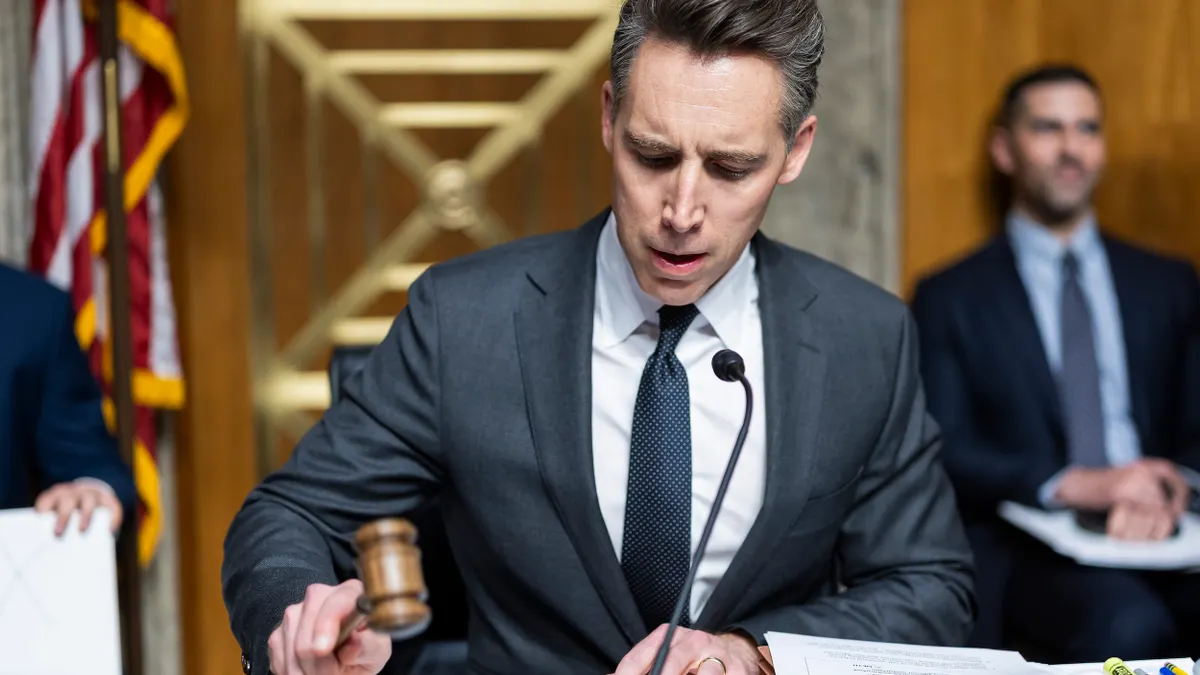
- Sen. Josh Hawley, R-Mo., on Wednesday announced he is introducing a bill to establish guardrails for automated license plate readers. The AI-powered cameras “are tracking and creating digital footprints of everyday Americans — a nightmare for individual liberties unless Congress enacts meaningful rules and accountability,” he said in a statement.
-
The Stop Flock Abuse Act would ban facial recognition technology, prohibit local governments from selling or sharing data with non-governmental third parties, require users to obtain written approval before searching data and maintain an audit log, and require law enforcement agencies to permanently delete driver data, with “narrow exceptions,” after 10 days, among other safeguards.
-
Rep. Thomas Massie, R-Ky., introduced the Flock-Off Act, which would prohibit the use of federal funds to install and operate automated license plate readers and biometric surveillance cameras, in the U.S. House on Sept. 2. "The Flock-Off Act withholds federal money from municipalities and police departments that deploy Flock cameras to surveil law-abiding citizens,” he said in a statement. “Federal taxpayers should not be forced to fund the surveillance state."
Dive Insight:
As backlash against automated license plate readers, or ALPRs, has grown in the past year, more than 50 U.S. cities and counties have cut ties with Flock Safety, which says it has partnered with more than 7,000 law enforcement agencies. Vandalism against ALPRs has been reported across the country.
Hawley launched an investigation into Flock Safety in August. “Your company boasts more than 120,000 cameras across 49 states and more than 20 billion vehicle scans every month,” he wrote in an Aug. 26 letter to Flock Safety CEO Garrett Langley. “The overwhelming majority of the Americans captured in those records did nothing wrong.”
The camera networks “harness artificial intelligence to pool what they capture into a national database that customers can search,” Hawley wrote.
Flock did not respond to Smart Cities Dive’s request for comment and declined an invitation to testify at last week’s subcommittee hearing. In a Sept. 8 letter to Hawley, the company’s chief legal officer, Dan Haley, said Flock agrees that “the rules that protect Americans should be set by law and not solely by the policies of any single company.”
“We would welcome the enactment of a coherent federal framework, and we stand ready to work with your office and with Congress on its efforts to help protect privacy without depriving communities of tools that solve crimes and save lives,” Haley wrote.
“If we rely on private camera networks to act as a dragnet, continuously logging the habits of innocent Americans without a warrant, we are paving the way to an AI-driven surveillance state,” Pinal County, Arizona, Sheriff Ross Teeple said during a Senate Judiciary Subcommittee on Crime and Counterterrorism hearing on the surveillance cameras last week. “If we allow government-funded private surveillance companies to push this envelope blindly, we risk a sweeping judicial correction that could strip away the legitimate, life-saving aspects of ALPR technology entirely.”
Calling Flock “a canary in a coal mine,” cybersecurity engineer Benn Jordan said during the hearing that “Axon and Motorola are actively rolling out the same reckless features that we’re shaming Flock for, and you can expect these same vulnerabilities will continue to happen over and over again when innocent people’s data is traded between private companies and police without any safeguard or protection.”