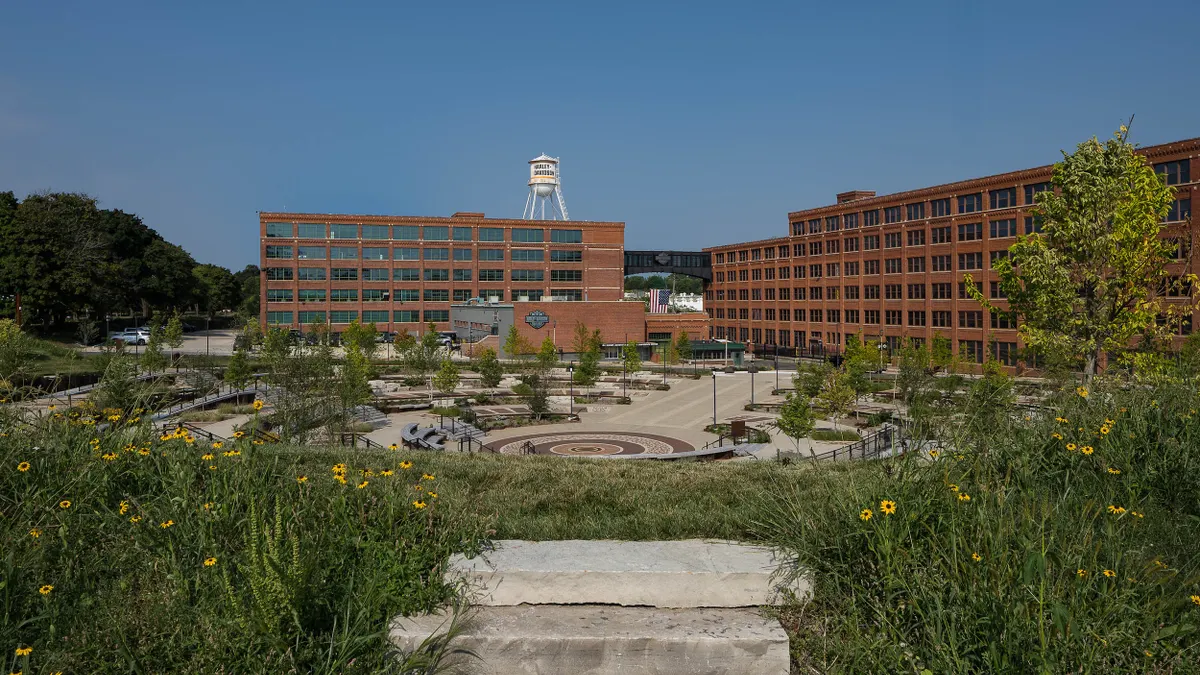
As historic rainfall flooded parts of Milwaukee last August, Peter Balistrieri, workplace market sector leader at design firm HGA, took his kids to Davidson Park. While neighborhoods nearby were under water, the park remained dry — exactly as its designers intended.
It was a proud moment for Balistrieri, whose firm designed the park with Heatherwick Studio and the Harley-Davidson Foundation in the Near West Side neighborhood that has been home to Harley-Davidson’s former factory-turned headquarters since 1906. “Stormwater was the theme from day one,” Balistrieri told Smart Cities Dive, and it was the design challenge that shaped everything else about the park.
Just west of downtown, the Near West Side — once one of Milwaukee’s wealthiest areas — is now home to affordable housing, plentiful businesses and a diverse population, according to the nonprofit Near West Side Partners. In 2021, Near West Side Partners and the Harley-Davidson Foundation brought together more than 200 neighborhood stakeholders to identify the community’s needs. “One of the outcomes of that event was a need for green space,” Balistrieri said.
Harley-Davidson recognized an opportunity to put an underutilized employee parking lot to better use. “Harley quickly measured up,” Balistrieri said. “They said, ‘Hey, we have this big impervious surface just collecting stormwater. No one’s using it, and it’s not great for the neighborhood. Let’s turn it into a park.’”
The paved parking lot and a vacated city street were transformed into the 4-acre park, which features 120 native plant species, a playground, a serenity garden and a 260-foot-wide multi-use events space. The park, which opened in 2024, is “a place where people can come together with friends and family to enjoy some of the wildness of Wisconsin’s incredible nature, listen to the state’s best music, or experience the energy of a motorcycle rally,” according to a Sustainable SITES Initiative case study.
Pushing the boundaries of green infrastructure
The park is also a much-needed green stormwater infrastructure project, capturing water the site once shed into Milwaukee’s overburdened sewer system.
“Prior to the park, the site had no stormwater best management practices or controls for peak flow and water quality,” according to the case study. “As a result, the almost entirely paved acreage contributed to regular downstream flooding of the combined sewer service area during heavy rain events posing community health and safety concerns.”
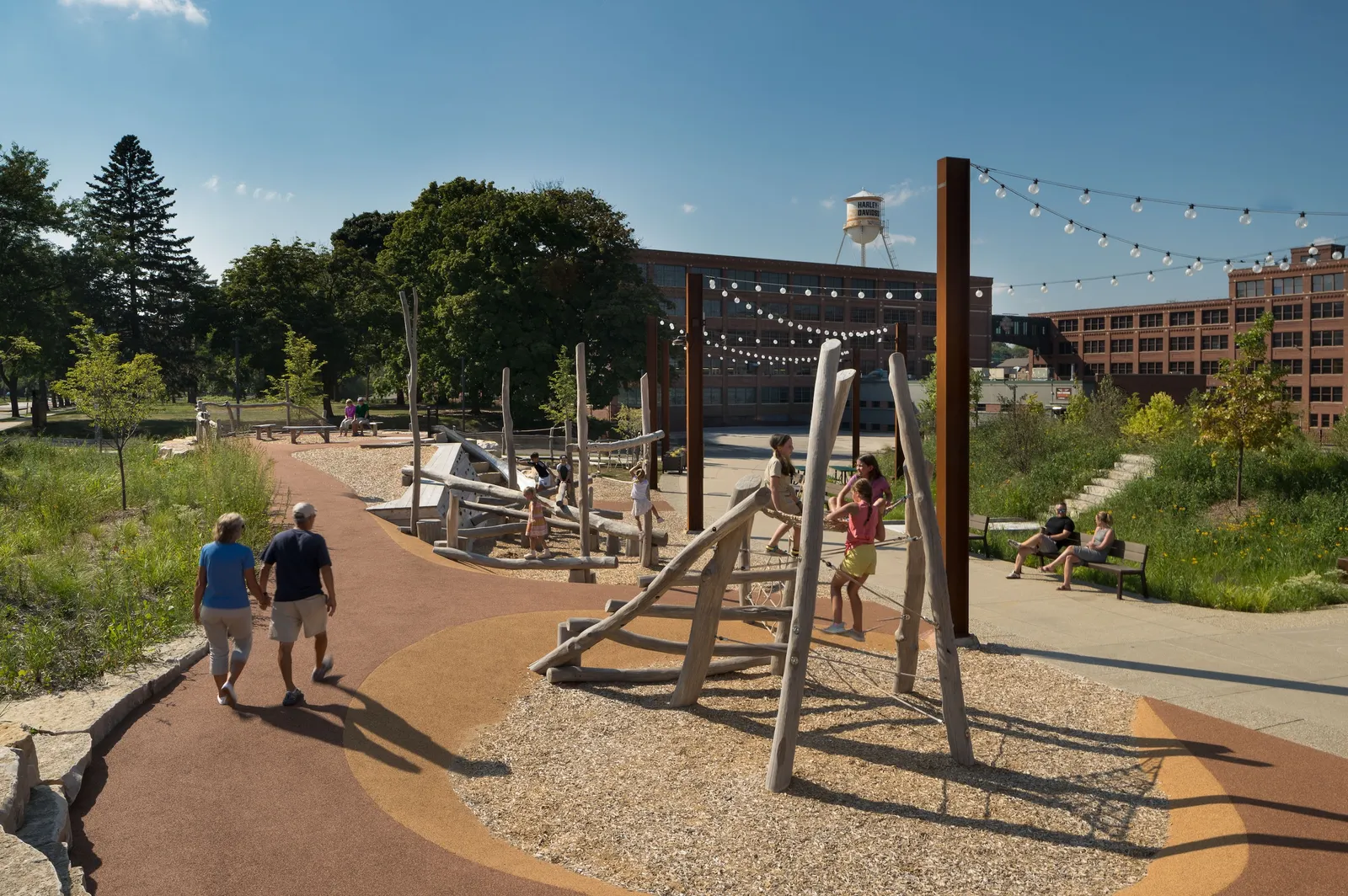
The sunken amphitheater — a multi-use events space with tiered promenades for seating, motorcycle parking and vendor staging — is the heart of the design team’s green infrastructure solution. Essentially a bowl with cisterns beneath it that collect stormwater and then slowly release it into the sewer system, it is called The Hub in homage to the hub of a motorcycle wheel.
Designing the amphitheater presented plenty of challenges, Balistrieri said. “We were building a bowl where water could collect, and we did not want a swimming pool,” he said. “That was a risk, so we talked about strategies for stormwater management.”
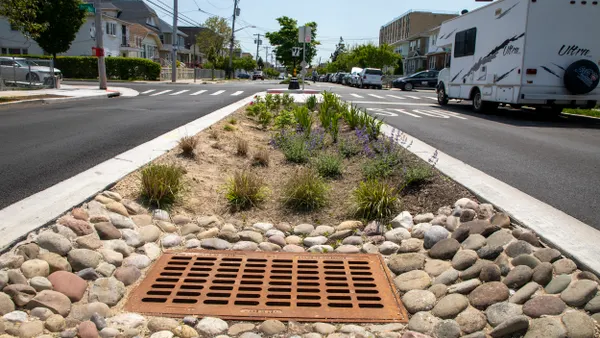
Developed through the Fresh Coast Protection Partnership, a community-based partnership between infrastructure construction company CIS and the Milwaukee Metropolitan Sewerage District, the green infrastructure project utilizes bioswales, bioretention systems, native landscaping, pervious pavers and an underground detention system that’s able to capture and filter more than 225,000 gallons of stormwater that once had nowhere to go.
“The green infrastructure approach with FCPP allowed us to push the boundaries of how we’re managing and storing stormwater,” Balistrieri said. And because Milwaukee is committed to reducing sewer system burden through its Flood Hazard Mitigation program, “there was energy around putting in green infrastructure specific to stormwater.”
Implementing stormwater infrastructure also generated nearly $500,000 in grants for the $20 million project. “There are dollars available to incentivize these sorts of things,” Balistrieri said.