Dive Brief:
-
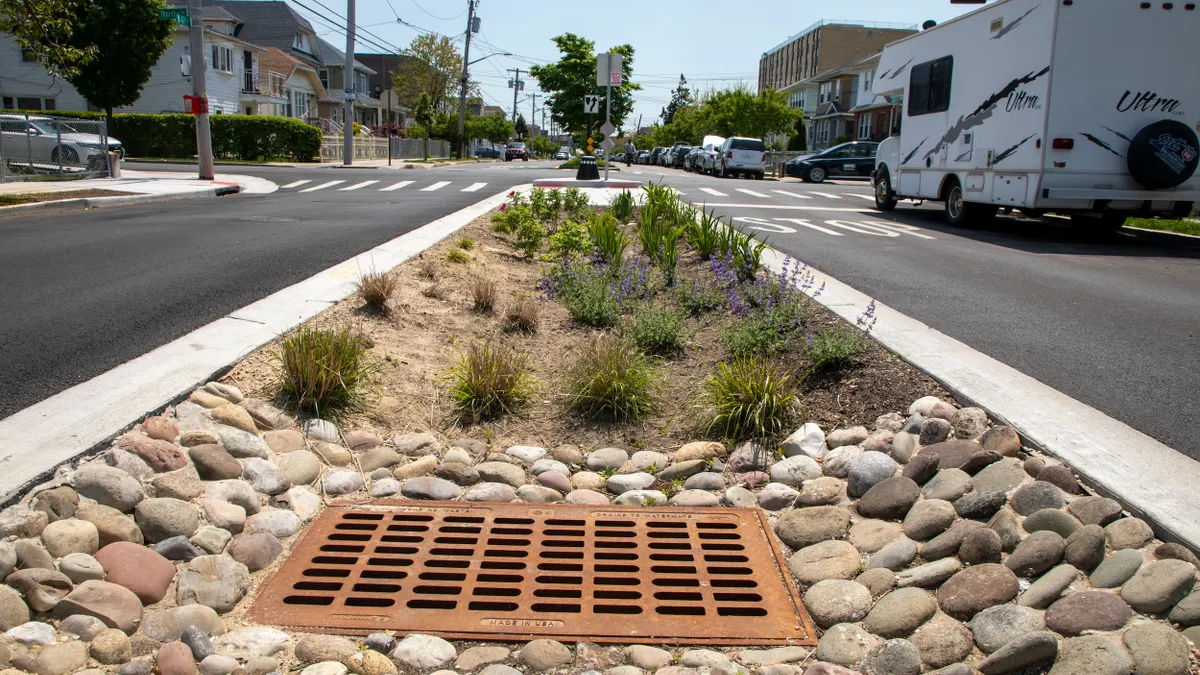
New York City will spend $8.4 million to turn three concrete roadway medians in the Queens borough into green infrastructure “sponges” designed to absorb stormwater and prevent extreme weather flooding, Mayor Zohran Mamdani, Gov. Kathy Hochul and NYC Department of Environmental Protection Commissioner Lisa Garcia announced Thursday.
- Concrete medians and curbs will be replaced with inlet openings that will divert stormwater from streets to underground storage systems and areas planted with native species, shrubs, grasses and wildflowers.
-
The state is helping fund the project with $5 million in grants from its Green Innovation Grant Program and Water Quality Improvement Project. “By supporting projects that work with nature to manage severe weather, the State is helping New York City build resilience while minimizing costs for ratepayers,” New York State Environmental Facilities Corporation President and CEO Maureen Coleman said in a statement.
Dive Insight:
New York City has been building a green infrastructure system to address stormwater runoff and flooding since 2010, when former Mayor Michael Bloomberg unveiled a $2.4 billion plan to capture and retain stormwater runoff before it enters the sewer system. About 60% of NYC’s sewer system is combined, meaning a single pipe carries both stormwater runoff and sewage, overwhelming treatment plants during heavy storms.
The city expects to experience as much as 30% more annual rainfall and 150% more days with over an inch of rain by the end of the century. As sea level and groundwater tables rise, stormwater will drain more slowly and contribute to flooding, according to the Mayor’s Office of Climate and Environmental Justice.
Distributed stormwater management is part of the larger green infrastructure project designed to slow down, absorb and filter stormwater by capturing it at the source before it can enter the sewer system. The city aims to reduce overflows in combined sewer areas by 1.67 billion gallons per year by December 2040.
In 2022, a year after the remnants of Hurricane Ida smashed the record for the most single-hour rainfall in New York City, causing widespread flooding, hundreds of millions of dollars in damage and the deaths of 13 people, NYC began a pilot “cloudburst” project to address intense rainfall that can overwhelm the sewer system. The project utilizes open spaces to store stormwater until storms pass and the drainage system can manage it.
While cloudburst projects use a network of neighborhood-scale infrastructure to move stormwater off streets during heavy rainfall, the median project announced last week is a smaller, more distributed intervention designed to capture an estimated 5 million gallons of stormwater each year.
NYC launched its first project to convert three roadway medians into green infrastructure in the Queens neighborhood of Arverne in 2022.
"Concrete medians help improve safety by making it easier for pedestrians to cross the street and by better organizing traffic — but they can also play an important role in protecting our city from the dangers of extreme weather and flooding," NYC Department of Transportation Commissioner Mike Flynn said in an Aug. 27 statement. "As New York City sees more and more intense rainstorms due to climate change, now more than ever it's crucial to improve and rethink our infrastructure to protect New Yorkers against growing environmental threats."
Medians in the Whitestone, Forest Hills and Queens Village neighborhoods will be re-engineered, preventing stormwater and sewage from entering the East River, Flushing Bay and Jamaica Bay.