Dive Brief:
- New York’s congestion pricing program did not materially improve air quality in the congestion relief zone or in environmental justice communities outside the zone, an Aug. 14 study from the New York City Health Department found.
- The finding is consistent with the Federal Highway Administration’s final environmental assessment completed in 2023. The assessment concluded that the program “is not a project of air quality concern.”
- “Air quality is literally a function of the weather and our wind patterns, [and] our geographical topography,” IQAir North America CEO Glory Dolphin Hammes told Smart Cities Dive. “It would be very difficult to isolate an area that small to try to show an improvement.”
Dive Insight:
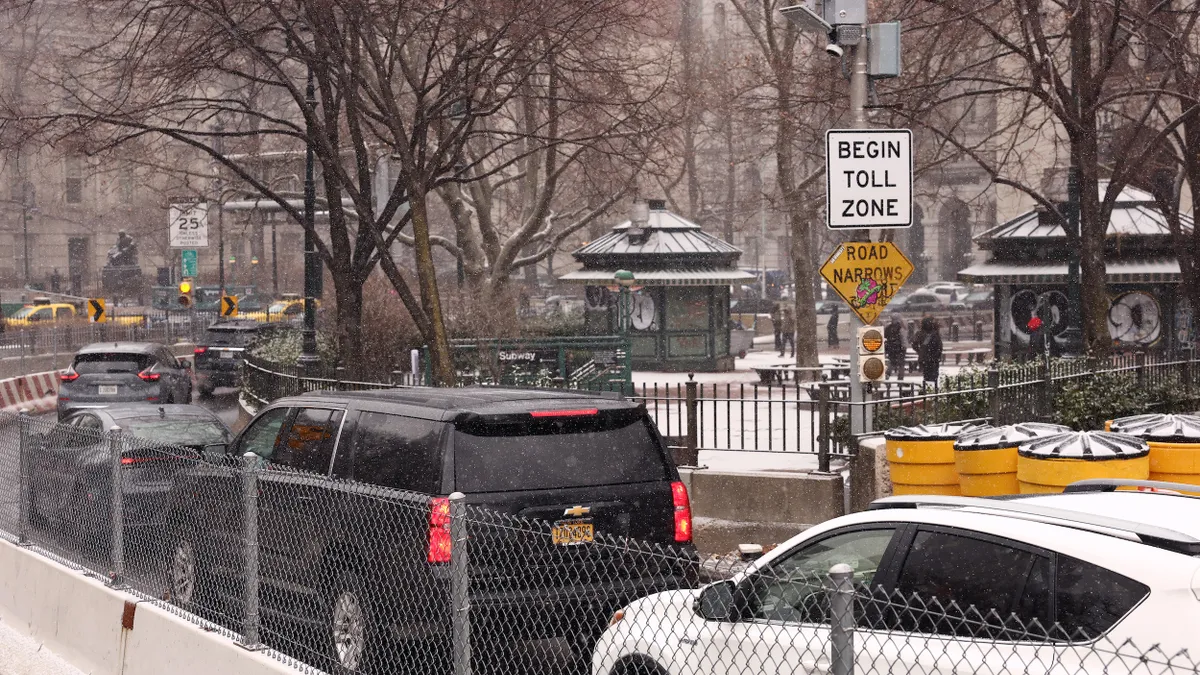
New York’s congestion pricing program stems from a 2019 state law with the goal of relieving traffic congestion in Manhattan’s central business district and generating revenue to support the transit authority’s capital investments.
“Before we turned the cameras on, there was concern about the potential for increased pollution caused by drivers looking to avoid the toll,” New York Metropolitan Transportation Authority Chair and CEO Janno Lieber said in a statement. “As this study confirms, that didn’t happen, and congestion pricing is already funding additional investments to further improve air quality.”
The city’s health department in May announced a $20 million investment from the MTA to improve childhood asthma outcomes in the Bronx.
The congestion pricing plan went into effect on Jan. 5, 2025. The study compared 2025 data with estimates of what the air quality would have been without congestion pricing. It focused on pollutants closely associated with traffic: fine particulate matter (PM2.5), nitrogen dioxide (NO2), nitric oxide (NO) and black carbon.
“The leading cause of air pollution really is traffic,” Dolphin Hammes said. According to the study, traffic accounts for approximately 14% of PM2.5 and 20% of NOx emissions in New York City.
The study tracked 73 sites outside the congestion zone but within city limits, including areas along major highways, and found no significant year-to-year changes. “I am reassured by the data showing that congestion pricing has not worsened air quality in communities with long histories of environmental injustice like mine in the Bronx,” New York State Sen. Gustavo Rivera said in a statement.
It found slightly higher pollution levels at Environmental Protection Agency monitoring locations in Connecticut and Eastern Long Island but not in New Jersey. A control site on the Van Wyck Expressway in the borough of Queens, which is heavily used and without parallel, alternative routes, helped to confirm the findings.
Dolphin Hammes said the study shows that congestion pricing could work in cities with a strong transit system — places like Boston, Chicago and San Francisco. “These kinds of policies would serve very well hand-in-hand with excellent public transportation, which not all cities within this country actually have," she said.