Caleb Smith is New York City policy manager at WE ACT for Environmental Justice, a Harlem-based advocacy organization advancing environmental and climate health equity since 1988.
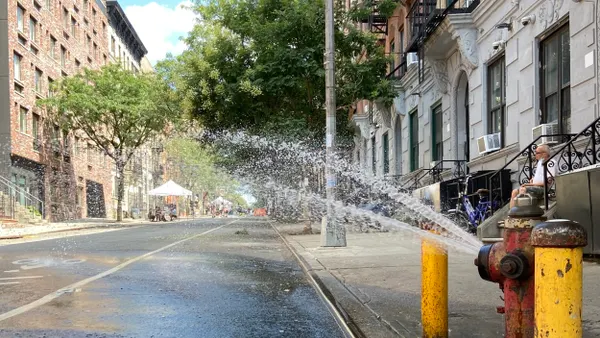
In New York City, approximately 500 people die from heat each summer. Black New Yorkers are three times more likely and Latinx New Yorkers two times more likely than white New Yorkers to die from heat stress. Cooling centers and emergency alerts are essential during dangerous heat waves, but they cannot answer a more basic question: Can people afford to stay cool in their own homes?
New York City’s recent Rental Ripoff Report put in black and white what many New Yorkers have experienced for years: Too many buildings are in poor condition. More than 13% of New York City households reported three or more housing maintenance problems in the 2021 Housing and Vacancy Survey, with rates reaching as high as 41% in historically Black and Latinx neighborhoods.
Environmental Justice NYC, a 2024 comprehensive assessment of environmental justice issues in all five boroughs, reported that environmental justice communities face overlapping risks from high heat vulnerability, lower rates of home air conditioning and persistent housing inequities. These conditions make homes more difficult and expensive to cool.
Heat waves are exposing vulnerabilities across the country, including in places such as the Pacific Northwest and New England, where homes and public systems were never built for sustained high temperatures. As municipal and state leaders grapple with how to keep residents safe from extreme heat, the conversation cannot begin and end with air conditioners.
Cities should pair cooling investments with weatherization, air sealing, insulation, shading, ventilation and other improvements that keep homes cool while using less energy. By addressing these problems head-on, municipal leaders can make it easier for low-income households to participate in renewable energy and energy efficiency programs that may otherwise require repairs or improvements before new equipment can be installed. Improving energy efficiency is also one of the most direct and enduring ways to reduce energy use and lower household energy costs despite rising utility rates.
Prioritize efficient cooling equipment
Making buildings more efficient also reduces pressure on the electric grid when thousands of households need cooling at the same time. New York City’s comptroller recently called for a coordinated strategy to put solar and battery storage on public properties to strengthen reliability during extreme heat and help community institutions provide cooling and other services during outages.
Cities should prioritize efficient cooling equipment. Public programs and landlord requirements should prioritize equipment like heat pumps while helping cover the electrical work and other upgrades installation may require, so households are not left with cooling systems they cannot afford to use.
Cities and states are already testing different approaches. Portland, Washington’s Cooling Portland program targets efficient heating and cooling equipment to low-income residents most vulnerable to heat. The Boston Housing Authority has installed 100 window heat pumps and is planning a networked geothermal retrofit at Franklin Field public housing. California has set a goal of deploying 6 million heat pumps by 2030. And in Las Cruces, New Mexico, state funding kept a free heat pump program for low-income households moving after more than $900,000 in anticipated federal funding failed to arrive.
New York is moving in the same direction. The New York City Housing Authority (NYCHA) has set a five-year goal of installing window heat pumps in 20,000 apartments, building on a $38.4 million investment at Beach 41st Street Houses. That is meaningful progress, but NYCHA operates more than 177,500 apartments, highlighting the need for sustained investment well beyond individual projects.
New York City has taken an important step toward treating cooling as a health protection rather than a private amenity. Local Law 23 of 2026 will require landlords to provide cooling capable of maintaining 78 degrees Fahrenheit in covered rooms when tenants request it, beginning in 2030. This law also directs the city to set standards intended to limit tenants’ operating costs and provide information on energy efficiency, weatherization and passive cooling. Yet the details of implementation will determine whether that promise translates into real protection or another version of the “landlord special,” where building operators install bare-minimum, inefficient cooling systems without making the investments needed to improve efficiency.
To keep residents safe and healthy all summer long, cities need to stop treating cooling access, housing quality, energy affordability and grid resilience as separate problems. No one should have to risk their lives because they cannot afford their energy bill. The tools exist. Governments need to use them.