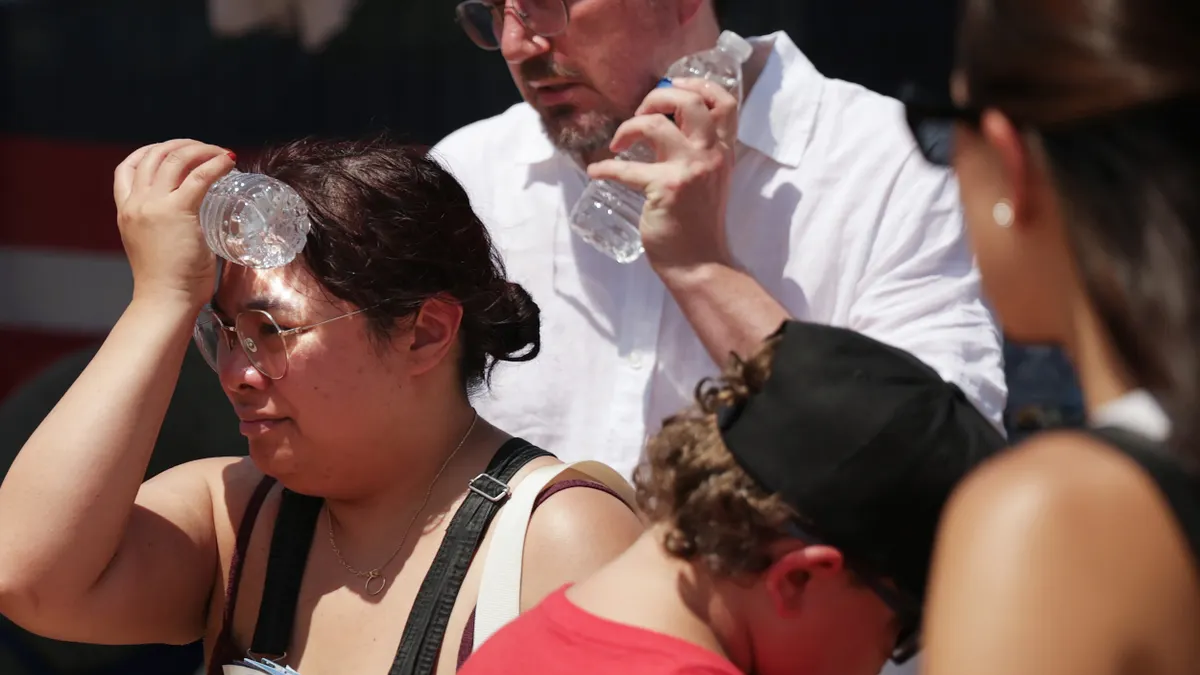
The U.S. is in a “heatshed moment,” says Ladd Keith, director of the University of Arizona’s Heat Resilience Institute: “a critical turning point in which heat must be rapidly addressed to protect health and livelihoods worldwide,” he wrote in a Journal of Urban Affairs commentary in April.
“Our cities were built for a climate that no longer exists,” Keith said in a recent interview with Smart Cities Dive. “Cities aren’t ready for the heat we're experiencing this year, and they won't be ready for the heat that we experience in a decade from now. We really need to move more quickly to retrofit our cities and adapt them for the climate that we will be experiencing in the future and that we're already experiencing right now.”
Editor’s note: The following interview has been edited for length and clarity.
SMART CITIES DIVE: You’ve said extreme heat is an invisible issue. Are city officials starting to understand its importance?
LADD KEITH: 100%. I've been working on extreme heat for over 15 years, and it wasn't until 2021 or so, with the Pacific Northwest heatwave in America, that cities started taking it seriously.
Why does heat get less policy attention than floods, hurricanes and wildfires?
Those other hazards do harm to human life — obviously quite a lot — but they also harm property. In the United States, we care a lot about property and infrastructure. We have insurance; we have lots of money tied up in those things. And unfortunately, it seems, based on the money that we spend, that we care a little bit less about human life and quality of life and health.
Are cities making meaningful progress on heat resilience?
If you looked at the United States 10 years ago, most governments didn't recognize heat as something they even had the authority or responsibility to address. And there were very few resources for communities to address extreme heat. There weren't guidebooks, there weren't toolkits like the Climate Mayor's Toolkit. If you were interested in addressing extreme heat, you had to just go it alone. Today there's much more awareness about it. Communities are interested in addressing it. There's more public support and public desire to address extreme heat. So, in those ways, we've come a long way.
What hasn't really followed is sustainable funding sources. With the federal government's new priorities, a lot of the progress that we did make over the last couple of years has been pulled back. That will certainly harm our efforts going forward because we're already behind where we should be for addressing a climate risk like extreme heat.
Which cities are setting the standard?
I'm in the city of Tucson, and we've been holding urban heat island workshops for 15 years. We have the longest-running publicly accessible urban heat island map from our Pima Association of Governments. And we adopted the state's first heat action road map three years ago. So, I think the city of Tucson is doing a great job.
But then you look at Phoenix, which is obviously the hottest American city of its size, and they have the nation's only publicly funded office of heat mitigation and response, which is an interesting innovation and experiment to see if that's an effective way to address extreme heat.
Boston had one of the earlier heat action plans and has done a pretty good job greening itself. There are lots of good examples from across the United States of places that are trying to make a difference.
What should mayors’ top three priorities be for addressing extreme heat?
First of all, set a point person in your city organization to deal with extreme heat. It does not have to be a chief heat officer. It would be great if every city had funds for something like that, but that's not practical in most places. It could be a chief resiliency officer, a sustainability director, maybe a city manager. This depends on the city.
Second, set goals, priorities, strategies and evaluation metrics. Create some sort of heat action road map or heat action plan just to see where you are today and the low-hanging fruit that can address extreme heat in your community.
Third, cooperate with other government agencies outside of the city. You have to internally coordinate, but you also have to cooperate, especially in the United States, with county-level public health departments, state-level funders and the federal government. We've really seen the most successful cities that have addressed extreme heat have both inter-city cooperation, but also inter-governmental [cooperation] across scales of government too.
What are the most cost-effective investments that less-resourced cities can make?
Coordination would be the thing I would recommend because it's likely that folks are already doing great work, but they're siloed. The public health department might have really important heat illness information, and the urban planning department might have really important information about the hottest places in the city or the places that lack vegetation. Just by coordinating and cooperating, you can bring some of those information sources that already exist together and make the whole of government more effective in its approach.
What interventions consistently produce measurable reductions?
Because heat research and heat science and heat practice is so new, it's very difficult to know which of the strategies cities are pursuing may have the best outcomes. We need more evidence to really know what appropriate triggers should be pulled in different places. The most popular strategies are urban forestry, cool pavements and cooling centers.
If you think more holistically, half of our heat-related deaths here in Arizona are among the unhoused population. So, housing all of the unhoused individuals would drop our heat deaths by half. And that would be a fairly effective strategy — but is there appetite with the American public to house all of the unhoused? We might have some very effective solutions that we're overlooking for political reasons.
Are cooling centers enough? How could they be more effective?
Cooling centers are a necessary strategy at this point in time because there are so many people who don't have safe cooling in their own house or may be unhoused or in other situations where they can't access safe indoor cooled environments. So, they're a necessary strategy, but looking again more broadly, the only reason we need cooling centers is because people don't have safely cooled indoor spaces of their own. I would love to see a day where cooling centers are made obsolete by the fact that everyone has adequate safe housing. But again, that's not where we're at right now.