Dive Brief:
-
A coalition of community development financial institutions created after the January 2025 Los Angeles wildfires released a playbook Thursday recommending seven financial products and 13 policies that could help communities access capital to recover and rebuild after disasters.
- Financing Options for Recovery, Growth and Equity, or FORGE LA, analyzed gaps in the financial recovery system after the Eaton and Palisades wildfires, which caused $76 billion to $131 billion in property and capital losses, according to the CDFI Disaster Recovery Playbook. Because insured losses were capped at around $45 billion, many homeowners were left dealing with “a significant funding gap between insurance proceeds and the cost to rebuild,” the playbook states.
-
Business owners, homeowners, renters and nonprofit leaders told FORGE LA the financial recovery system was “fragmented, hard to navigate, and slow to adapt,” according to the playbook. Microbusinesses and low-income households “that needed help most” were often excluded, and financial institutions “were operating in parallel rather than in coordination, each solving a piece of the problem without a shared view of the recovery landscape,” it states.
Dive Insight:
The Eaton and Palisades wildfires were “an unprecedented stress test on the disaster response and recovery systems that Los Angeles residents depend on,” the playbook, released by the community development nonprofit the Center by Lendistry, states.
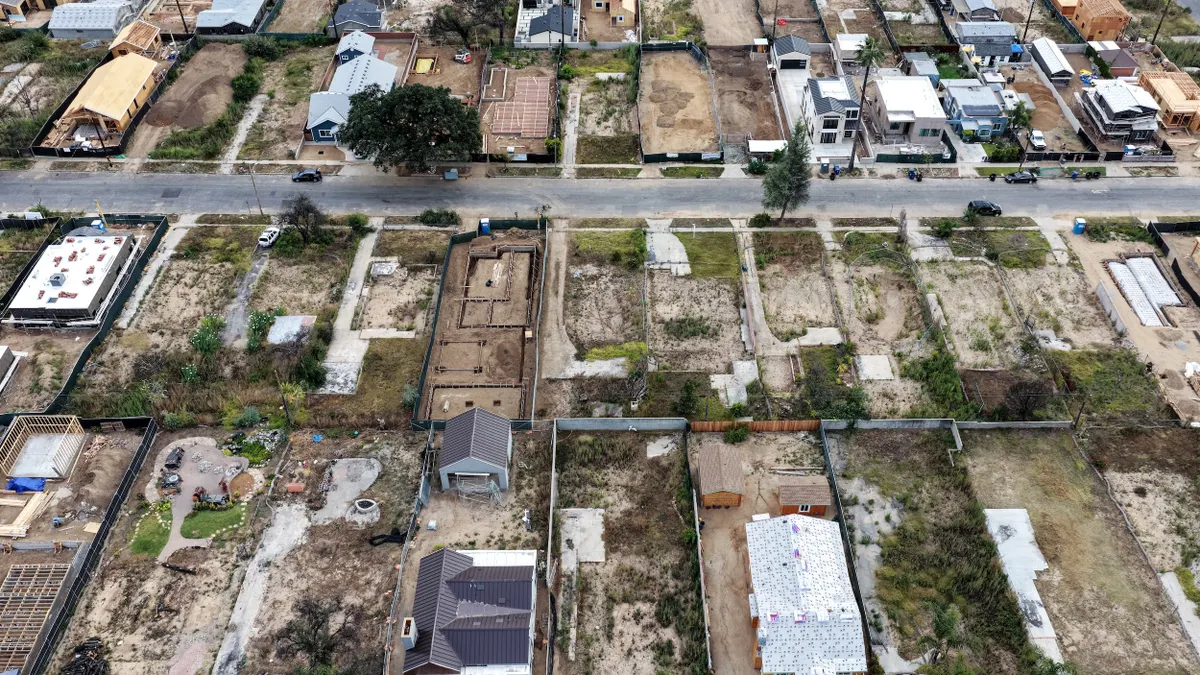
Most of the more than 16,000 structures destroyed in Altadena and the Palisades were single-family homes, Center by Lendistry President and CEO Tunua Thrash-Ntuk told Smart Cities Dive, and most of the homeowners were not familiar with how to apply for construction loans. Private financial institutions don’t offer products to help families in this situation, she said.
“It’s one thing to raise money for water and food. It’s another thing to raise money to fill a $500,000 gap in rebuilding a home,” she said. “Displacement occurs because we don’t have a solution for that gap in a timely manner.”
CDFIs deployed grants and loans ranging from under $1,000 to several million dollars for affordable housing developers, according to the playbook. Even so, just 35% of LA wildfire applicants who sought disaster recovery capital through CDFIs were approved because demand exceeded available funding, documentation was deemed insufficient and eligibility requirements failed to account for “post-disaster realities,” it states.
Making CDFIs a permanent part of local government disaster recovery programs and securing dependable pools of available money to deploy after disasters “are two critical steps for improving the capital landscape for communities most in need,” the playbook states.
The playbook recommends seven financial products CDFIs could offer to meet the unique post-disaster needs of single-family homeowners, multifamily developers, small businesses and community facilities, with an emphasis on child-care centers, Thrash-Ntuk said. FORGE LA envisions creating a network of CDFIs that can be called upon before and after disasters, she said.
“I just don’t think enough people understand that the goal of a community development financial institution is to serve whoever is vulnerable at that moment,” Thrash-Ntuk said. “And so some communities have historically been without these organizations, but we have a whole network across the country, many of which would be willing to come and help to rebuild.”
FORGE LA envisions creating “one door for the community,” so homeowners, small businesses and community groups can apply for financial assistance and learn about all their options in one place, she said.
Local governments can help by adopting “13 policies we think need to be elevated to create immediate opportunity that could loosen up financial resources to get this work done,” she said. These include building strong working partnerships with CDFIs, instituting by-right permitting and removing parking minimums for builders, pre-approving architectural designs and identifying opportunities to expand and sustain funding for disaster recovery.
“Cities and municipalities just have to get serious about the fact that the disaster is coming, and they’ve got to have reserves for it,” Thrash-Ntuk said. They need to “plan for it as a line item, just like everything else within the budget.”