Dive Brief:
-
Climate Mayors released a model local law intended to help local leaders guide siting and permitting, operational standards, transparency and community benefits as they address data center development.
-
The framework offers a menu of legal and regulatory approaches for “responsible development,” including suggestions to prohibit nondisclosure agreements, require community benefit agreements and mitigate environmental impacts.
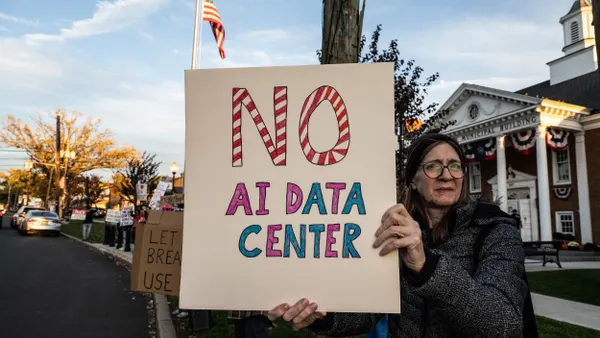
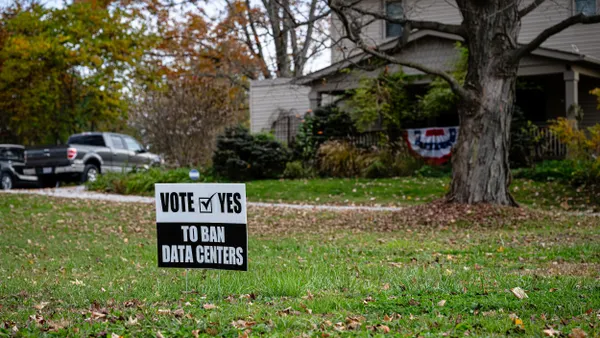
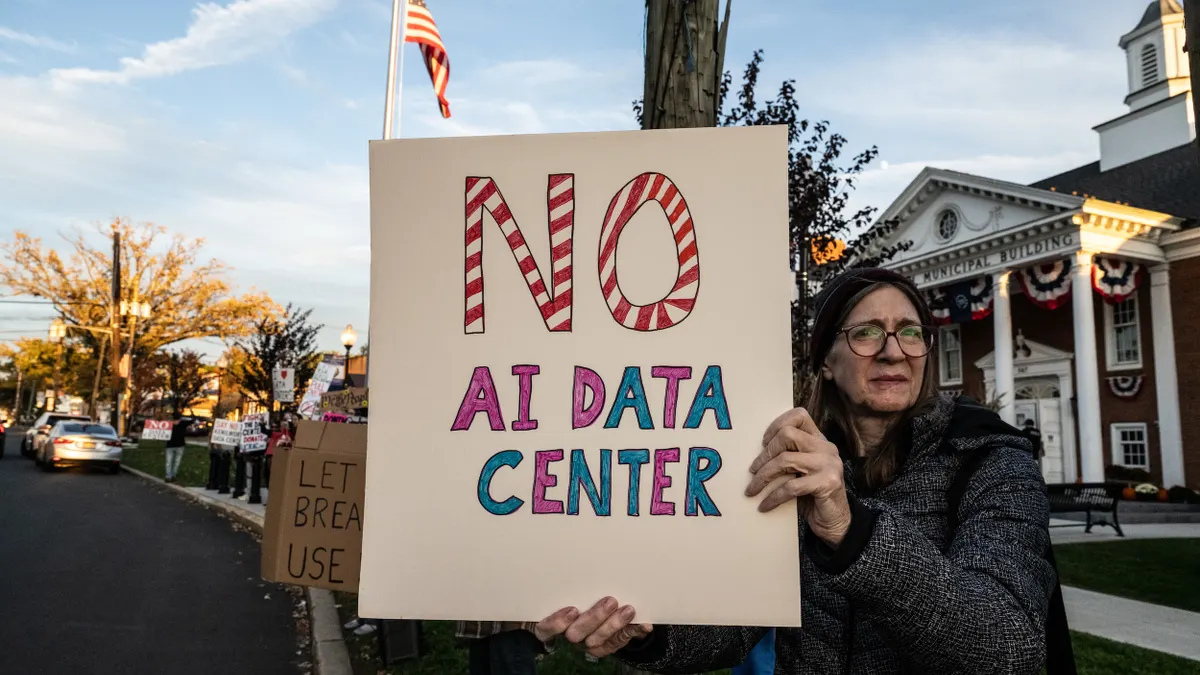
- Voters in dozens of localities across 10 states overwhelmingly rejected data centers in last week’s midterm elections. “It’s going to be on the municipalities to be better prepared,” Andy Roehr, managing director with accounting and advisory firm Baker Tilly’s energy and infrastructure practice, told Smart Cities Dive.
Dive Insight:
Following a roundtable discussion with mayors late last year, Climate Mayors and Bloomberg Associates released a report in January focusing on how cities can influence data center outcomes.
Climate Mayors created the model local law this fall because “data centers are moving faster and at a larger scale than most local codes were built to handle,” Climate Mayors Executive Director Kate Wright told Smart Cities Dive. “We realized we really need to equip our mayors to understand what regulatory authority they have and how they should be thinking about this decision-making.”
Climate Mayors worked with the Model Climate Laws Initiative, the Sabin Center for Climate Change Law at Columbia Law School and Climate XChange to develop the framework.
“What we found is there's an asymmetry in information between utilities, technology providers, data center developers, local governments, mayors and community members,” Wright said.
Most cities’ regulatory environments aren’t set up to deal with data centers’ scale and how fast they’re being developed, she added.
More than 500 local governments in 46 states have placed moratoriums on data center development, according to the US Data Center Moratorium Tracker maintained by Interconnected Capital.
“We wanted to make sure that as our mayors are pressing pause, they’re hearing the growing opposition from community members,” Wright said. “Mayors are hearing from their residents and wanting to be responsive to their community members and wanting to ensure that there’s a good community engagement process.”
The model local law focuses on four major issues:
Transparency: “Secret deals” and NDAs between cities and data center developers have “become really problematic, and it’s really eroding public trust around these projects,” Wright said.
Siting and permitting: Wright said siting could be a “core component to ensuring that data centers aren’t causing harm.” Data center development should be encouraged on underutilized land, brownfields and industrial areas and discouraged in areas prioritized for green space, housing and transit-oriented development, she said.
Community benefit agreements: CBAs should include job and wage considerations, environmental mitigation and enforcement mechanisms around decommissioning, Wright said. “A big issue that has come up in cities is what makes sense in terms of the scale of investment compared to the scale of revenue being created,” she said.
Operational standards: How data centers are powered, backup generation sources, noise standards and the materials used to build them must all be considered, Wright said.