After voters across the U.S. expressed overwhelming opposition to data centers Tuesday, local governments should prepare for greater scrutiny of their role as both gatekeepers and negotiators with the companies looking to build them, industry experts told Smart Cities Dive.
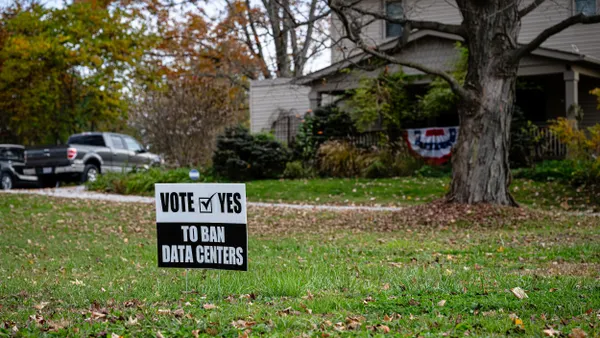
In dozens of localities across 10 states, voters resoundingly approved measures to prohibit or place moratoriums on data center development and rejected calls to allow them. NBC exit polling found that 76% of voters opposed construction of new data centers in their communities, and 56% said data centers were a crucial or major factor in their choice of congressional candidates.
Senators-elect including Sherrod Brown, D-Ohio, and Abdul El-Sayed, D- Mich., are among the candidates who made opposition to data centers a centerpiece of their campaigns. Gubernatorial candidates who pledged to place moratoriums on data center development were elected in major data center markets including Georgia, Ohio and Texas.
“The message is very clear,” said Subodha Kumar, a business and management professor at Temple University. “The main message here is not that people are rejecting AI. The main message is that people are rejecting the cost that they need to pay for these data centers.”
It’s up to cities to make developers pay their fair share to cover the land, electricity and water costs of building data centers, Kumar said, and to make sure communities understand that the companies — not taxpayers — are footing the bill.
“It’s going to be on the municipalities to be better prepared,” said Andy Roehr, managing director with accounting and advisory firm Baker Tilly’s energy and infrastructure practice. “And I think communities can get a little more expansive about the social-related impacts. Instead of just saying, ‘Hey, here’s your transmission distribution cost,’ I think this will give them a little bit more confidence and a little bit more standing to do things like say, ‘Hey, we’re going to need you to widen and strengthen that bridge that goes from your facility out onto the highway because you’re going to be running cement mixers on it for the next five years, and it wasn’t built for that.’”
Tuesday’s election results are a clear sign that cities need to move from reactive to proactive policymaking around data centers, said Ishyan Veluppillai, who tracks state and local data center policy for energy companies and investors at investment advisor group Capstone. “You’re going to see more proactive zoning ordinance changes, maybe even temporary pauses and moratoriums.”
That voters rejected data centers through 41 local ballot measures across the country is “indicative that there’s a lot of bothered people in lots of places,” said Ben Heininger, senior manager of the energy and resources practice and U.S. data center lead at management consultancy Baringa. But “city-level bans or moratoriums are a rounding error, really. It’s a sentiment that demonstrates the level of revulsion, but I don’t think it will change much.”
Statewide bans and moratoriums are “more problematic” for data center developers, Heininger said, and the election results portend more state involvement and oversight.
“With a lot of these newly elected Democratic governors and potential Democratic trifectas created in states like Pennsylvania and Michigan, I think that’s going to supercharge the early opening months of 2027 legislative proposals at the state level to regulate data centers,” Veluppillai said. “I think these Democratic trifectas will be very motivated to try to solve the big data center reform questions themselves rather than punting the issue to local governments.”
While Veluppillai stopped short of predicting state legislatures would preempt local policy, he believes they will be “trying to look out for local governments who just oftentimes are not very well-equipped to deal with these types of questions.”
Slowing down and recalibrating
Data center developers are recalibrating to meet the new challenges, the experts told Smart Cities Dive. “Companies will move slower now because they have to regroup and replan how they will deal with this issue,” Kumar said. They’re including community approval as a factor in their cost analyses and reconsidering where to build, “trying to go to the sites where they will see more openness,” he said.
“There’s increasing importance from a developer perspective to really engage with local officials early, don’t spook them during that process and be really transparent,” Veluppillai said.
“It’s clear that many of the developers have not gone about their business in the best way,” Heininger said. Data center developers will have to work hard to earn back city officials’ and the public’s trust, he said, but “I would love to see city leaders and councilors actually engaging with the developers because they’re mostly trying to do their best.”
It’s up to city leaders to give data center developers guardrails and rules to work with, “and if you want to be very strict, that’s fine, but you might lose the benefit that comes with a data center if you believe there is one,” Heininger said.
City leaders need to “take the ambiguity out of the interaction,” Roehr said. “And I think if we start by treating each other with a little bit more respect, understand everybody has a point of view and listen, municipalities will be able to win their way through what could be a real set of landmines for them.”
Developers will build “in the states and localities that are, frankly, easiest to work with,” Roehr said, and the impact of slowing down development “is massive, mostly on state and local budgets.”
“Cities need this money,” he said. “And so politicians will have to be very careful that they don’t legislate in such a way that they kill the golden goose.”