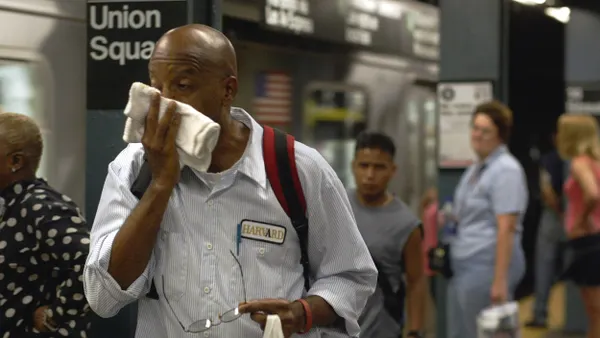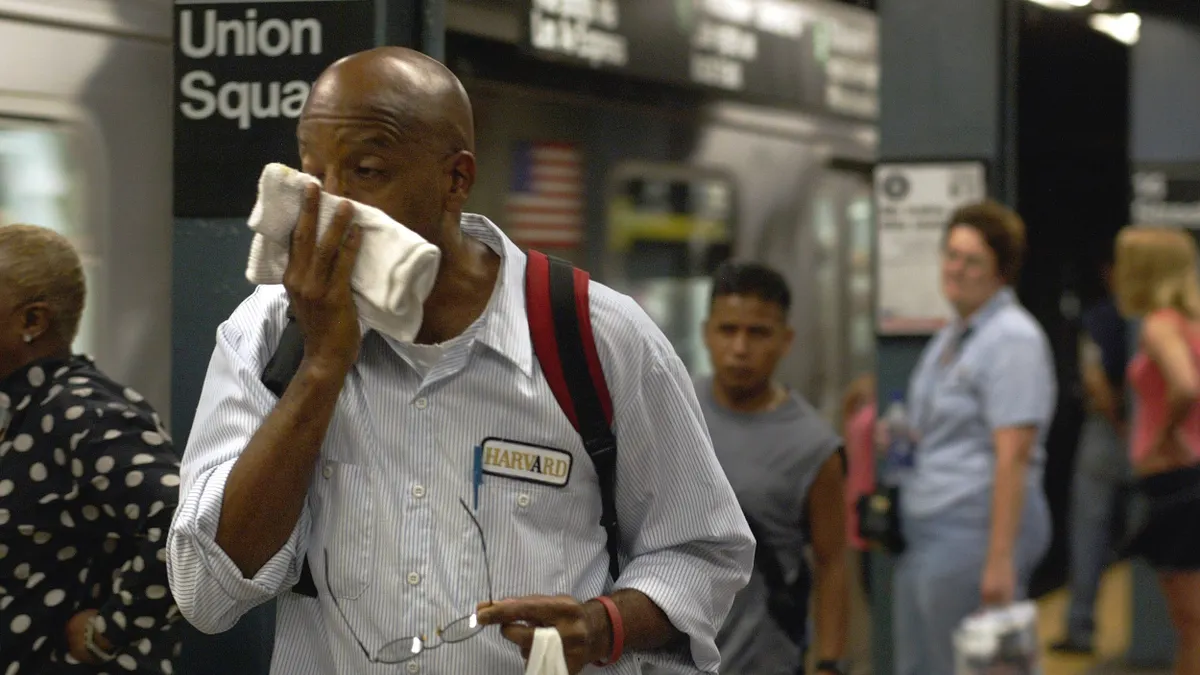
The average temperature inside New York City’s Brooklyn Bridge-City Hall subway station peaked last summer at 96 degrees Fahrenheit. “Anyone who has stood on a subway platform in August knows that our stations do not just get hot, they turn into underground saunas,” Mayor Zohran Mamdani said during a press conference at the Chambers Street station Monday.
New York Gov. Kathy Hochul, Mamdani and a host of other city officials held the press conference to announce the city and state are studying a method to capture that heat and recycle it to nearby municipal buildings by installing the first thermal energy network in a U.S. transit system. TENs use a system of water pipes and heat pumps to connect buildings to otherwise wasted thermal energy from sources including other buildings, sewage systems and underground transit stations, providing a shared heating and cooling network.
An $800,000 feasibility study will determine how much cooling could be achieved on subway platforms and how much the city could save in energy costs if it built a TEN that captures and stores excess heat from the Chambers Street and Brooklyn Bridge-City Hall stations and transfers it through pipes to geothermal boreholes, where it would be stored until it can be used in colder months to heat nearby municipal buildings.
The contract for the study will be awarded this fall. If it determines geothermal is feasible, design work would begin in early 2027.
“It could be a real win-win: cooler stations for our subway riders, and the city of New York gets to save on energy costs, potentially,” said Metropolitan Transit Authority Chair and CEO Janno Lieber.
The project would be part of a gut renovation of the Chambers Street station — one of the oldest in the subway system — that is being funded with proceeds from New York City’s congestion pricing system.
“This is what effective partnership between city and state government can yield — innovative solutions that have the potential to help millions of subway riders,” Hochul said in a statement.
Thermal energy networks are already in use in New York City at St. Patrick’s Cathedral and the New York Botanical Garden, Lieber said.
“One of the benefits of doing something like this is that they’re creating a methodology that could be scaled and replicated both across New York City and also in other big cities that have subway systems,” Johanna Partin, founding principal of Transformative Strategies Consulting, told Smart Cities Dive. Partin is working with the city of Boston to study whether it can tap thermal energy from Boston’s waterways, as well as “other waste heat sources like data centers and the transit system and wastewater treatment facilities,” she said.
“It’s wonderful that cities like New York and Boston are looking at what really has been this massive untapped energy resource of ambient waste heat and turning something that we think about as a problem — like a sweltering subway platform — into part of the solution,” Partin said.
Correction: We have updated this article to correct a quote from Johanna Partin describing the subway system.