Dive Brief:
-
President Donald Trump on Wednesday signed the Secure America Act, a $70 billion budget reconciliation bill that provides long-term funding for border security and immigration enforcement operations through fiscal year 2029.
-
The bill allocates $350 million for Immigration and Customs Enforcement operations in cities and states that don’t participate in 287(g) agreements, which authorize local law enforcement to make immigration arrests, and appropriates funds to expand, facilitate and implement the agreements.
-
The U.S. Conference of Mayors issued a statement expressing “deep concern” about the “unprecedented expansion” of funding. “Congress should not provide tens of billions of dollars in new funding to ICE and [Customs and Border Patrol] without also requiring reforms that improve transparency, strengthen accountability, ensure due process, and establish clear professional standards,” USCM President and San Diego Mayor Todd Gloria said in a statement.
Dive Insight:
The Secure America Act gives ICE $38.9 billion — nearly four times its fiscal year 2025 budget — to hire new officers and carry out immigration enforcement functions. “You’re going to see targeting increase, you’re going to see arrests increase,” border czar Tom Homan said in a statement. “With additional funding, we’re going to keep our foot on the gas and keep moving forward.”
The National Fraternal Order of Police said in a statement that the funding will allow DHS and its law enforcement components “to strengthen our nation’s defenses against illegal immigration, transnational criminal organizations, terrorists, and other threats to our country by enhancing operational capabilities, supporting our personnel, and helping ensure that law enforcement has the resources and tools necessary to protect our communities.”
According to the American Immigration Council, the bill “includes a substantial focus on enforcement against states and localities that do not participate in federal immigration enforcement” by allocating money for ICE operations in states that don’t participate in 287(g) and restrict communication with federal authorities over individuals’ immigration status. Over 1,900 jurisdictions have signed 287(g) agreements, up from 135 in January 2025, according to AIC.
In February, mayors from Baltimore, Boston, Chicago, Denver, Los Angeles, Minneapolis, New Orleans and Portland, Oregon, issued a joint statement calling for Congress to condition Department of Homeland Security funding on “immediate reform and an end to ICE's unchecked and reckless operation in American cities.”
Portland Mayor Keith Wilson said in a Tuesday statement that the city “remains steadfast in its commitment to protecting all who call this city home” and “has taken concrete steps to strengthen our preparedness and protect our immigrant communities.” The city hired its first immigrant affairs lead to oversee sanctuary protections, developed stronger protocols for city employees and created emergency planning frameworks for impacted communities.
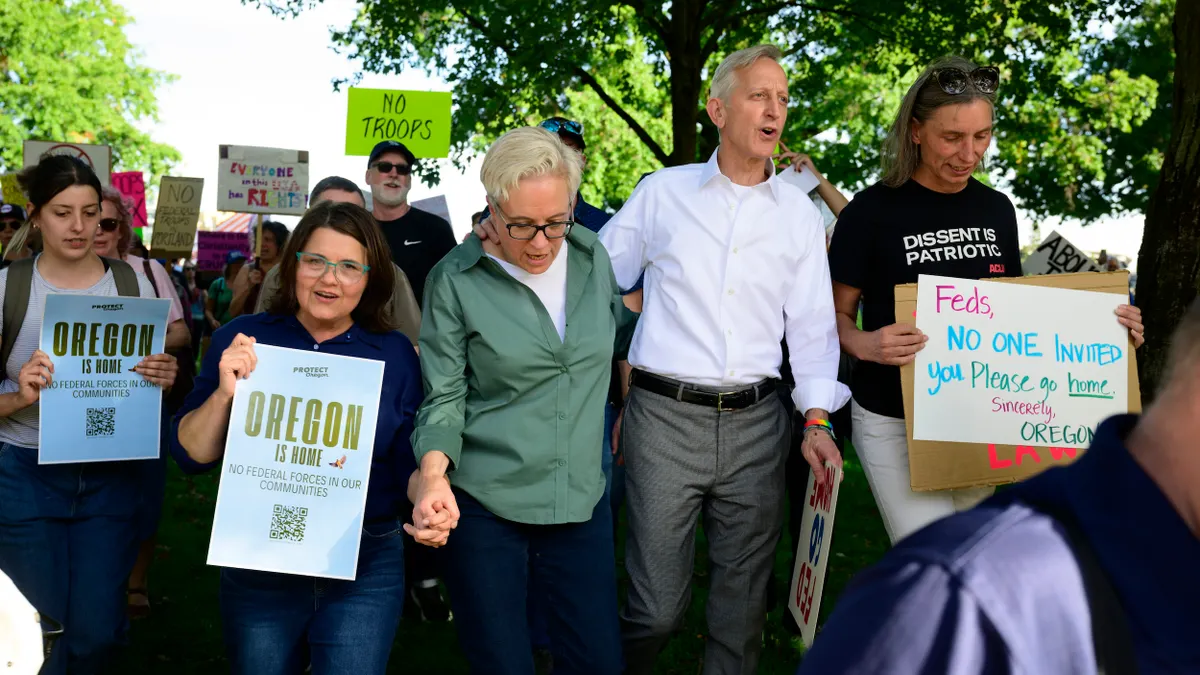
ICE surged into Portland last fall, spurring months of protests. Wilson said the city is working with other “sanctuary” cities, including Minneapolis, San Diego and Chicago, to share lessons learned during federal immigration surges.
“We are strongest when we stand together,” he said. “We will continue to work in partnership to protect our most vulnerable community members and to uphold the values that define Portland.”