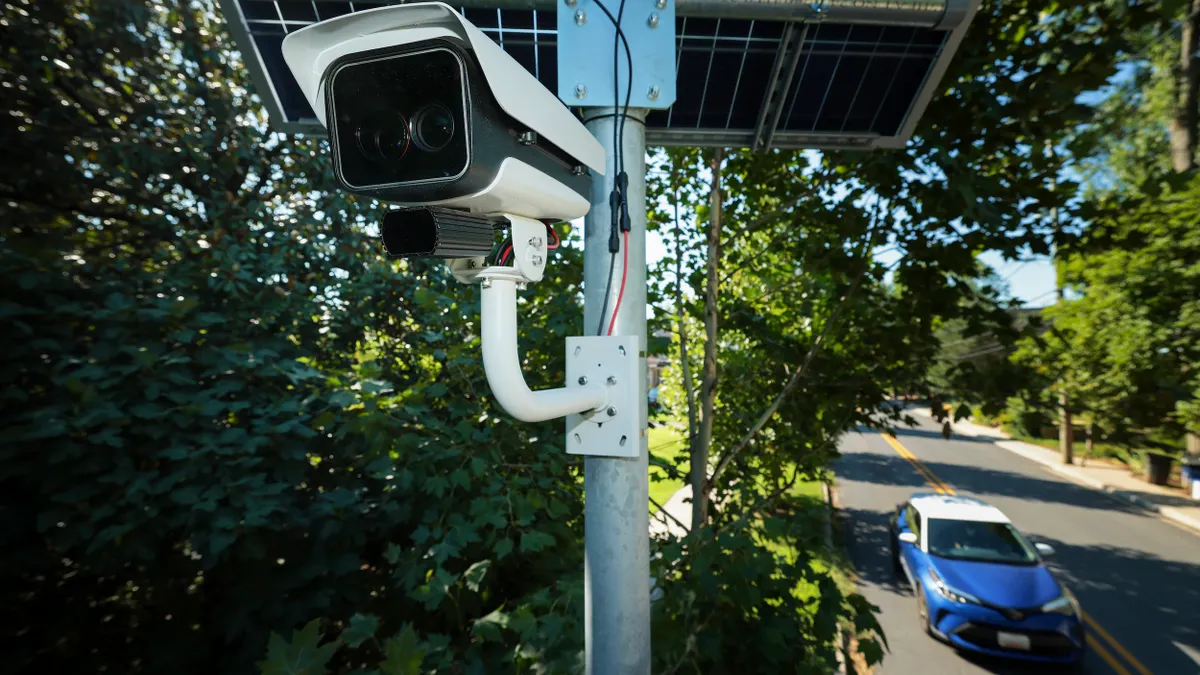
As public outcry over the proliferation of automated license plate reader systems grows and more cities cancel contracts with Flock Safety, states are stepping in.
Arizona Attorney General Kris Mayes announced Thursday that she will review automated license plate reader systems. “We need a statewide approach to this issue,” she said in a press release.
Mayes will analyze how the technology has been used, how it impacts Arizonans’ privacy and whether it infringes on Fourth Amendment rights for a report she will deliver to the state legislature and the governor’s office.
“Cities and towns across Arizona have been grappling with these questions on their own, and that's part of why this review is needed,” Richie Taylor, communications director for the Arizona attorney general’s office, said in a Thursday email to Smart Cities Dive. “Issues of constitutional rights and privacy are too great to be decided in isolation at the local level. These are questions that deserve a coordinated, statewide approach.”
Earlier this month, South Dakota Attorney General Marty Jackley announced he is proposing legislation to ensure license plate readers are used solely for legitimate law enforcement purposes “without compromising individual rights,” Jackley said in a social media post that he is talking to legislators, law enforcement and other stakeholders about what should be in the bill.
Governors are also weighing in.
Florida Gov. Ron DeSantis said this week that license plate readers are “out of control.” He said he is reviewing New Hampshire laws that restrict use of the cameras in the state, according to the Wall Street Journal. “No one’s been stronger on law enforcement than me — but I don’t want to have this become a surveillance state,” he said in a Wednesday press conference.
In an Aug. 7 letter to the Connecticut Police Officers Standards and Training Council, Connecticut Gov. Ned Lamont asked the council to develop guidance for state and local police departments. Lamont also urged municipalities in his state to pause camera installation until a review can be completed.
This month the Policing Project at the New York University School of Law launched its License Plate Reader Policy Scorecard listing each state that has enacted automated license plate reader legislation and comparing the laws against seven key policy provisions in the Policing Project’s model ALPR statute.
Connecticut, Oregon, Virginia and Washington lead the nation in protecting residents from ALPR misuse, the Policing Project stated in a LinkedIn post, while 26 states and Washington, D.C., leave surveillance rules entirely to internal police policy.
At least 16 states have statutes expressly addressing ALPR use or the retention of data collected by this technology, according to the National Conference of State Legislatures.
Maine and New Hampshire are the only states that restrict ALPR use, according to the Electronic Privacy Information Center.